
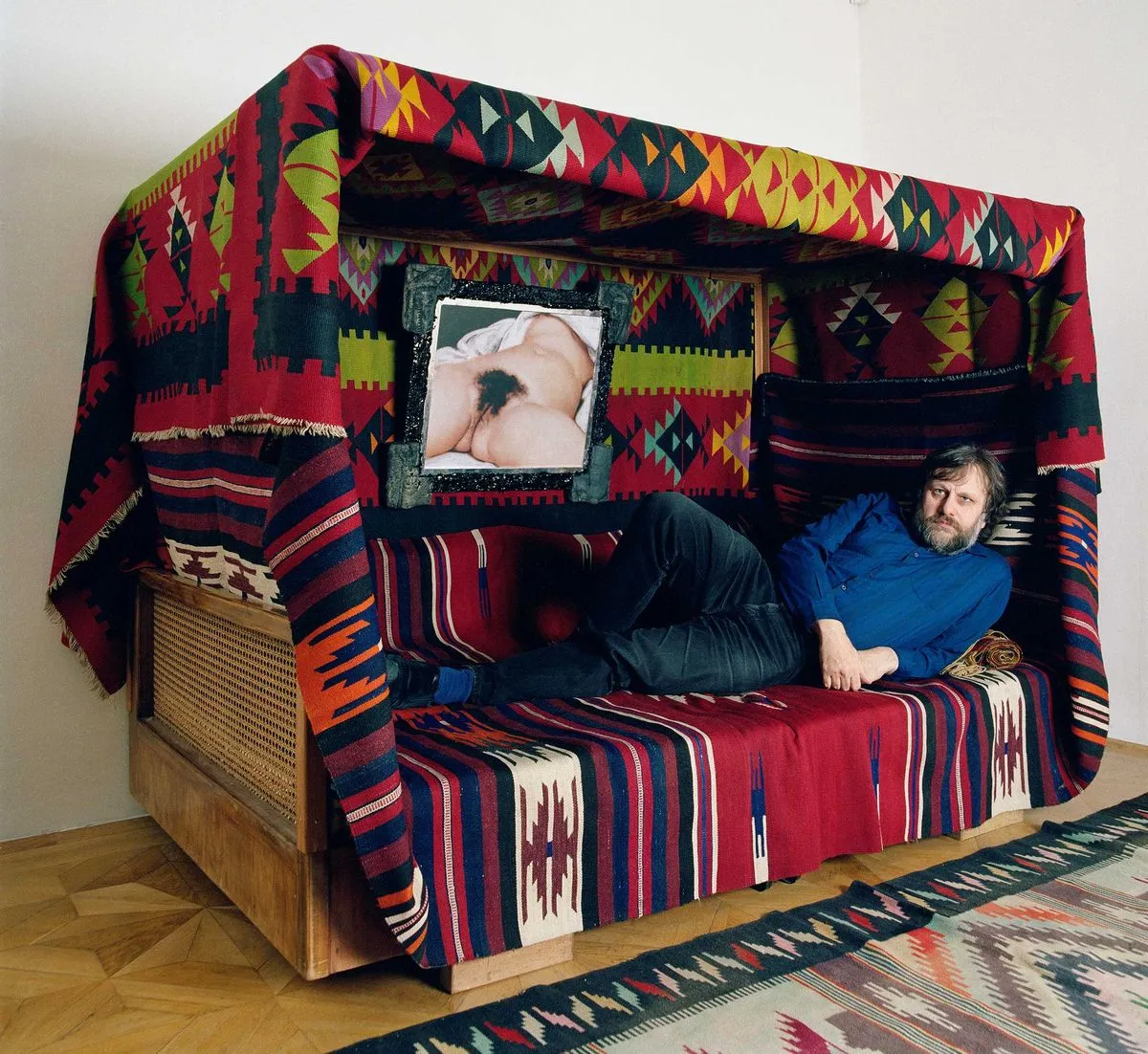
 IRWIN, Mother with Child, 2001. Portrait of Slavoj Žižek in Sigmund Freud's study, on the 100th anniversary of the birth of Jacques Lacan. Photo: Michael Schuster. Courtesy of Galerija Gregor Podnar
 Few art collectives are as unusually organized as the Slovenian group IRWIN. It has been the same five people since 1983, self-organizing, using the principles of direct democracy, by consensus, without the lineup ever changing. That is a genuinely rare commitment for a collective now in its fifth decade. What makes that more interesting is that they built this model with full awareness of the alternatives sitting right next to them. Laibach, their labelmate collective, has operated almost oppositely, cycling through members for decades under a single sustained identity. Neue Slowenische Kunst itself, the umbrella structure both groups helped found, went a third direction. It has total openness, a citizenship anyone anywhere could apply for. IRWIN is five people who chose each other once and had no need to revisit this choice.
The City Museum of Ljubljana is currently showing more than ninety photographs by IRWIN. Titled IRWIN: Photographic Work, it is the first exhibition ever devoted specifically to the Slovenian collective's photographic output, drawn from four decades of a practice that has otherwise produced around 450 group and solo shows. The exhibition draws a useful line through the material. Some of what's on the wall is documentation, records of interventions, performances and temporary installations, and some of it is photography made as an artwork in its own right.
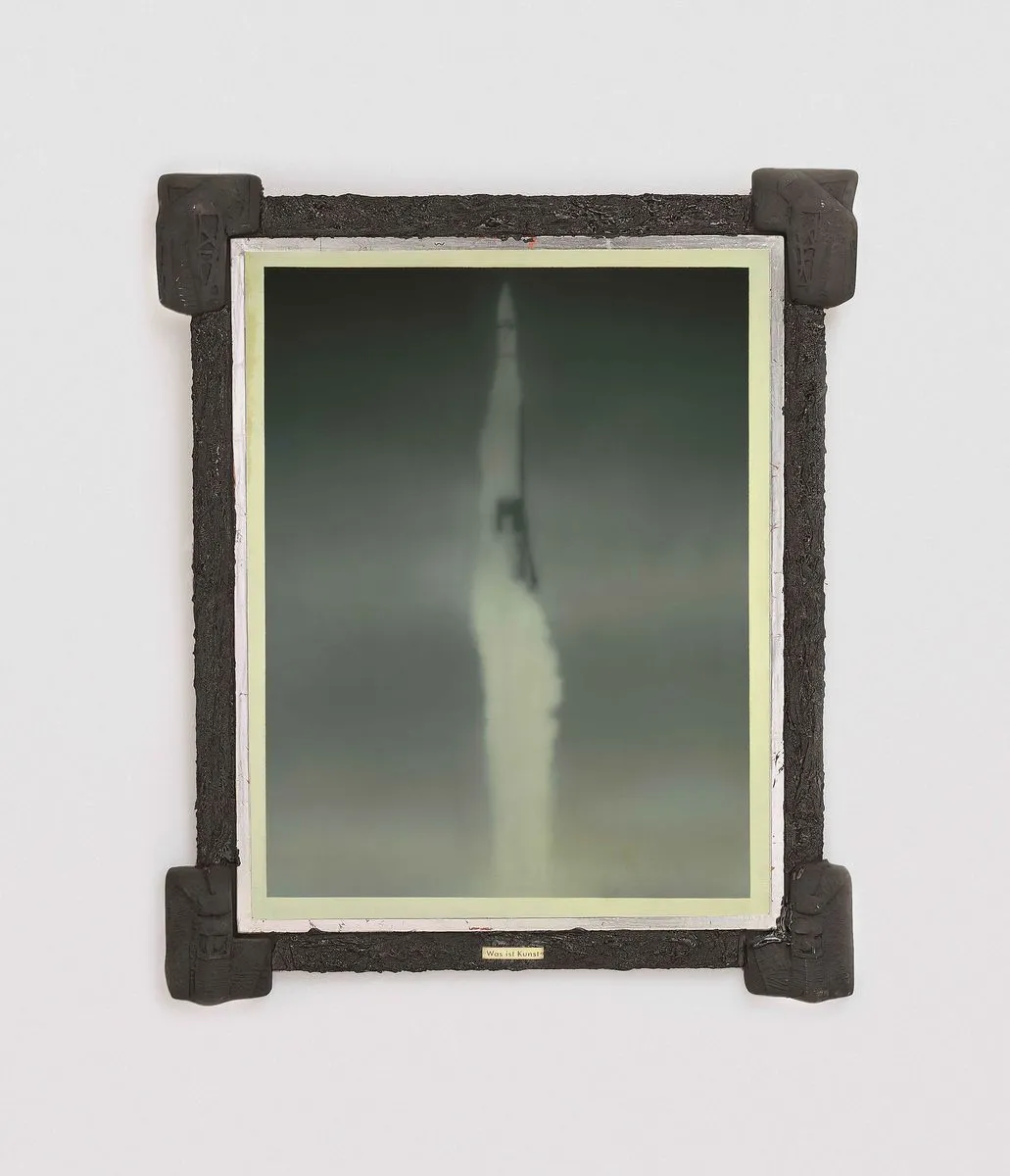
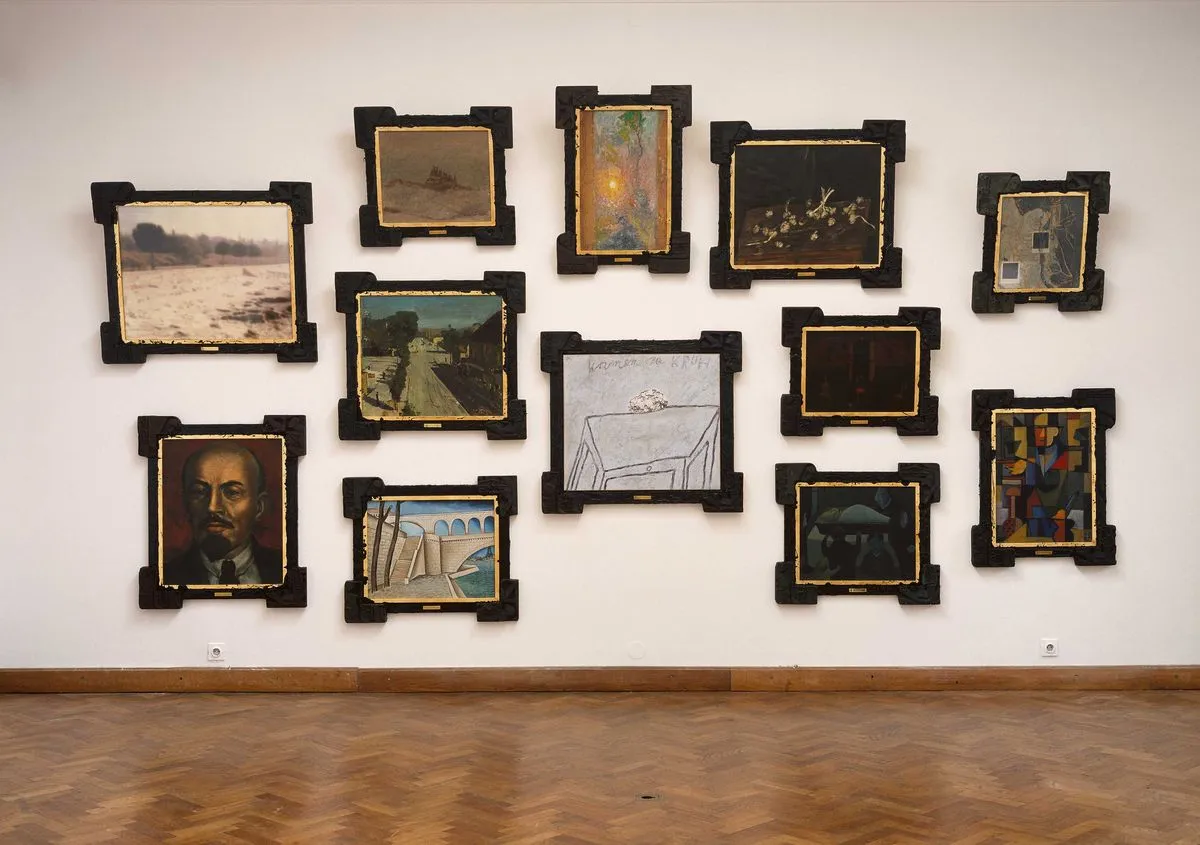
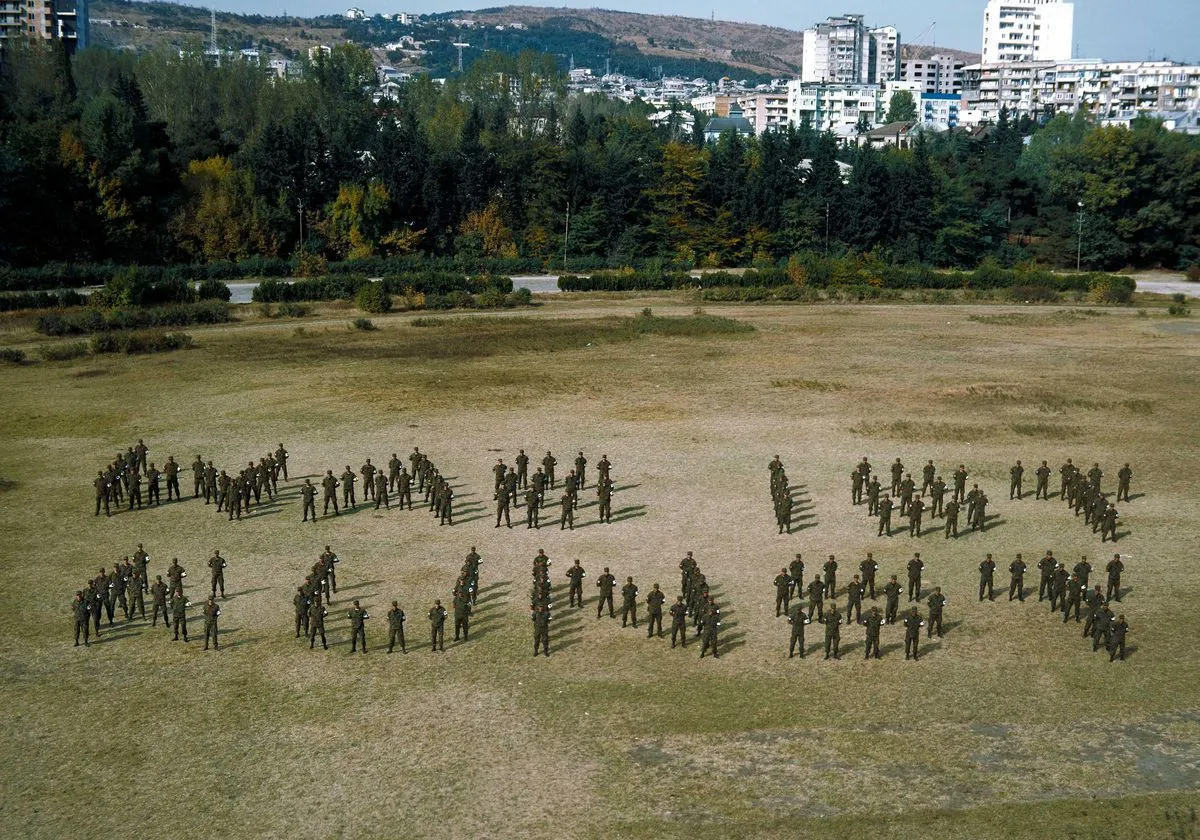
Curated by Hana Čeferin, the show moves through several of the group's best-known photographic strands: Birds of a Feather / Like to Like, Was ist Kunst?, the NSK Guard poster series and the It's a Beautiful Country series. The museum's own framing is worth holding onto: at a moment of resurgent nationalism and historical narratives being bent to fit present arguments, it asks visitors to see these photographs, and perhaps photographic images generally, as places where meaning doesn't sit still, where it gets redistributed and rewritten, and where the politics of representation get settled and unsettled again. That documentation-versus-artwork line, and that instability of meaning, turn out to be the two ideas the exhibition keeps returning to.
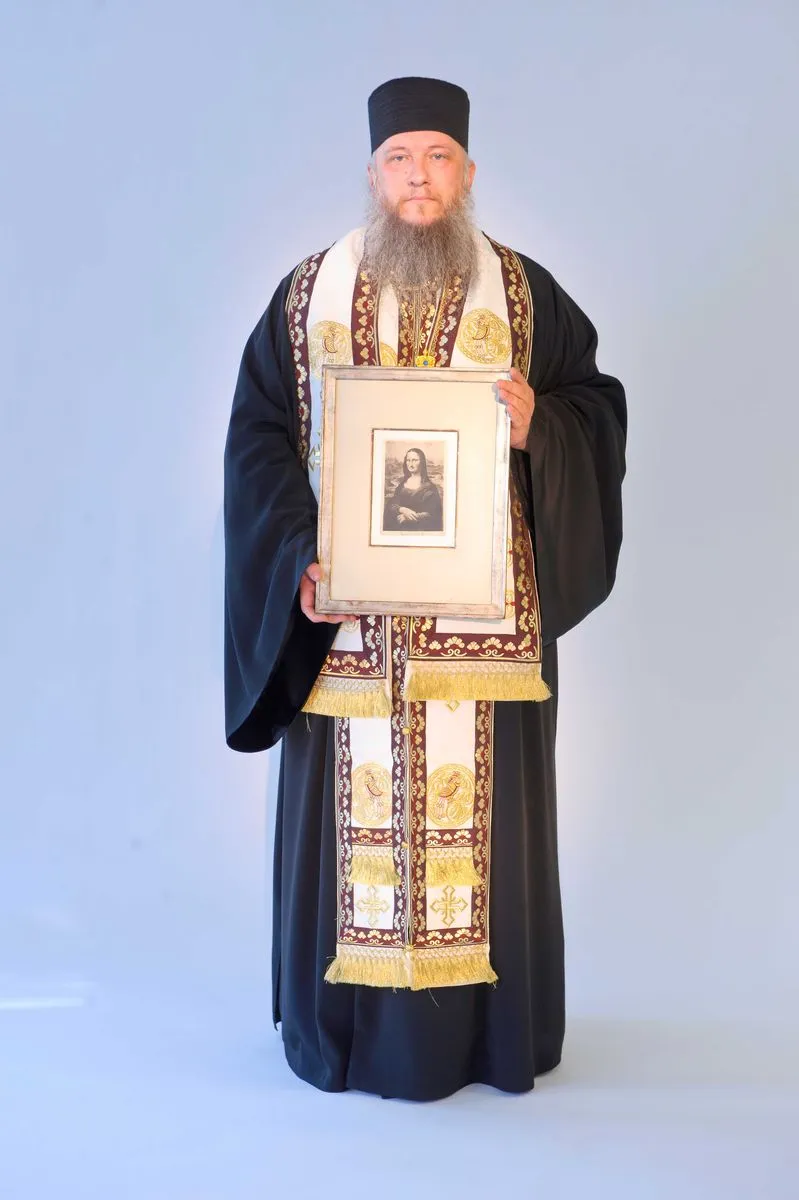
IRWIN was founded in Ljubljana in 1983 by Dušan Mandić, Miran Mohar, Andrej Savski, Roman Uranjek and Borut Vogelnik, and the following year became one of the founding pillars of Neue Slowenische Kunst (NSK), alongside the band Laibach and the theatre group later known as Kozmokinetični Kabinet Noordung. The founding members emerged from Ljubljana's punk and graffiti scene, where they developed a practice of identifying the contradictions and failures embedded in the state's ideological and social apparatus. Rather than opposing these mechanisms from the outside, they mimicked and exaggerated them through a strategy of over-identification, making the system confront its own logic.
The clearest early example came from their sister group in NSK. Laibach is the German name for Ljubljana, and by choosing it the group deliberately picked up a word Slovenian conservatives in the early 1980s used pejoratively, loaded with the memory of wartime occupation. That memory wasn't abstract for the generation then running Yugoslavia. Socialist Yugoslavia had been founded, among other things, on the Partisan victory over Nazi Germany and its collaborators, and Germans were, within living memory for most adults, the enemy that had occupied the country and been driven out. Reaching for a German name in that atmosphere reopened a wound the state's legitimacy was built on.
Laibach weren't being nationalistic themselves, and never have been. If anything, the name exposed how easily a supposedly anti-fascist, internationalist socialist establishment could be provoked into the same reflexive, language-based nationalism it claimed to have defeated. Naming an industrial band this way is a punk move, and it tells you something the later, more solemn work sometimes obscures: the humor and the provocation were both there from the very first decision. It also does exactly what over-identification is supposed to do, it makes the establishment enact the nationalism it claims to have overcome.
IRWIN is put in a genuinely strange position relative to almost every other art movement that has followed an avant-garde before it. The usual pattern of art history is adversarial by design: each new movement announces itself by rejecting the one before it, clearing ground rather than building on it. That's especially true of the avant-garde itself, whose whole self-image was rupture. Every avant-garde defined itself by insisting that nothing before it had counted for much, that it alone was starting from zero. Which makes IRWIN's move stranger still, they pay homage to a tradition whose founding gesture was refusing homage to anyone. Critiquing the avant-garde by honoring it is already close to a contradiction. Honoring a tradition built entirely on dishonoring its own predecessors is the contradiction squared.
IRWIN has always described their project as construction, not deconstruction. Deconstruction assumes something is already standing and your job is to take it apart. IRWIN's retro-principle goes back into the wreckage of Slovenian avant-gardes and rebuilds it, with respect for what came before rather than a critic's distance from it. Critique delivered as tribute, applied to a lineage that never offered tribute to anyone but itself. Their long engagement with OHO, the Slovenian conceptual art group active in the late 1960s, is the clearest example. IRWIN reenacted OHO's work directly in Birds of a Feather, 1985, one of the strands this very exhibition is built around, and returned to it again with Like to Like in 2004, treating a predecessor's visual language less as a position to argue against than as an aesthetic code worth honoring and continuing to speak in.
IRWIN's reverence extends only to art. Toward power itself, its stance is the opposite of reverent, even if it looks that way at first glance. The tool IRWIN shares with Laibach is over-identification. Rather than critique an ideology from outside, you inhabit its aesthetics so completely, so excessively, that the system is confronted with its own logic and has no safe way to disown you. Push the mimicry far enough and you place the system in a kind of checkmate: any attempt to suppress the work only confirms the very mechanism it was exposing in the first place.
It's close, too, to what's sometimes called Laibach's exorcist strategy. The idea isn't to stand outside a suppressed collective fear or fantasy and explain it to an audience rationally, the way a lecture might. It's to drag that hidden material onto the stage bodily, make it physically and psychically present in the room, so palpable you can feel it operating on you in real time. Only by making the mechanism sensible in that direct, unmediated way does it lose its grip. You can't be talked out of a fear, but you can, sometimes, be shown it so plainly that it stops being able to hide. It's only by drawing attention to the aesthetic foundations an ideology rests on that the ideology can be, to some degree, drained of its power. Not its arguments, its aesthetics: the uniforms, the typefaces, the choreography of mass gesture, the whole sensory apparatus that makes a belief system feel inevitable before anyone has agreed to a single one of its claims. Point at the costume long enough and the costume stops being invisible.
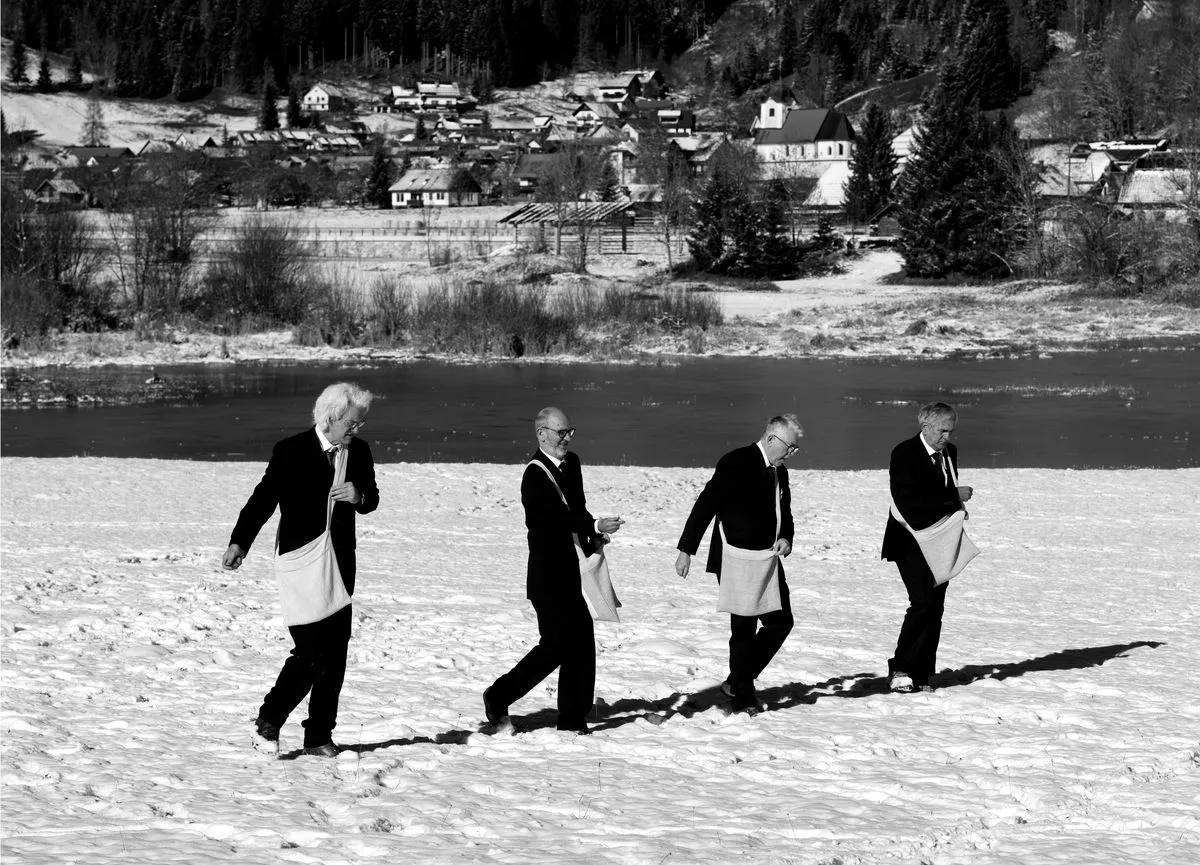
The same trick runs through IRWIN's most visible habit. At openings, performances and artist talks, the group appears in matching dark suits, the official uniform of state functionaries, ambassadors, and men who sign things, and these suits recur throughout the photographs in this show. By dressing as the very officials whose aesthetic they've spent decades appropriating, they turn their own bodies into the punchline and the argument simultaneously. A suit is not proof of seriousness. It's a costume that has been collectively agreed to be read as one, and once you notice that about a diplomat's suit, you start noticing it about diplomacy itself.
The clearest, highest-stakes demonstration of all this is the 1987 Yugoslav Youth Day poster scandal, documented by the Slovenian art historian Ljiljana Stepančič. IRWIN, together with the design collective New Collectivism, won the official competition to design that year's poster celebrating Tito's birthday, one of the most solemn dates on the Yugoslav calendar. The commission came from the Association of Socialist Youth of the Republic of Slovenia, and it was only after the poster had been approved and printed that anyone noticed what it actually was: a pastiche of a Third Reich propaganda image, Richard Klein's The Third Reich. Allegory of Heroism, with socialist Yugoslav symbols swapped in for the originals.
A Slovenian republican youth organization commissioning the Yugoslav-unity poster of the year, only to hand back a redressed Nazi image, wasn't just an art scandal. It read as confirmation of everyone's worst suspicions about Slovenian loyalty to the Yugoslav project, and it dropped the Slovenian republic itself into a separate, and separately awkward, controversy right as the question of whether Slovenia belonged inside Yugoslavia at all was starting to turn serious. The timing made it especially charged. Slovenia was, at that exact moment, drifting toward the front of Yugoslavia's slow collapse, and Slovenians had long been eyed with suspicion inside the federation as the republic most likely to break away first. That is more or less exactly what happened a few years later, in 1991, when Slovenia became the first to declare independence.
It became one of the largest cultural scandals in Yugoslav history, and it worked precisely because the state itself couldn't tell the difference until it was too late. Proof that treating an ideology's imagery with total seriousness is exactly how you stop being able to see it clearly, and that the healthier response, the one IRWIN has built a whole practice around, is to play with it until the seams show. The method above scales, eventually, into IRWIN's largest project NSK State in Time, which we can see in the NSK Guard photographs and NSK State in Time tourist poster mimicking 80s tourist advertisements, called It's a beautiful country, seen in this show.
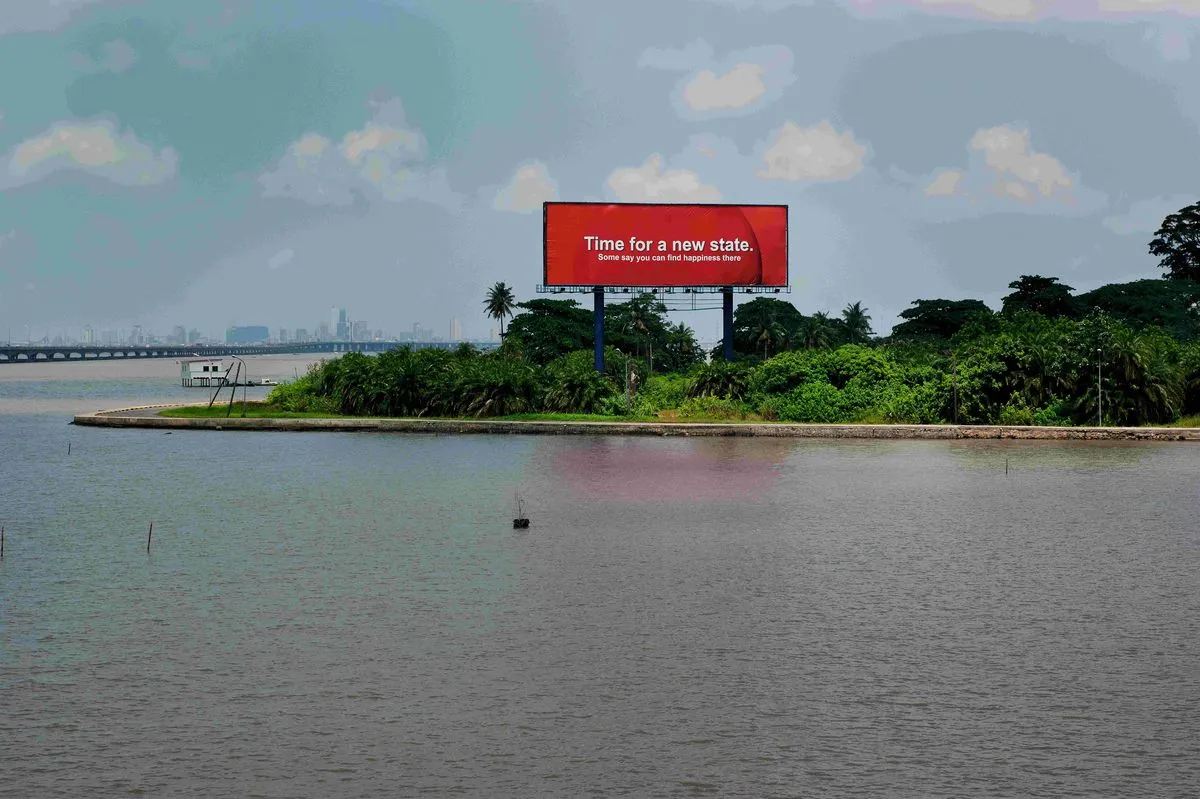
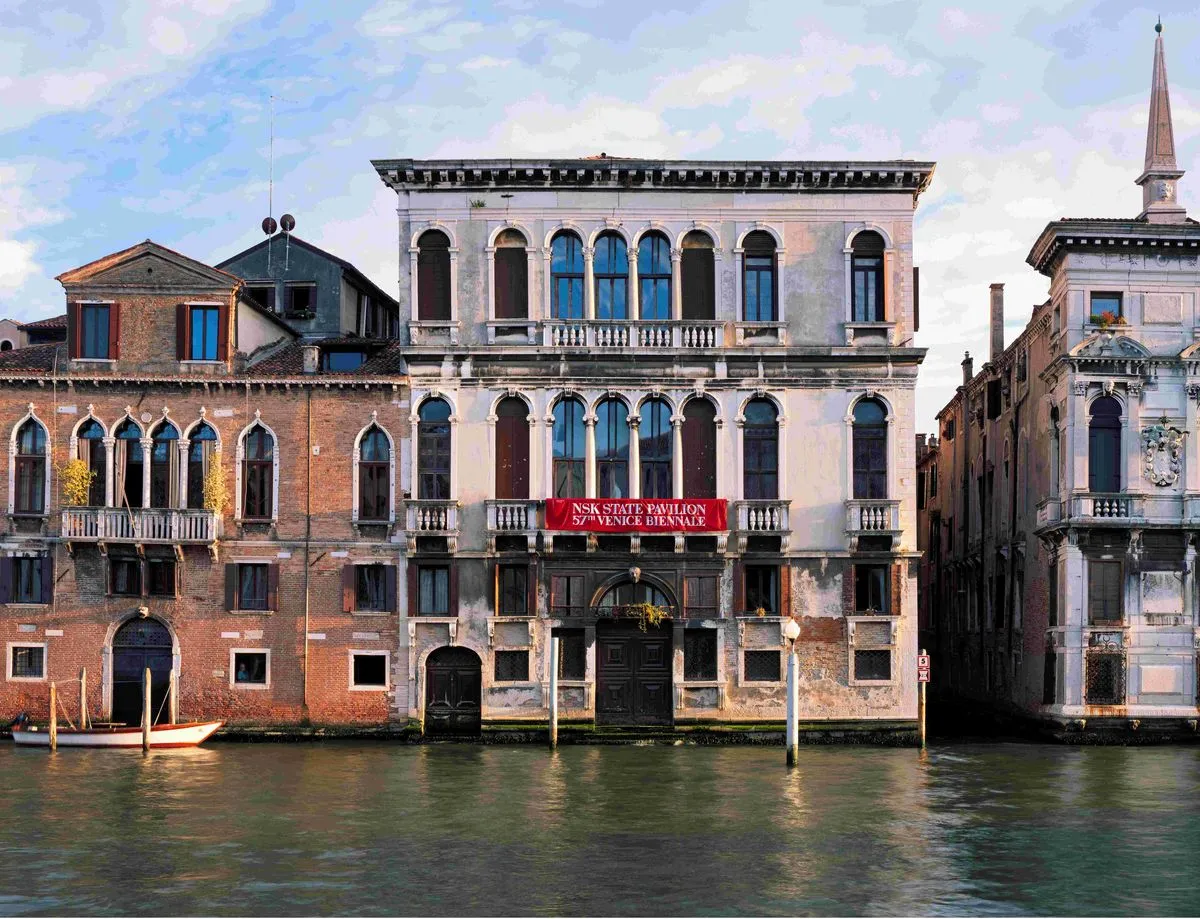
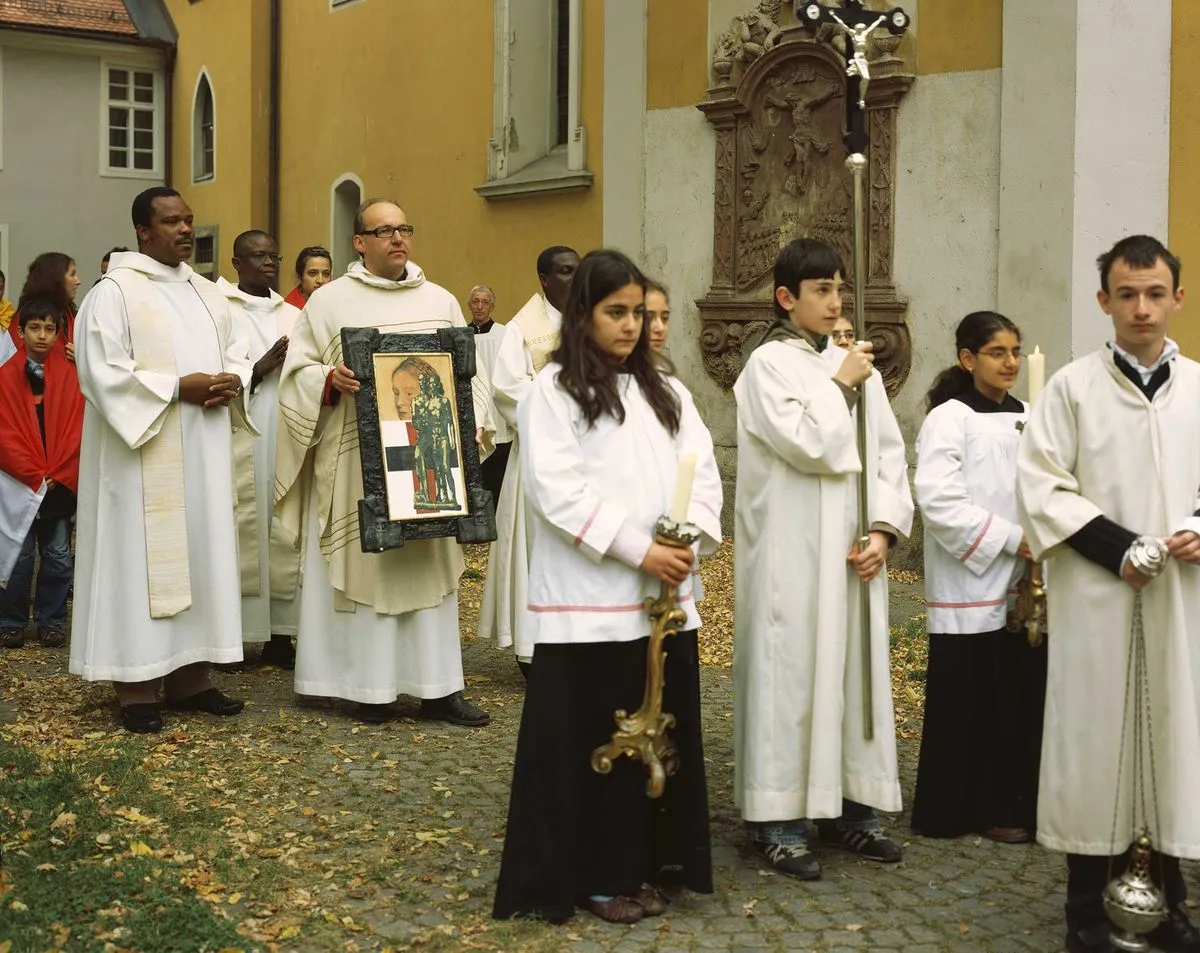
Declared in 1992, in the wreckage of Yugoslavia's and the USSR's collapse, NSK claimed no territory, only time and the shared agreement of its citizens. It opened its first embassy in Moscow that same year and kept building out consulates and passport offices for years afterward, in Ghent, Florence, Berlin, Sarajevo and elsewhere, treating the machinery of statehood, the embassies, stamps, ceremonies of belonging, the whole iconography, as the actual building blocks a state is made of. Citizenship was open to anyone, regardless of nationality, religion or origin. By some counts, more than fifteen thousand people worldwide now hold NSK passports.
NSK State in Time, a humorous project, got taken literally almost immediately, and in the most serious circumstances imaginable. In 1995, NSK travelled to besieged Sarajevo to perform and hand out passports, and by multiple accounts those documents helped some residents get past checkpoints and out of the city. An official-looking document presented at an overwhelmed, improvised checkpoint was sometimes enough. By the group's own account, an even sharper case came the following year, when the Bosnian artist Edin Numankadić used an NSK diplomatic passport to enter South Korea after being refused a visa. A document invented as a conceptual art object ended up functioning, however precariously, as a genuine instrument of movement across real, heavily policed borders, and that collapse of distance between "artwork" and "usable document" is one of the most serious things this group has ever done.
It happened again, in May 2007, when IRWIN travelled to London to meet NSK passport applicants, many of them Nigerian immigrants who had come to believe the passport was equivalent to Slovenian or EU citizenship, with genuine travel and residency rights attached. IRWIN sat down with them to explain, directly, that this wasn't the case. NSK was not a recognized state, the passport conferred no legal rights, and refunds of around €20 were available to anyone who wanted one. Almost no one wanted a refund. People chose to keep holding a document issued by a country that doesn't exist, because what it offered them, a form of membership that didn't ask where they were from, mattered independently of whether any border guard would ever recognize it. That's the point where the project stops being a clever art project and starts looking like an accidental social experiment in what people actually need a state to provide.
It's also why the project hasn't dated the way a 1990s Cold War curiosity might have. More than three decades on, the premise that made it urgent in 1992 keeps restaging itself. States and their institutions keep dissolving or getting shut out from under the people who depend on them: Palestinian diplomatic missions have been closed in country after country as recognition and relations shift under political pressure; borders keep hardening in ways that turn administrative status into a matter of life and death, from the recurrent crises at the Spain–Morocco frontier at Ceuta and Melilla to the broader tightening of migration policy across Europe. NSK's invented machinery of statehood looks less like a joke every year, and more like a diagnosis, precisely because the real machinery keeps failing the people who need it most.
It also explains a claim IRWIN has made about themselves since very early on, and which I've come to think is less paradox than plain description, that they are state artists. Not government-employed, not officially sanctioned in any bureaucratic sense, but this is a group that has spent decades exhibiting in Slovenia's own national and municipal museums, this show at the City Museum of Ljubljana being only the latest example, and whose most notorious scandal, the 1987 poster, was commissioned by an official republican organization in the first place. Recognition came early, and it came from the state apparatus itself, even at the moment it was most embarrassed by them.
Slovenia has also had a smoother path than most of its former Yugoslav neighbors: it was the first ex-Yugoslav republic into the EU, in 2004, without the kind of prolonged friction over official positions and international recognition that countries like Bosnia or Serbia have had to navigate. A group operating from inside that relatively settled, internationally legible state has had institutional room that artists working out of more contested post-Yugoslav contexts simply haven't had in the same way. None of that requires an apology from IRWIN. A museum retrospective isn't something a group manufactures for itself; it's something a state's own institutions choose to grant. So when they call themselves state artists, I don't think it's only conceptual play with the idea of officialdom. It's also, largely, a fairly accurate job description.
All of which makes it fitting that the clearest joke about authorship and value in the whole show is hanging on the wall right there with everything else: Namepickers, made in 1995 with Marina Abramović and photographer Bojan Brecelj. The work is a single image of Abramović surrounded by the members of IRWIN, printed three times as identical photographs. Each of the three prints carries a different signature, one signed by Abramović, one by Brecelj, one by IRWIN as a collective. What makes the piece land so well in the museum specifically is the small detail underneath each print: the price tag. Three physically identical photographs, hung side by side, each with its own wall label and its own number. And, of course, Abramović's signed print carries by far the highest price.
There is no single owner of the work, because there is no single work. There are three, each holding a print indistinguishable from the other two except for whose name is on it, and, evidently, what that name is worth. It's a funny demonstration of exactly the kind of institutional looseness IRWIN has spent forty years pointing a camera at. The art market needs a signature to know who owns what and what a thing is worth, and Namepickers just multiplies the signature until the question of value stops having a clean answer, then hangs the proof of that on the wall with prices attached, as if daring you to notice.
A group whose entire practice is built on exposing how arbitrarily authority and authorship get assigned ends up, quite literally, signing the same photograph three different ways and watching the market obediently produce three different prices for it. I don't think that's a contradiction. I think it's the joke completing itself, and it's not a bad place to end a show that spends ninety photographs and four decades asking the same question the wall text does: who gets to decide what an image means, and what it's worth, and why?
Curated by Hana Čeferin, IRWIN: Photographic Work is on view at the City Museum of Ljubljana through 6 September 2026.