
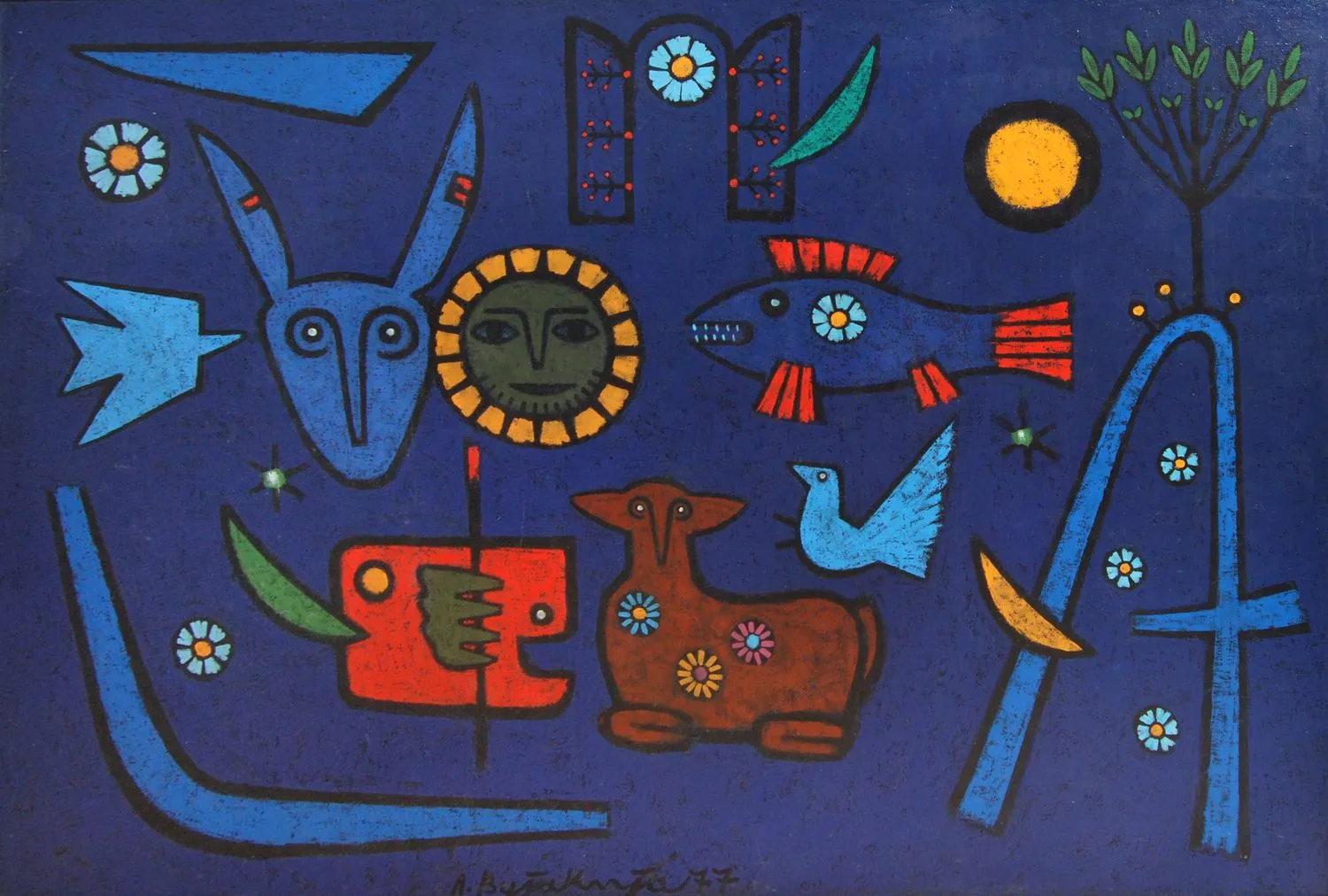
 Lazar Vujaklija, Untitled (Rhapsody = Revolution III), 1977, oil on canvas, 135 × 200 cm. Private collection. Photo: ARTE galerija / Vladimir Miloradović
 In 1953, Yugoslav painter Lazar Vujaklija visited the medieval necropolis at Radimlja in Bosnia and Herzegovina. He was thirty-nine years old, working as a teacher at the Graphic Industry School in Belgrade, and had already held his first solo exhibition the previous year to considerable critical acclaim. What he encountered at Radimlja, the great carved tombstones of medieval Bosnia known as 'stećci,' changed the course of his work entirely. He described the moment as decisive and transformative: in those rough, monumental forms he recognised "timeless contents that need to be transposed," a visual language rooted in the fundamental facts of life and death, operating outside the conventions of naturalism or academic painting.
The encounter did not happen in a vacuum. Three years earlier, Yugoslav writer Miroslav Krleža had organised an exhibition in Paris titled Medieval Art of Yugoslavia, presenting the carved tombstones of Bosnia as evidence of a distinct South Slavic visual tradition, independent of both Rome and Byzantium. In Krleža's reading, they were spiritually and politically resistant to the imperial and clerical powers that had historically dominated the region. While these tombstones had become ideologically charged objects within Yugoslav cultural policy, Vujaklija's use of them was entirely his own.
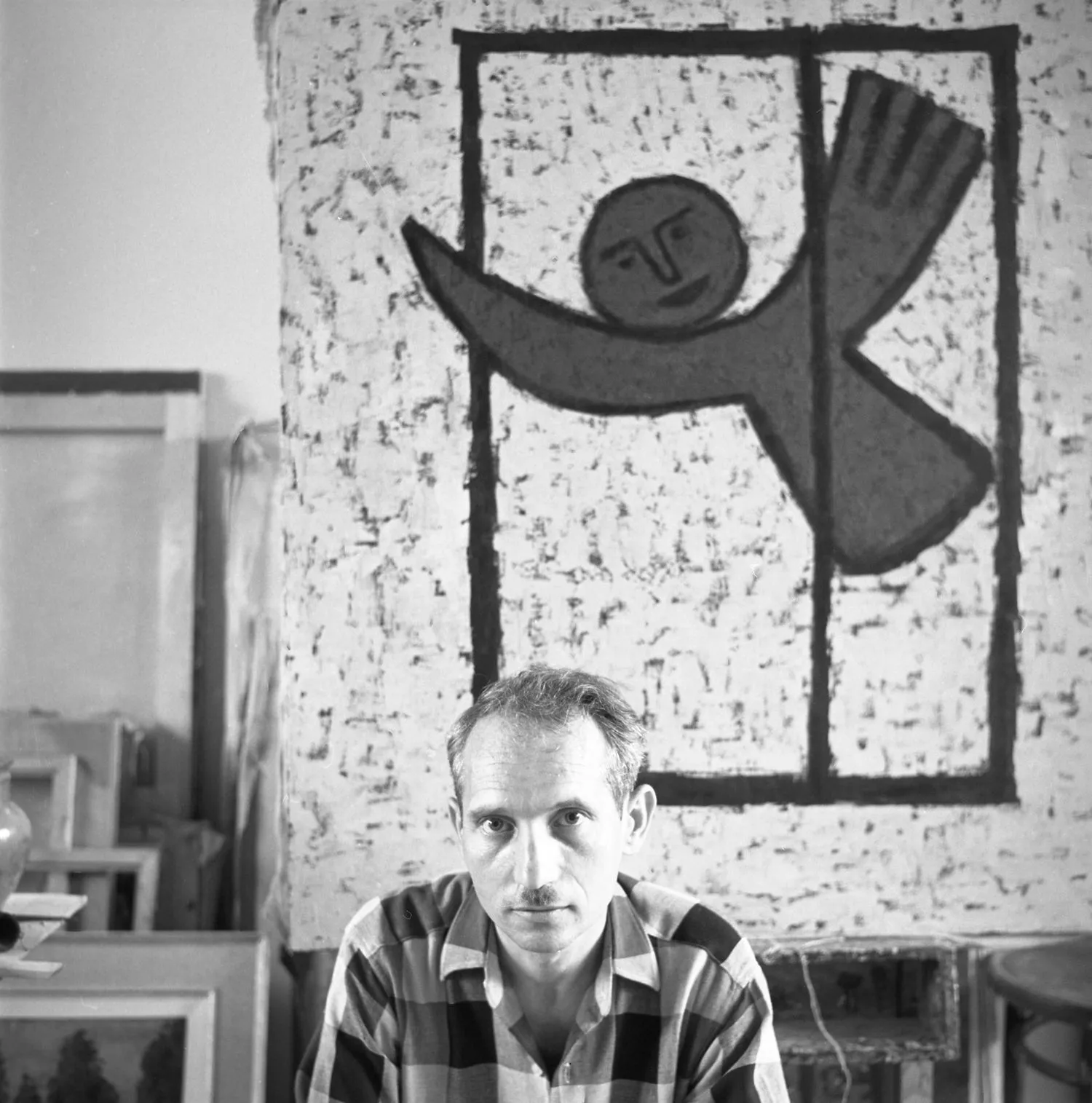
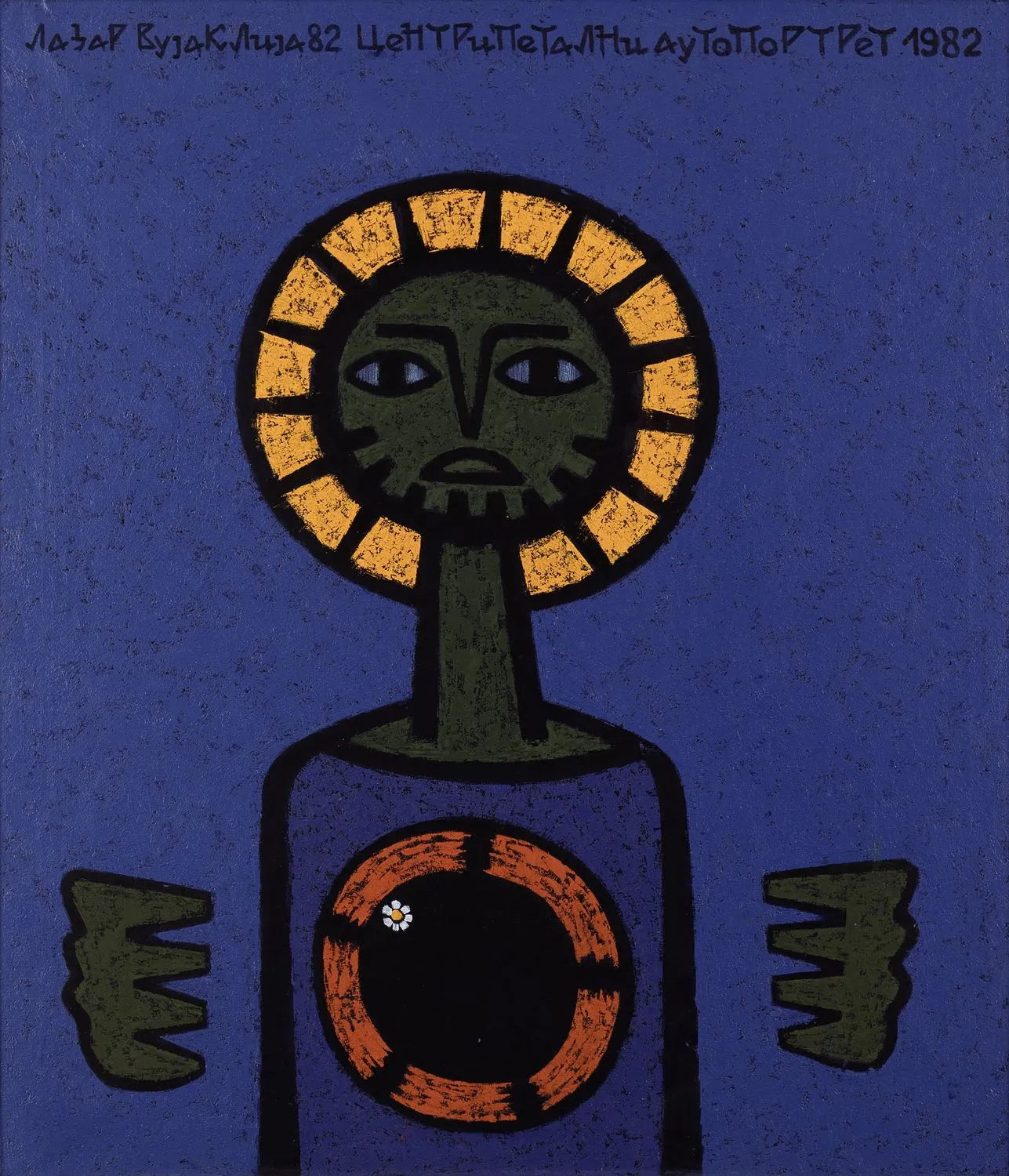
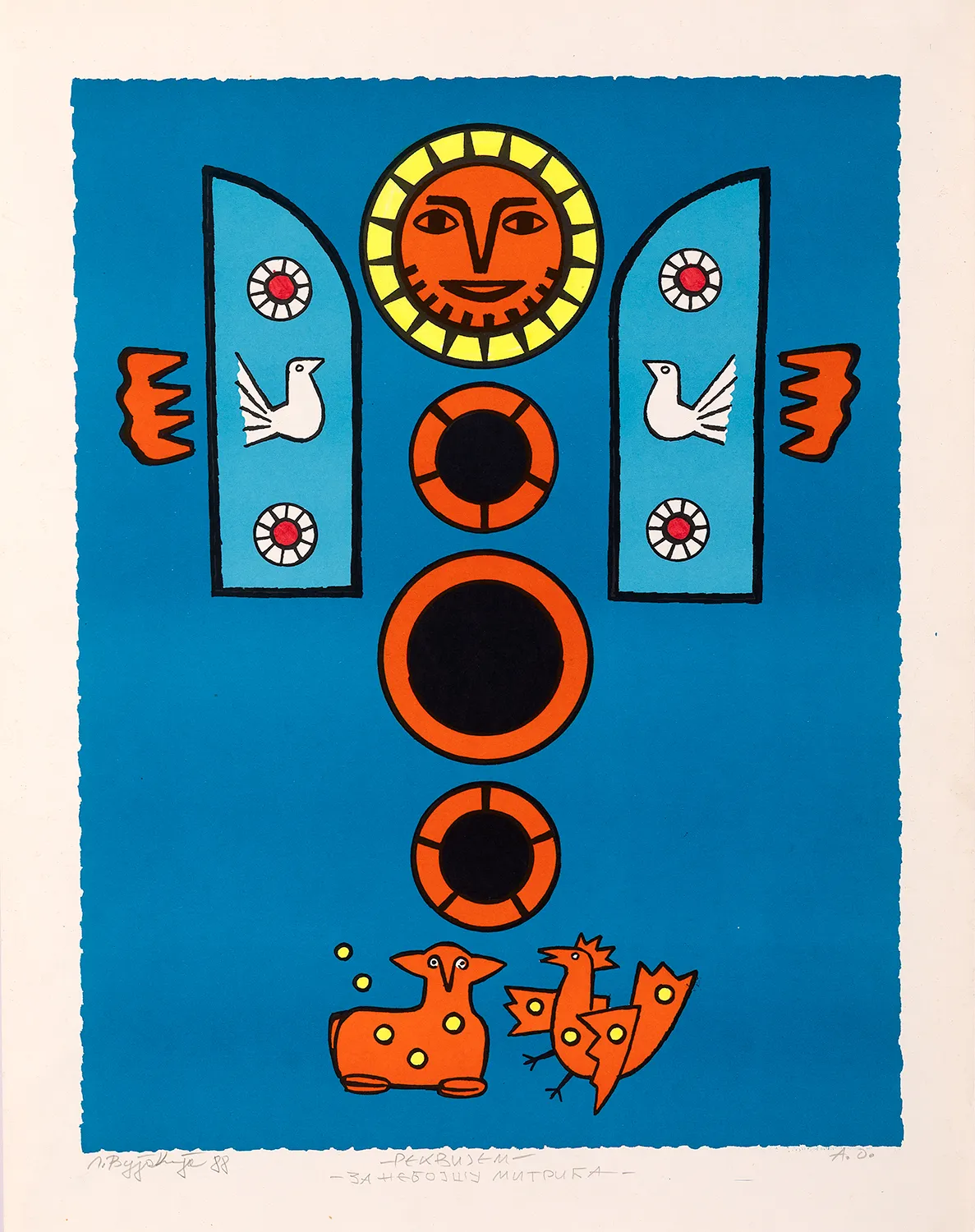
He appropriated certain motifs directly, translating them into another medium and adding color as an element the stone could not contain. Over the following decade, he built what would become his painterly alphabet: a system of recurring symbols, suns, hands, doves, birds, combined and recombined according to his own logic. He constructed his images from flat forms enclosed by heavy black contours, with color used symbolically rather than naturalistically. The result was an autonomous visual language, one that refused to graft either Western modernist conventions or folkloric tradition onto his work. At the center of almost everything he made is the human figure, schematised to the point of universality, rarely defined by gender, reduced to gesture and sign.
The hands are always open, representing a pure heart and an open character. The hand can often resemble a tree, because I do not pursue likeness; rather, through such forms I wish to express a striving upward–something that is not constrained but ascending and positive. The sun, as a circle and as a mass is a concept of permanence, eternity, and security. Red expresses struggle, life, joy–and the colour green–death.
– Lazar Vujaklija
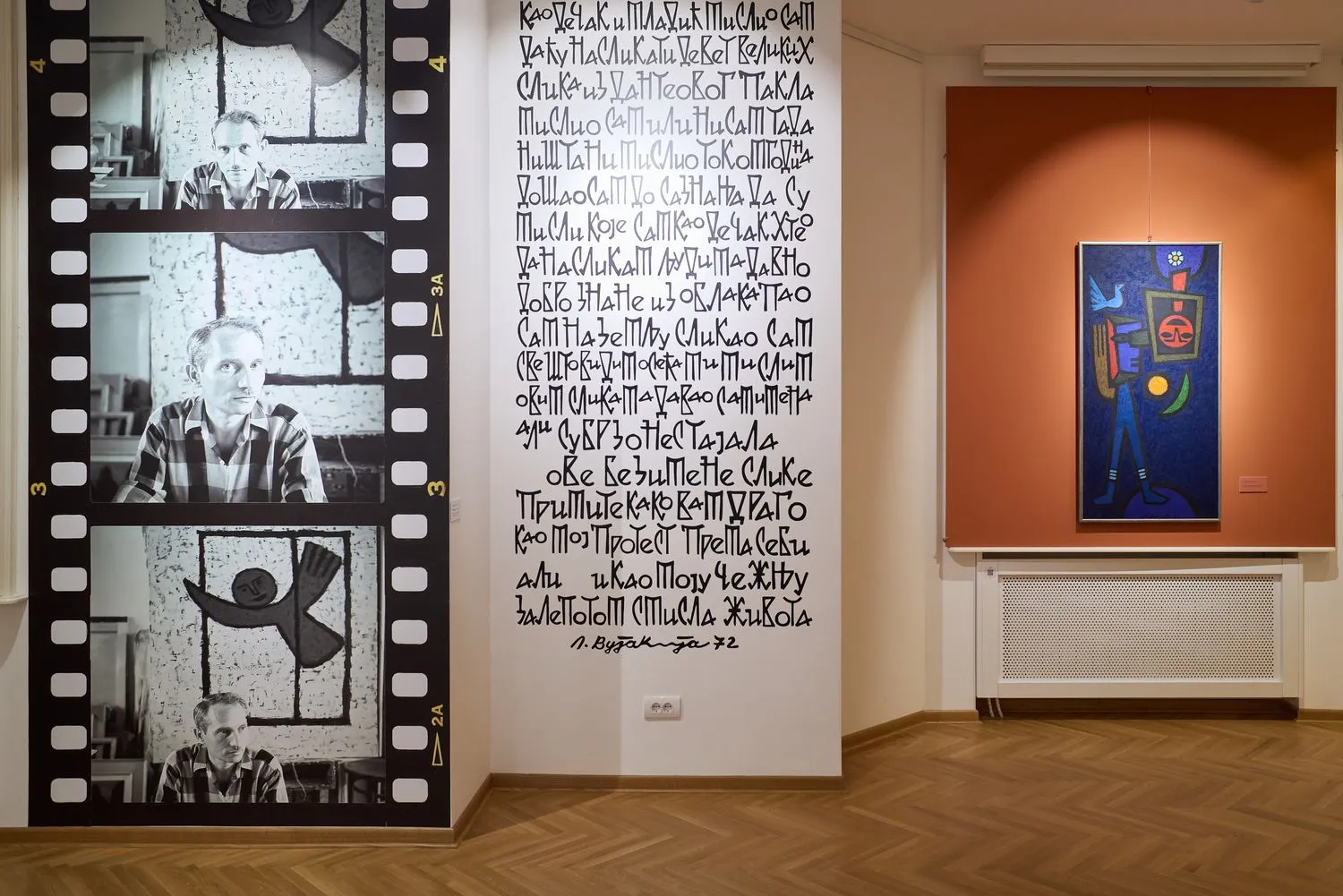
The first comprehensive retrospective of his work, titled Lazar Vujaklija: A Protest Within, debuted at the Museum of Naïve and Marginal Art in Jagodina in Serbia, before traveling to the Museum of Contemporary Art of the Republic of Srpska in Banja Luka this July. Curated by Danica Đorđević Janković and Vladimir Kokoruš, it brings together 170 works across every medium he worked in: painting, printmaking, drawing, tapestry, mural, sculpture, book illustration, poster, carpet design. The title comes from a text Vujaklija wrote and self-published in 1972, a rare direct statement from an artist who rarely spoke about his own work in those terms, painted in his own distinctive lettering on the wall of the Jagodina gallery:
Accept these nameless paintings as you will, as my protest within, but also as my longing for the beauty of the meaning of life.
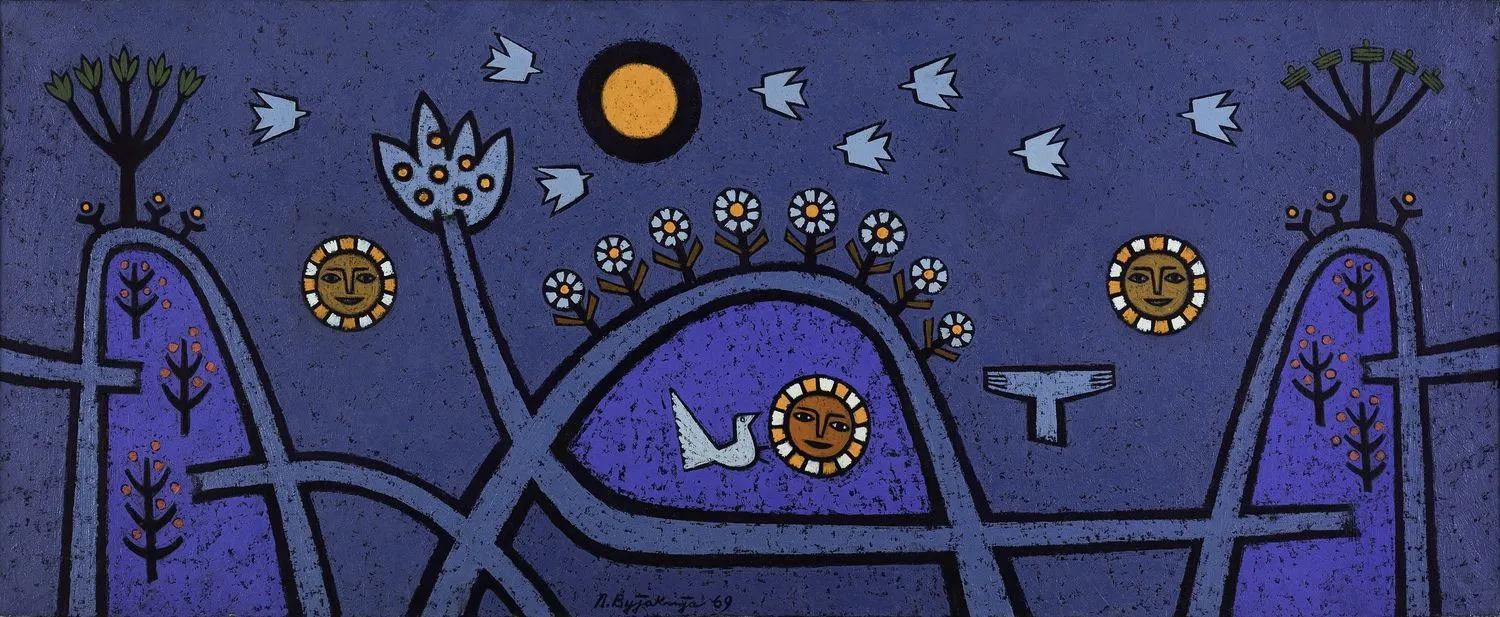
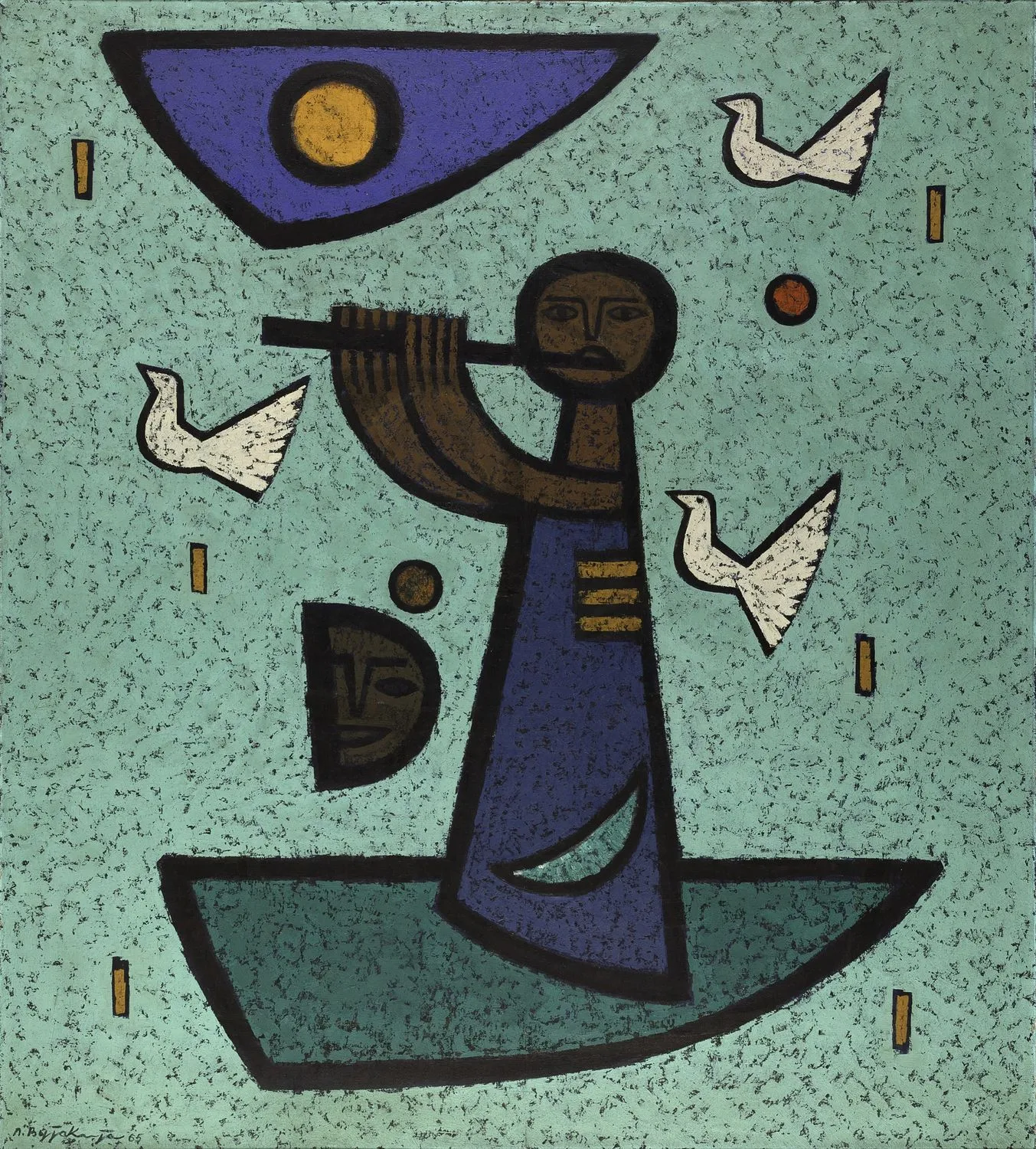
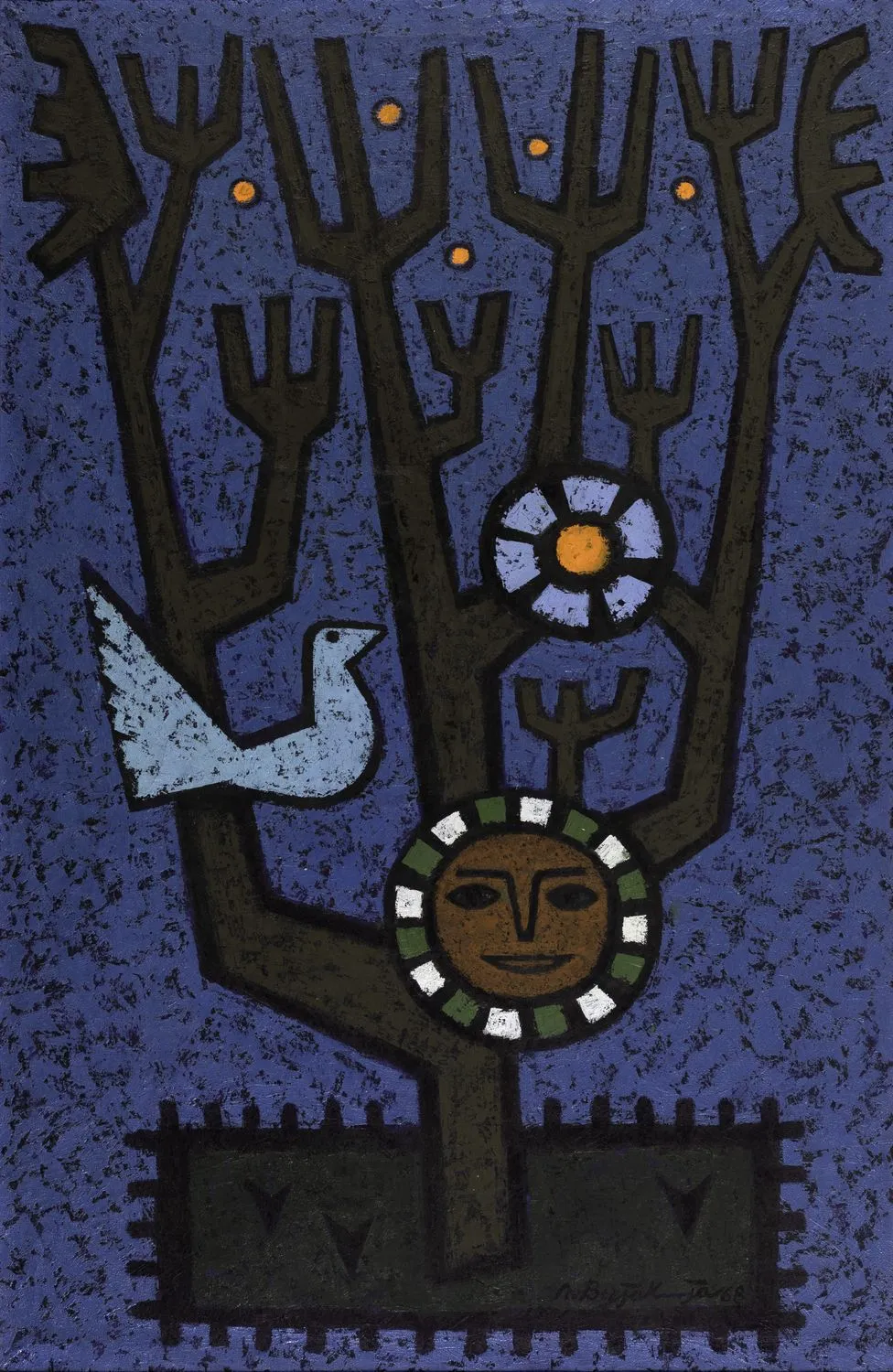
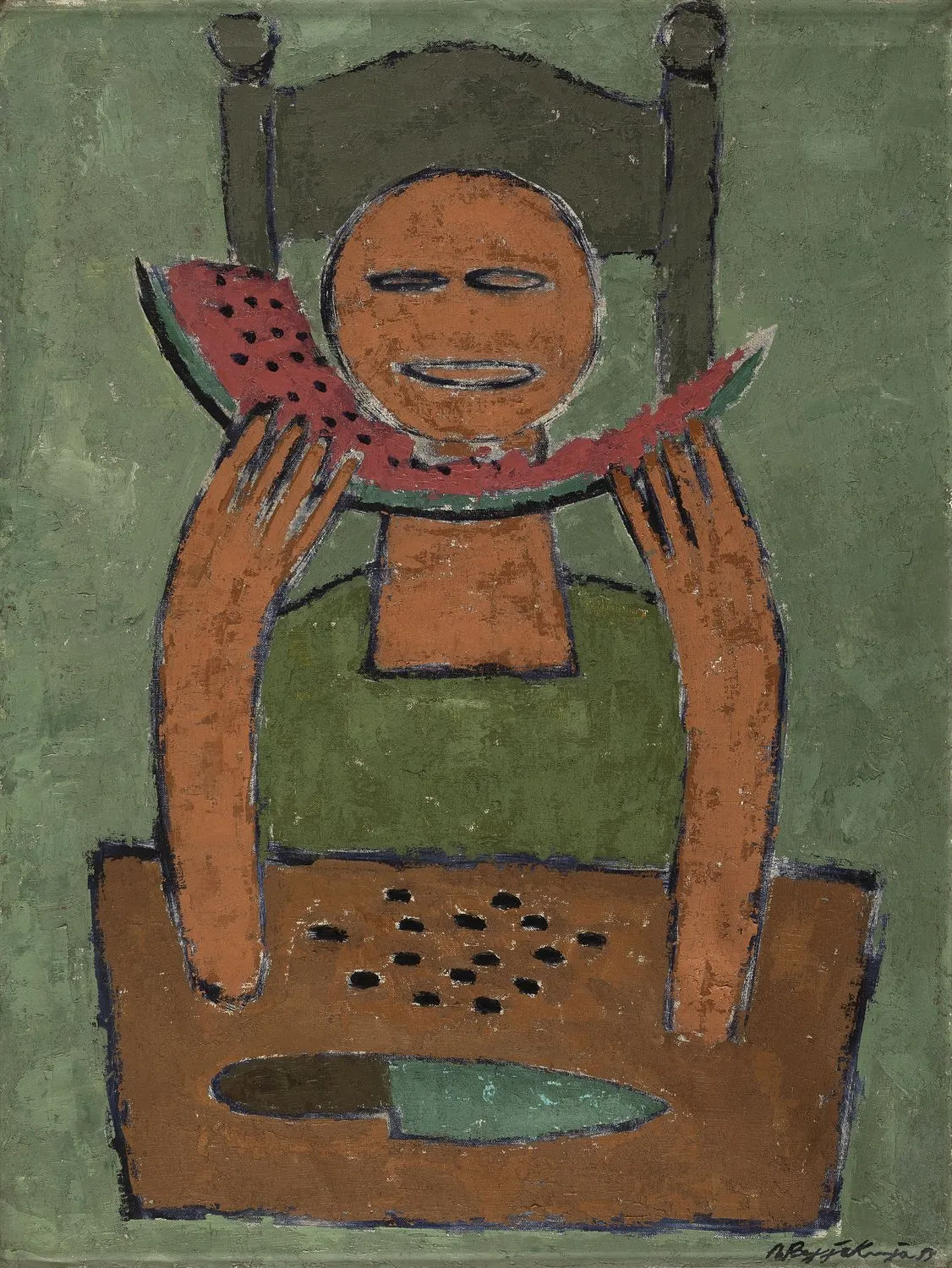
Vujaklija was born in Vienna in 1914 and died in Belgrade in 1995. He trained as a bookbinder from the age of twelve, and took an evening painting course with the famous Serbian painter Petar Dobrović at the Kolarac People's University, later working as a teacher at the Graphic Industry School. He was self-directed and voracious: he visited the National Museum regularly, seeking out exhibitions and reproductions wherever he could find them. While the lack of an academic credential made him easy to misfile, he was not an outsider. He was a member of the December Group alongside Lazar Vozarević, Stojan Ćelić, and Miodrag B. Protić, the significant artistic group of postwar Yugoslavia, and he exhibited twice at the Venice Biennale, in 1954 and 1956.
His reception followed an arc that the retrospective is now working to reverse. When he first exhibited in 1952, art critic Aleksa Čelebonović wrote that he was "a new phenomenon with whom one must reckon in our artistic life." Through the late 1950s and early 1960s, he accumulated prizes, institutional commissions, and international exhibitions. But two things were working against him simultaneously. The first was the naïve label, which attached itself to him because of his bookbinding background and his turn to the medieval tombstones, and which, even when contested, colored how his work was received. The second was more decisive: in 1966, art historian Ješa Denegri published a damning review of his solo exhibition at the Museum of Contemporary Art in Belgrade, dismissing his work as repetitive and decorative, drained of genuine meaning. Denegri was writing from within a critical framework shaped by the rise of conceptual art, which was rendering painting itself unfashionable, and Vujaklija's kind of painting, symbolic, figurative, rooted in folk and medieval sources, particularly so. He never fully recovered the critical standing he had before 1966.
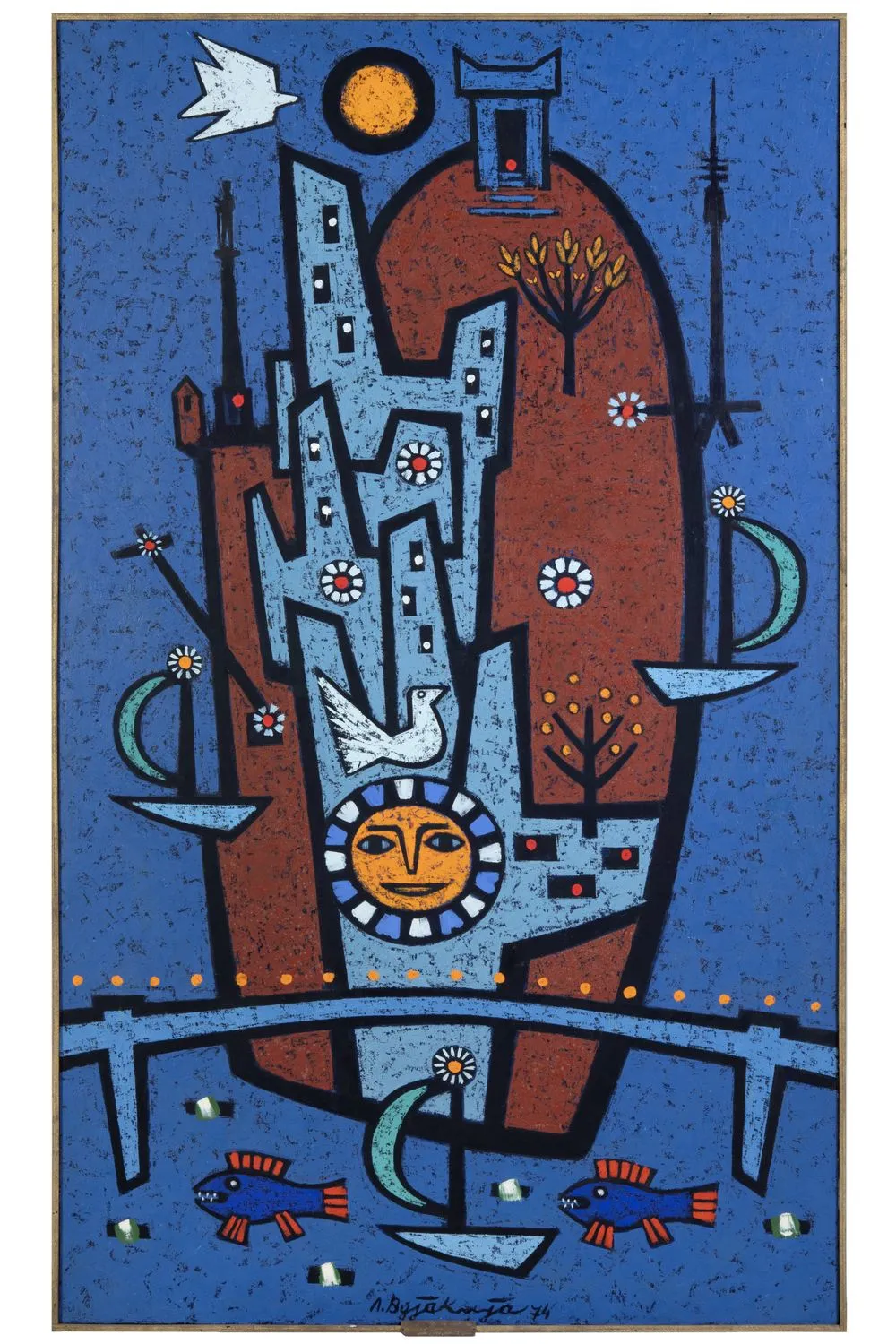
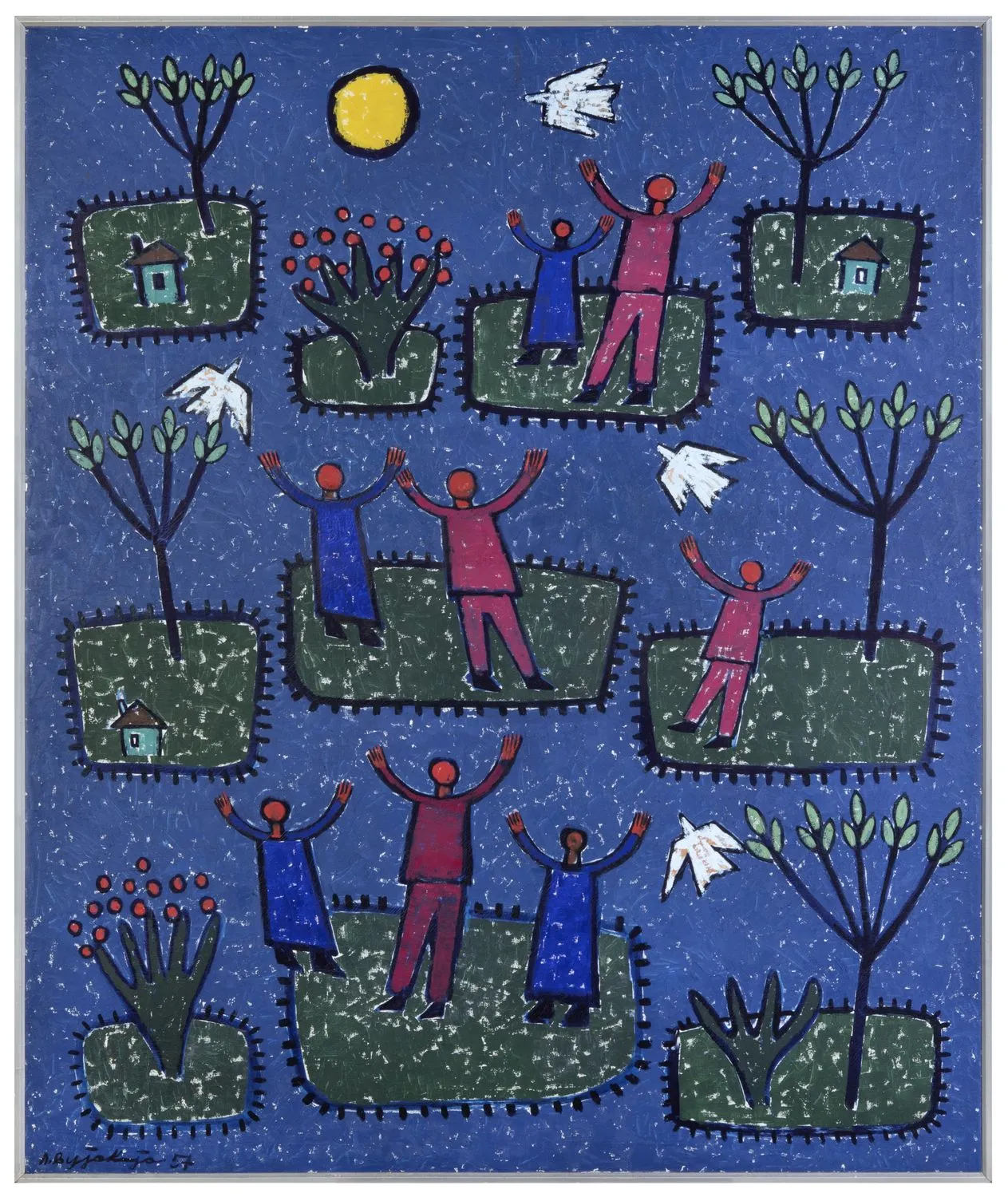
The retrospective proposes a rereading of his work through six thematic frameworks his contemporaries did not apply. It argues that the serial combination of motifs that critics dismissed as repetition was in fact a deliberate pictorial strategy, one that built meaning through consistency. The tombstone motifs he first encountered at Radimlja were not passively absorbed but consciously appropriated, transformed into the foundation of a wholly personal visual language that treated the past as living material rather than heritage. His insistence on circulating his work across media, reproducing paintings as prints, prints as tapestries, taking murals into public space, the exhibition reads as both a Duchampian gesture and a consistent philosophical position about what art is for. Running alongside this public commitment was a permanent internal dialogue between his own convictions and the world around him, a form of self-examination that the retrospective names directly in its title. Taken together, these arguments present an artist of considerably greater conceptual ambition than his critical reception suggested.
Vujaklija was an artist with a clear and consistent philosophy, and his formal choices follow from it. "There is only birth and death, and in between one brief intermezzo," he said in a 1969 interview. His paintings are full of vivid color and recurring life. Behind that brightness sits a sustained meditation on transience and on what it means for art to be present in people's lives. His position on art's social function was unambiguous:
I mainly insist on painting, and I strive for my paintings not to end their journey on a wall, but rather to influence textiles, furniture, and similar forms through the attitude and concept they contain.
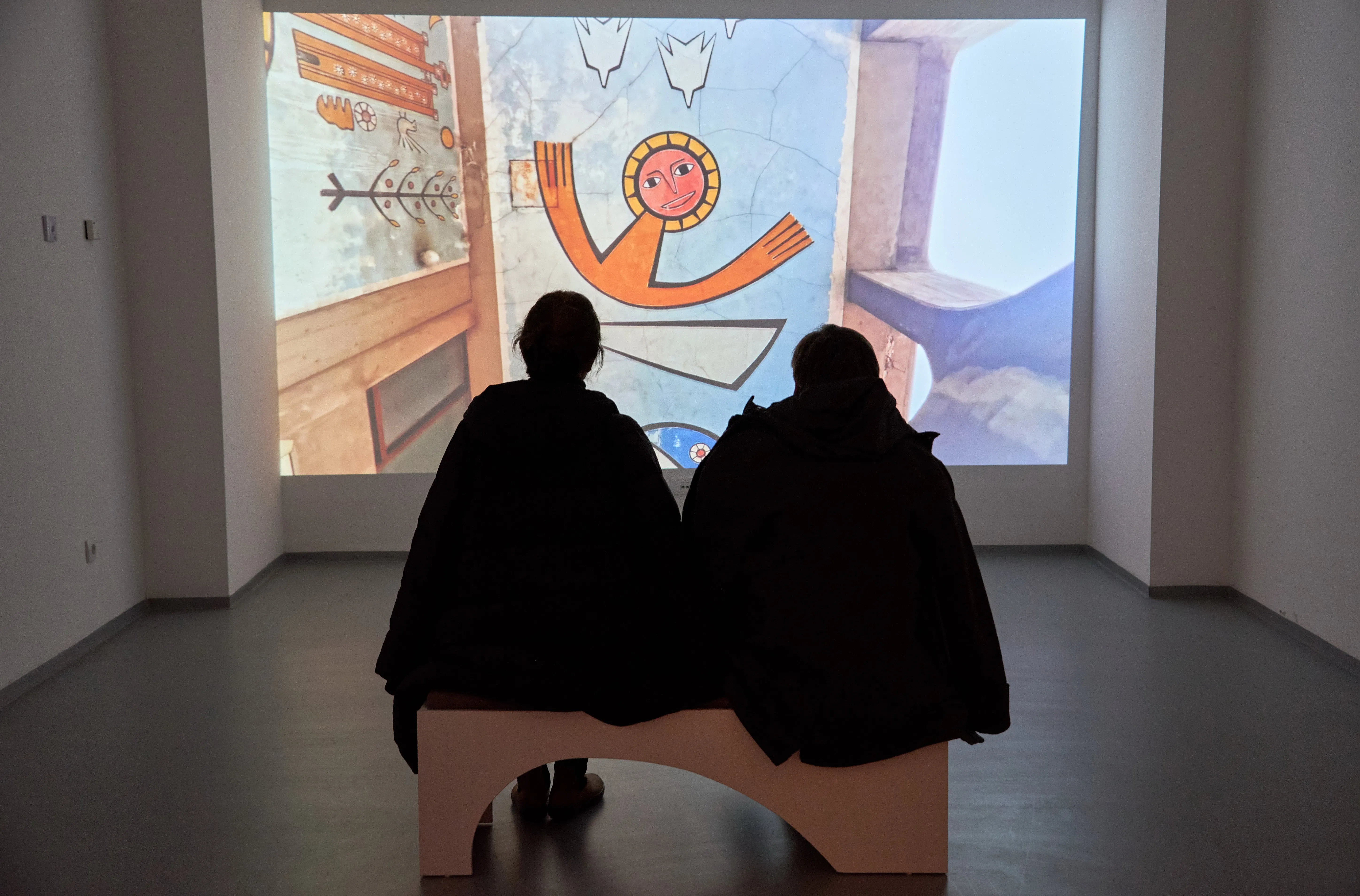
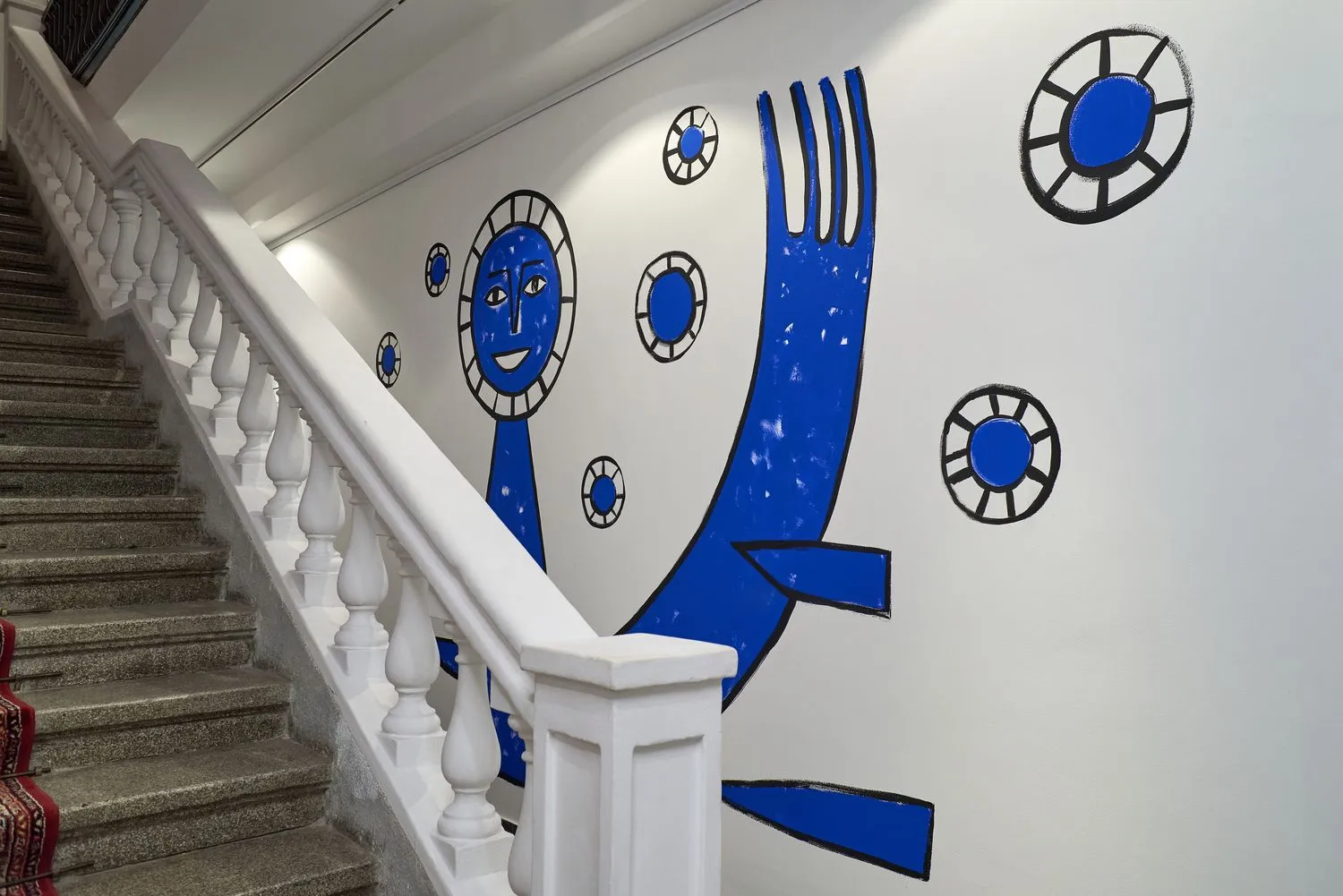
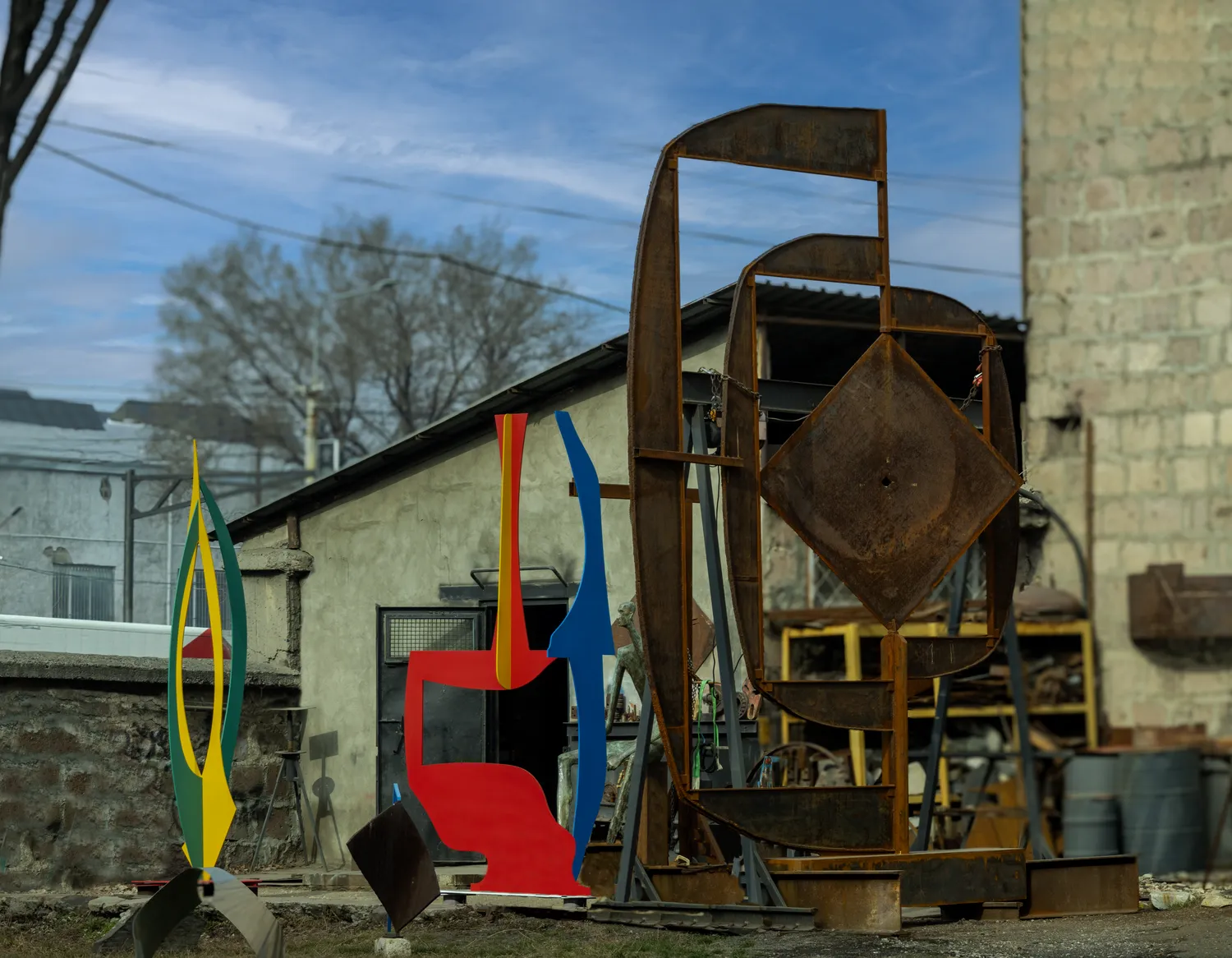
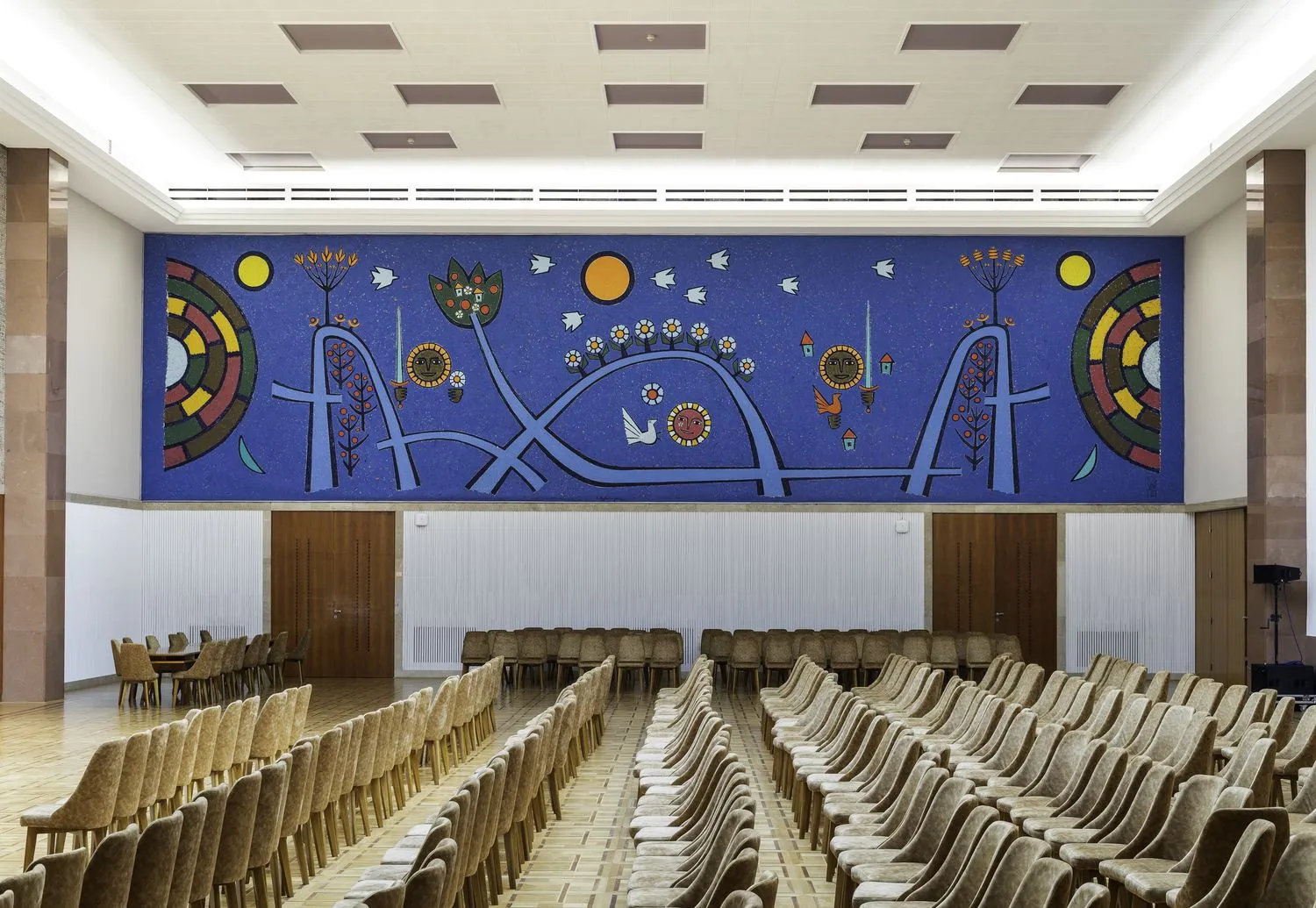
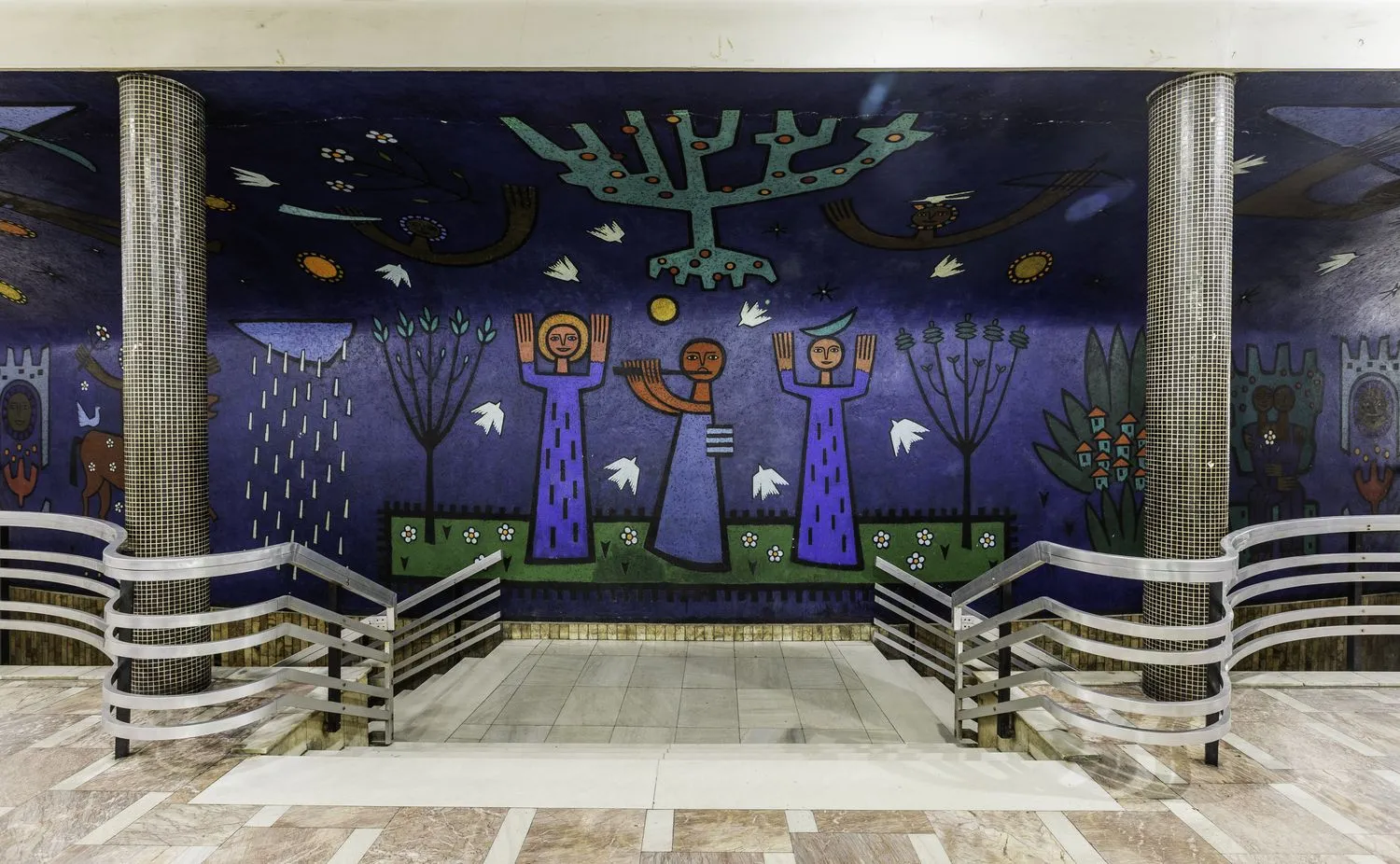
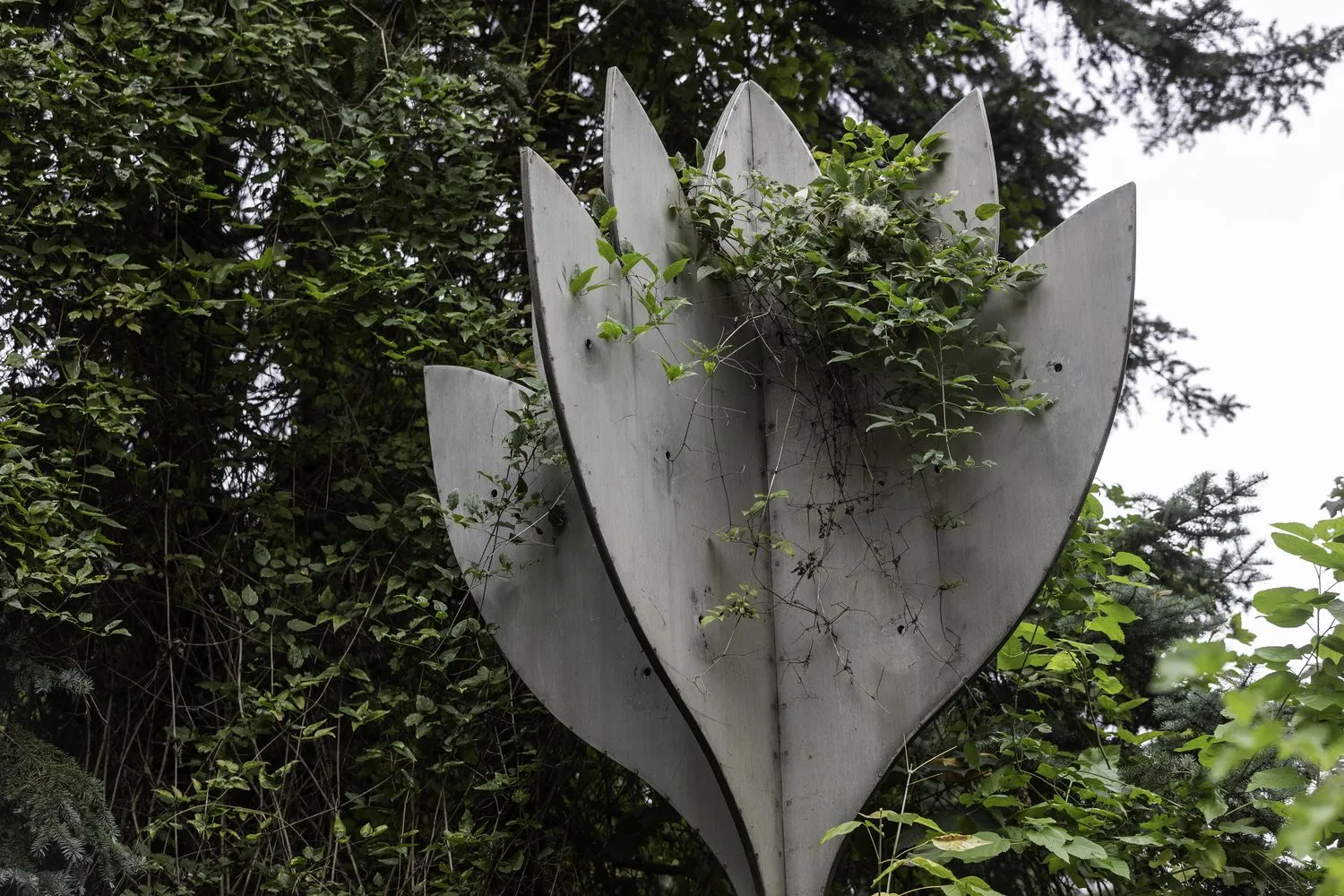
His first mural, painted for a friend who was a bookbinder along the wall of a workshop on King Aleksandar Boulevard in Belgrade, is considered the first postwar mural in the city. Although the work was destroyed, it marked the beginning of a long practice of taking painting into public space. He went on to paint murals at the Palace of the Federation, the Genex building, a hospital, and a cinema in Kruševac, and produced the only sculpture attributed to him, Tree of Life, for the grounds of the Prvi Maj factory in Pirot. For this retrospective, the artist Darinka Pop-Mitić was commissioned to reconstruct the first mural.
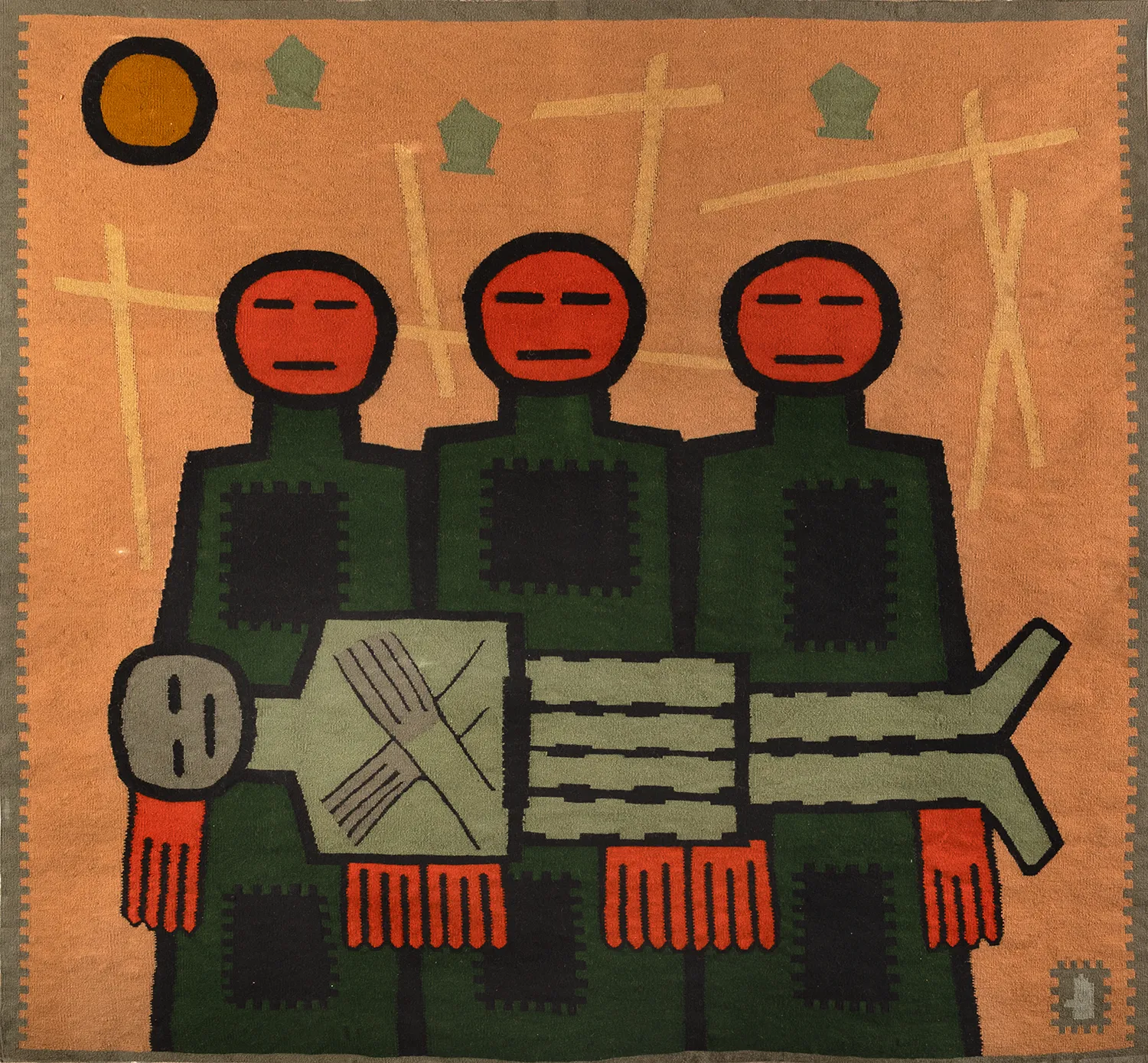
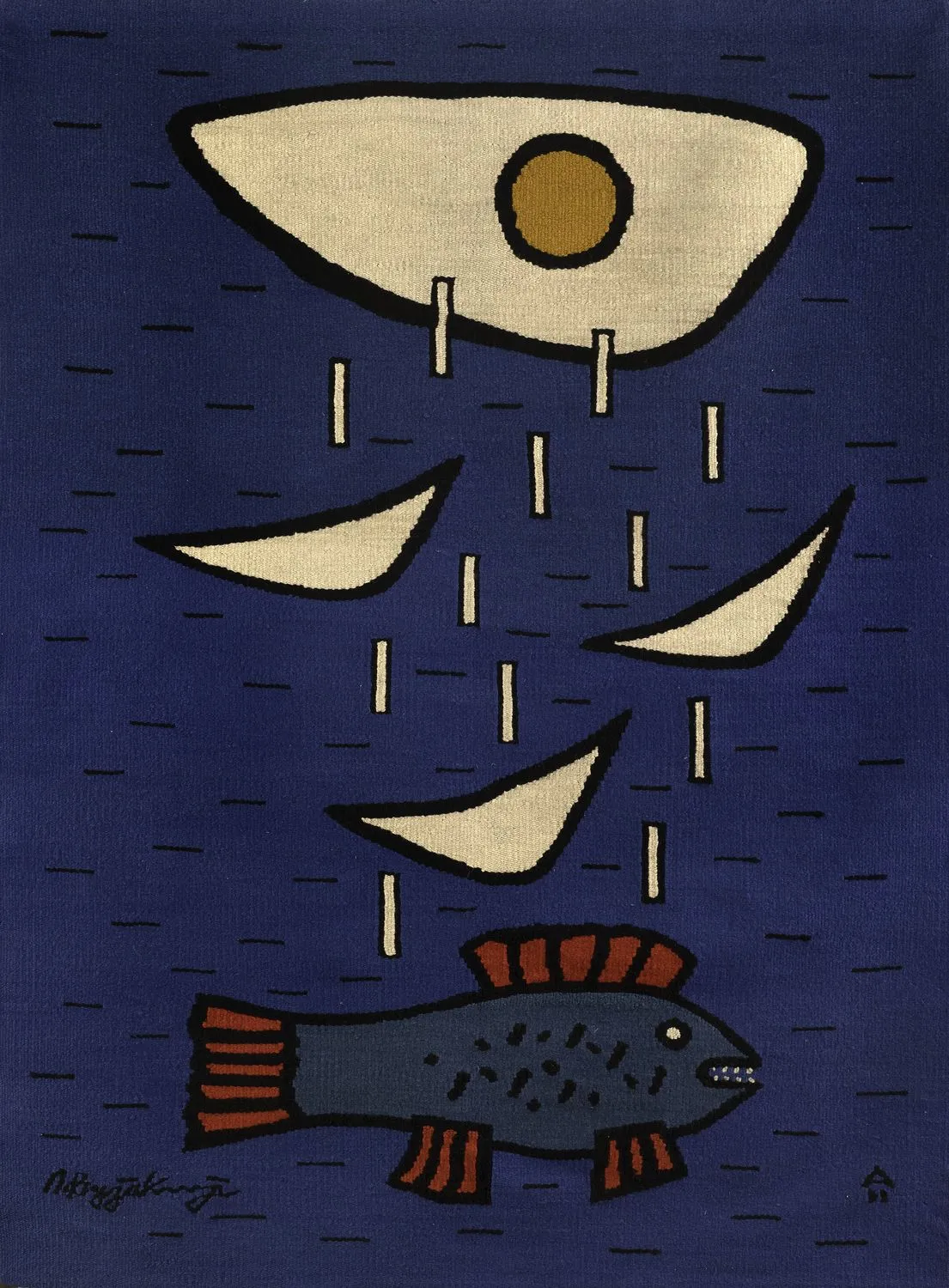
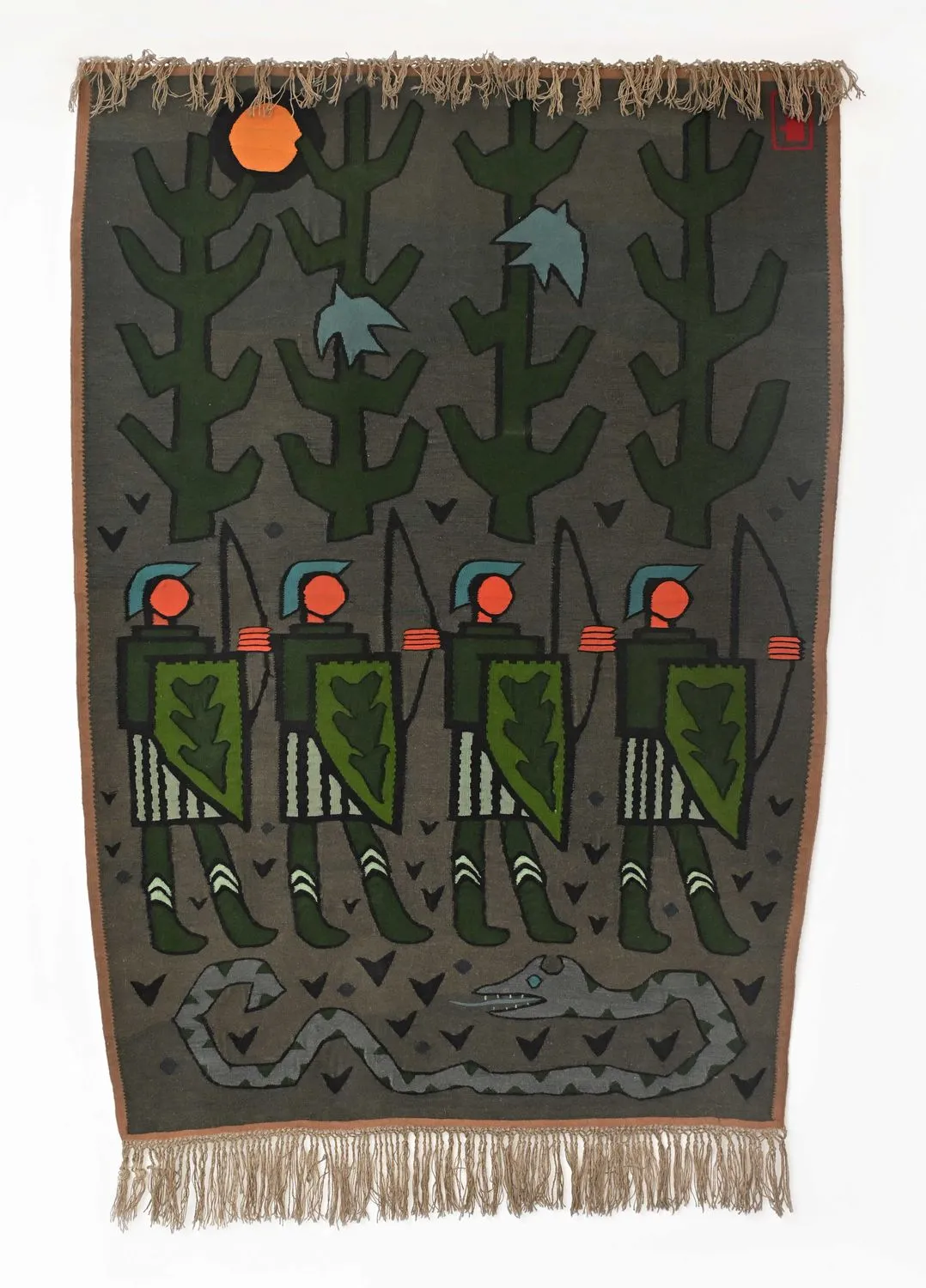
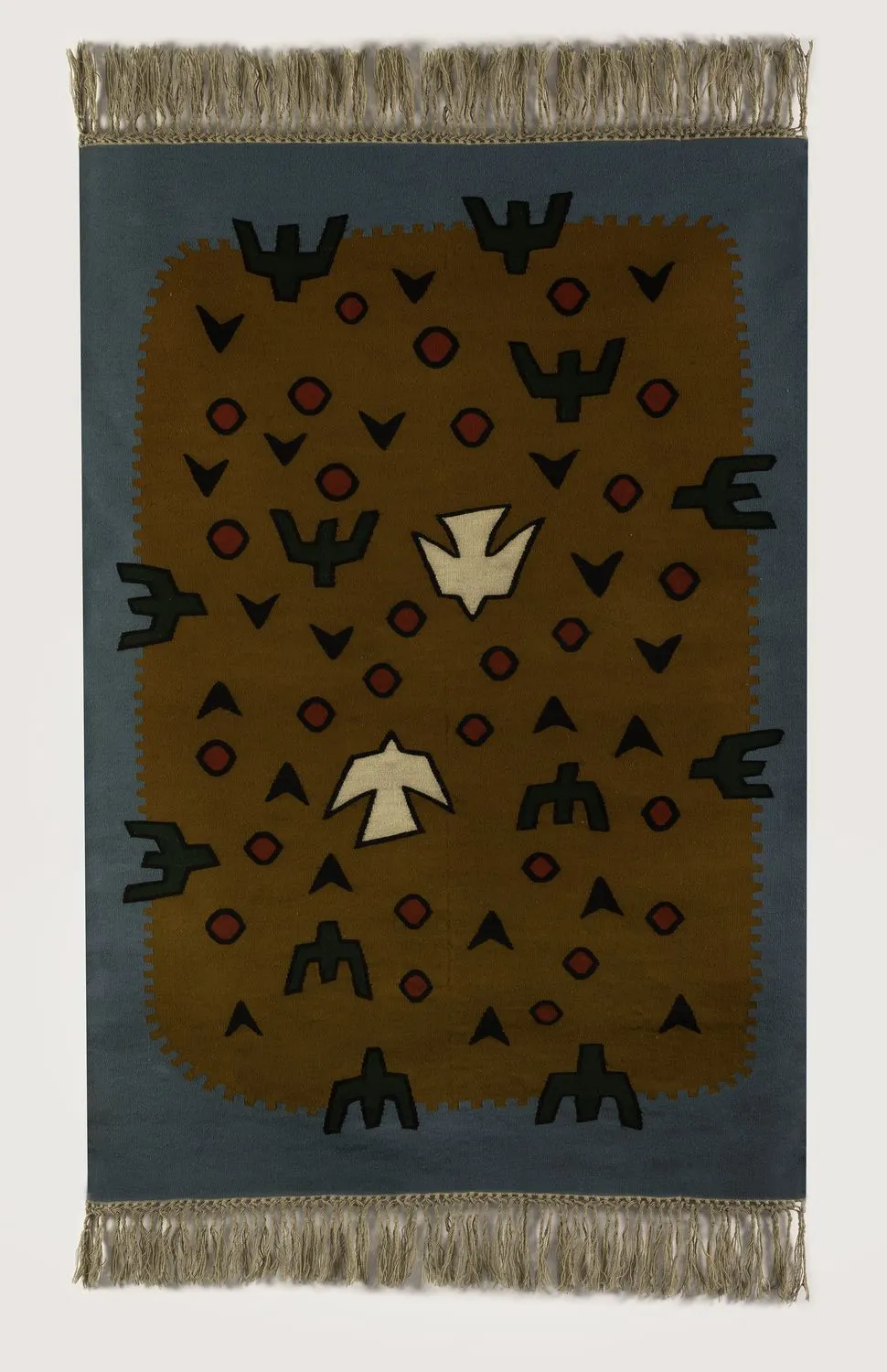
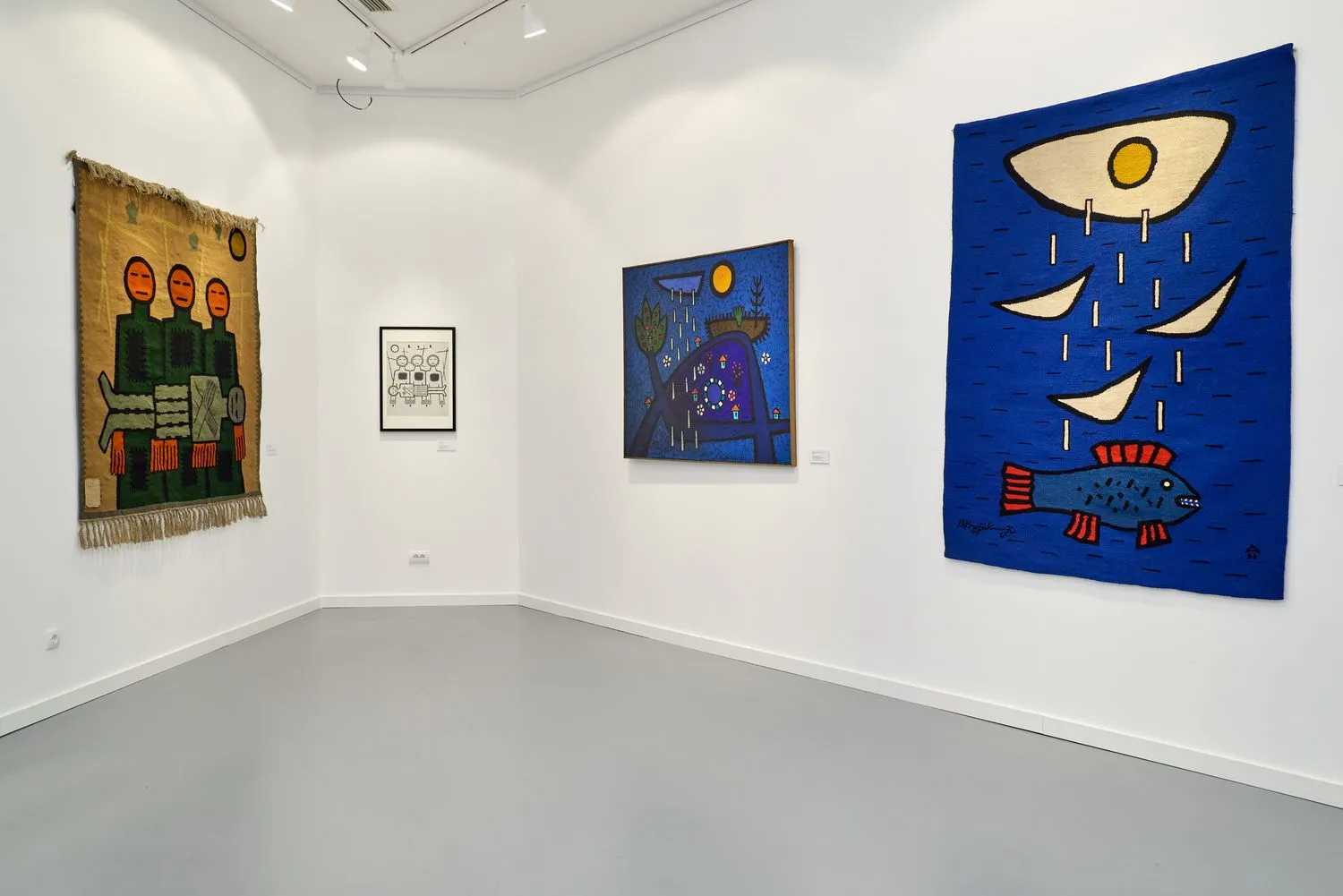
He produced tapestries, and by 1973 had made thirty-five, leading contemporaries to consider him one of the revitalizers of the medium. "I insisted that by using local materials, Pirot wool and traditional weaving techniques, I should conceive and shape these themes in a contemporary way," he once explained. He also illustrated books across genres, from children's literature to Pablo Neruda's poetry. The portfolio of twenty lithographs he produced in 1962, reproducing his most significant paintings in graphic form so that they could travel and enter circulation, embodies what the exhibition calls the portability of the artwork: the image freed from the wall, multiplied without loss of meaning.
His commitment to accessible, public art was shaped by the specific conditions in which he worked. His visual language, built from motifs that Yugoslav cultural policy had elevated to symbols of a shared national identity, became something close to an official visual idiom: his forms appeared on the walls of federal buildings, in state interiors, on greeting cards, in book illustrations. Yugoslavia needed visual symbols that were neither Soviet nor Western, and Vujaklija's work filled that space. Yet, he was not a state artist: his humanist convictions were genuine and consistent across his entire practice.
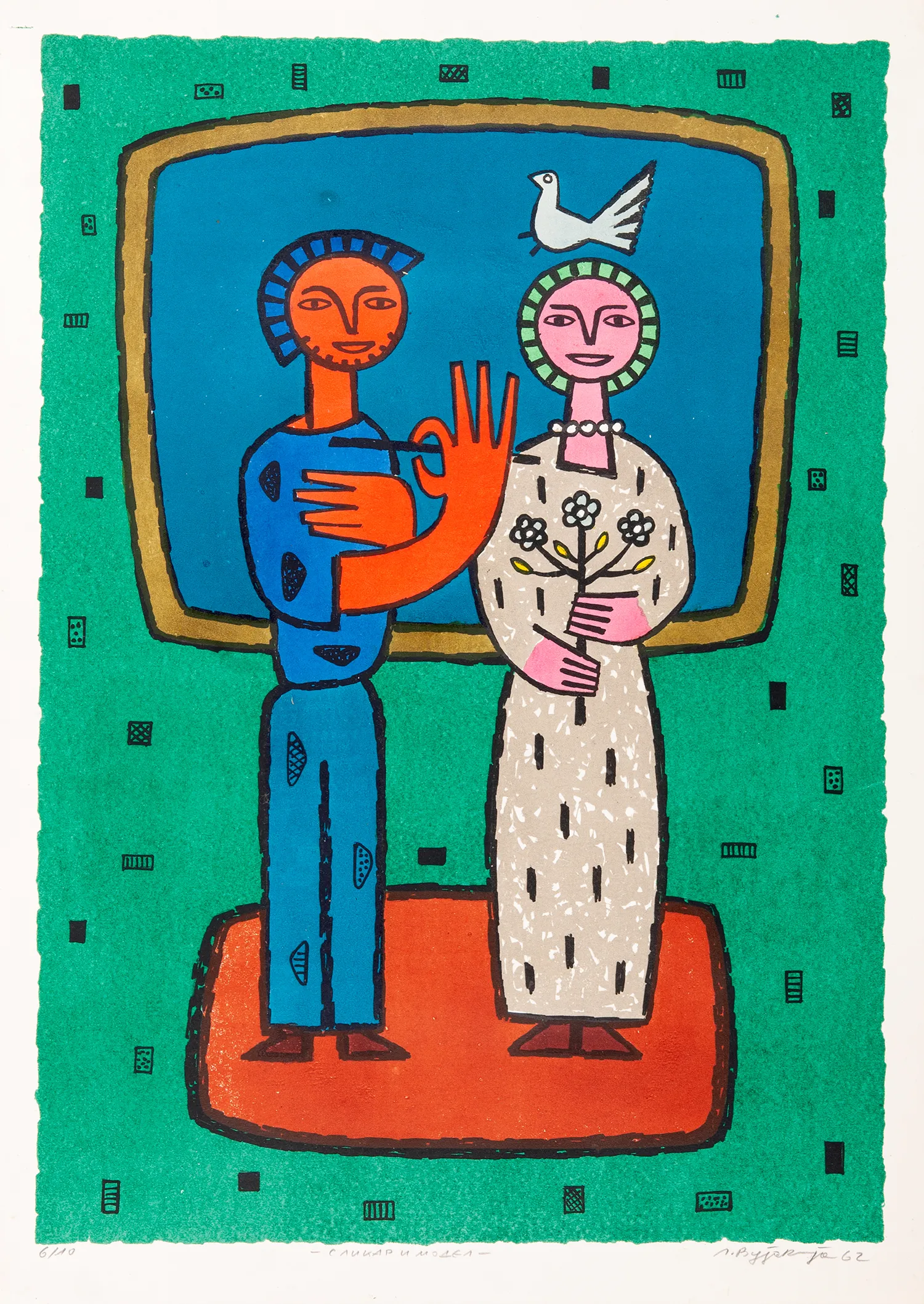
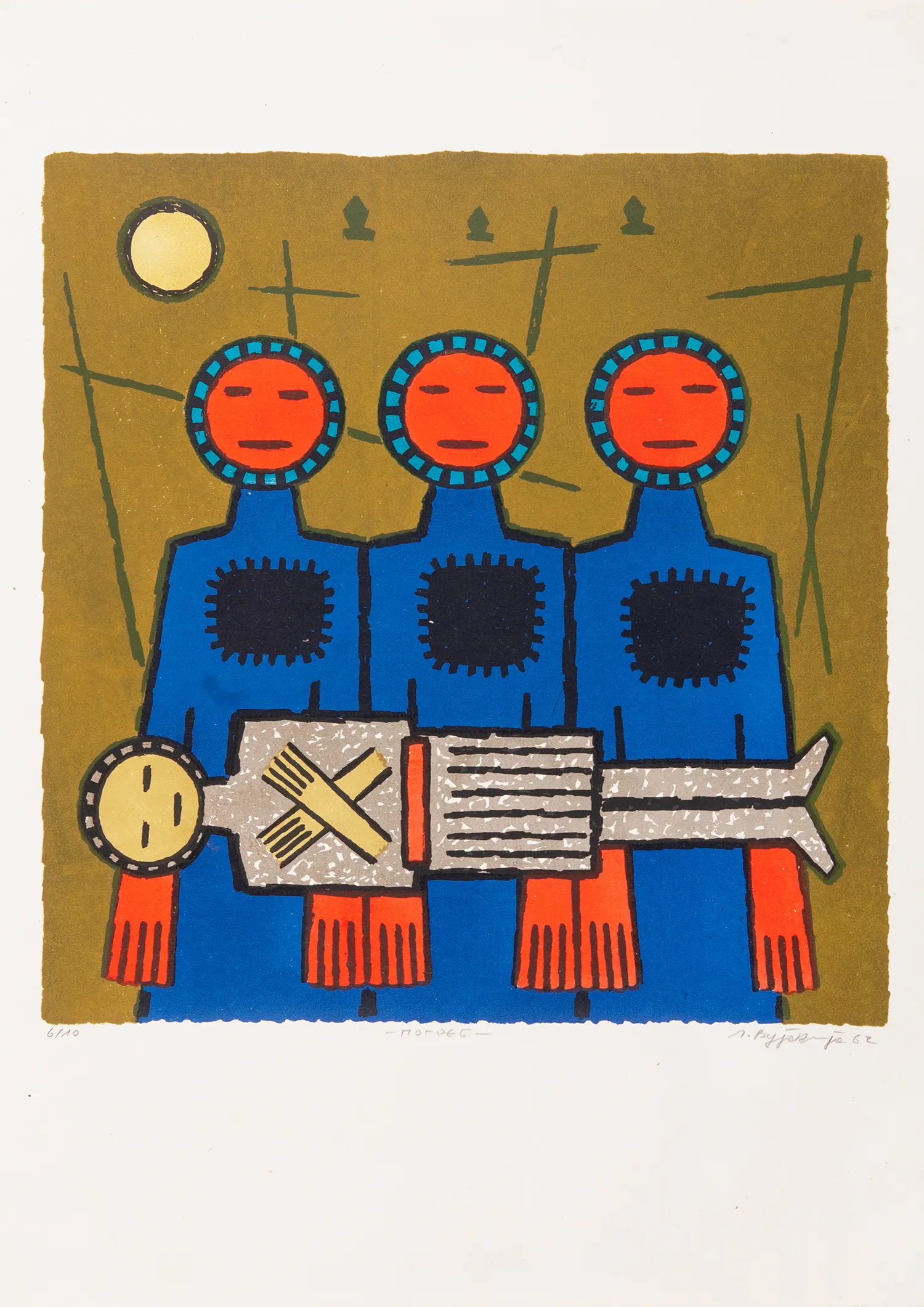
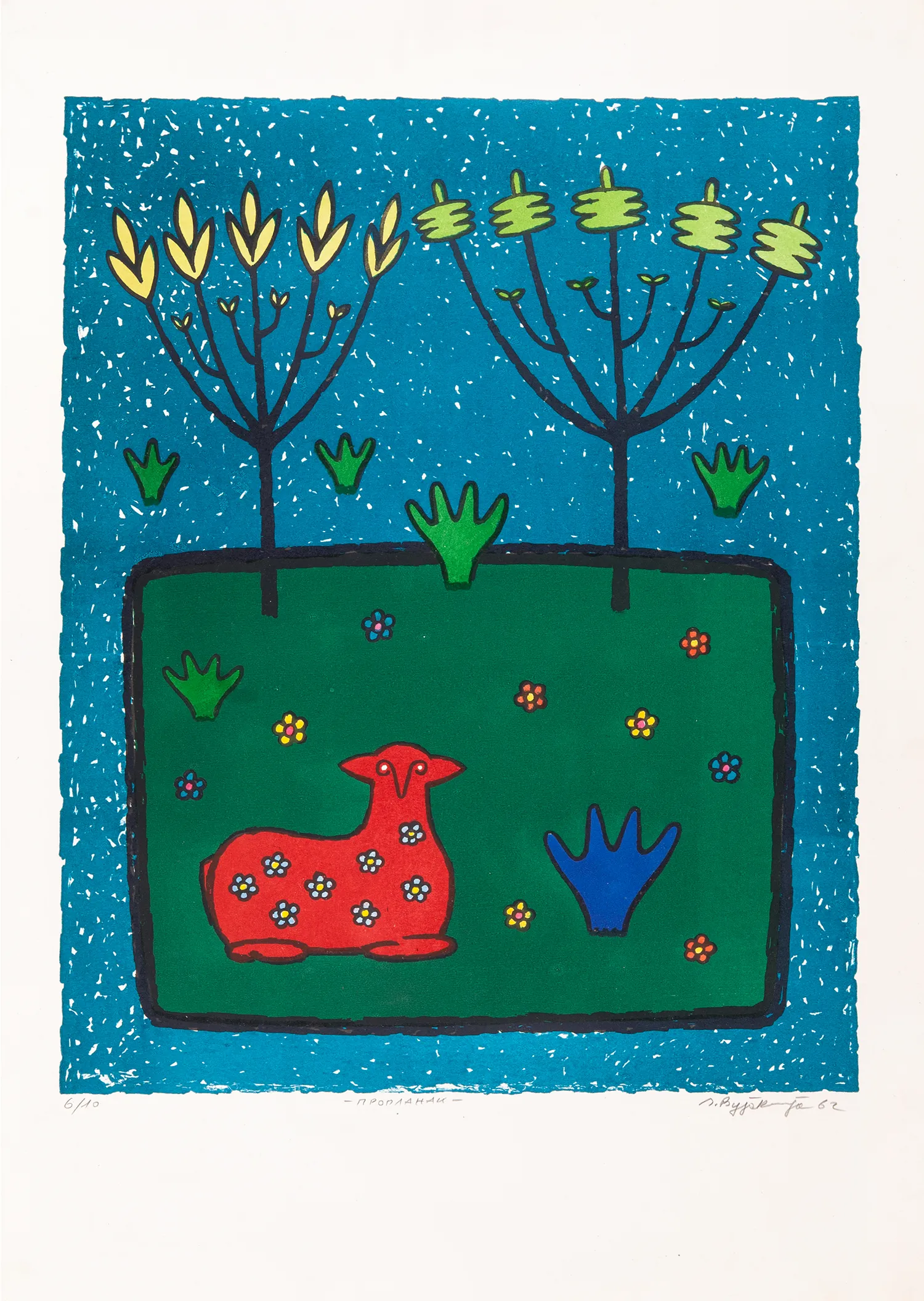
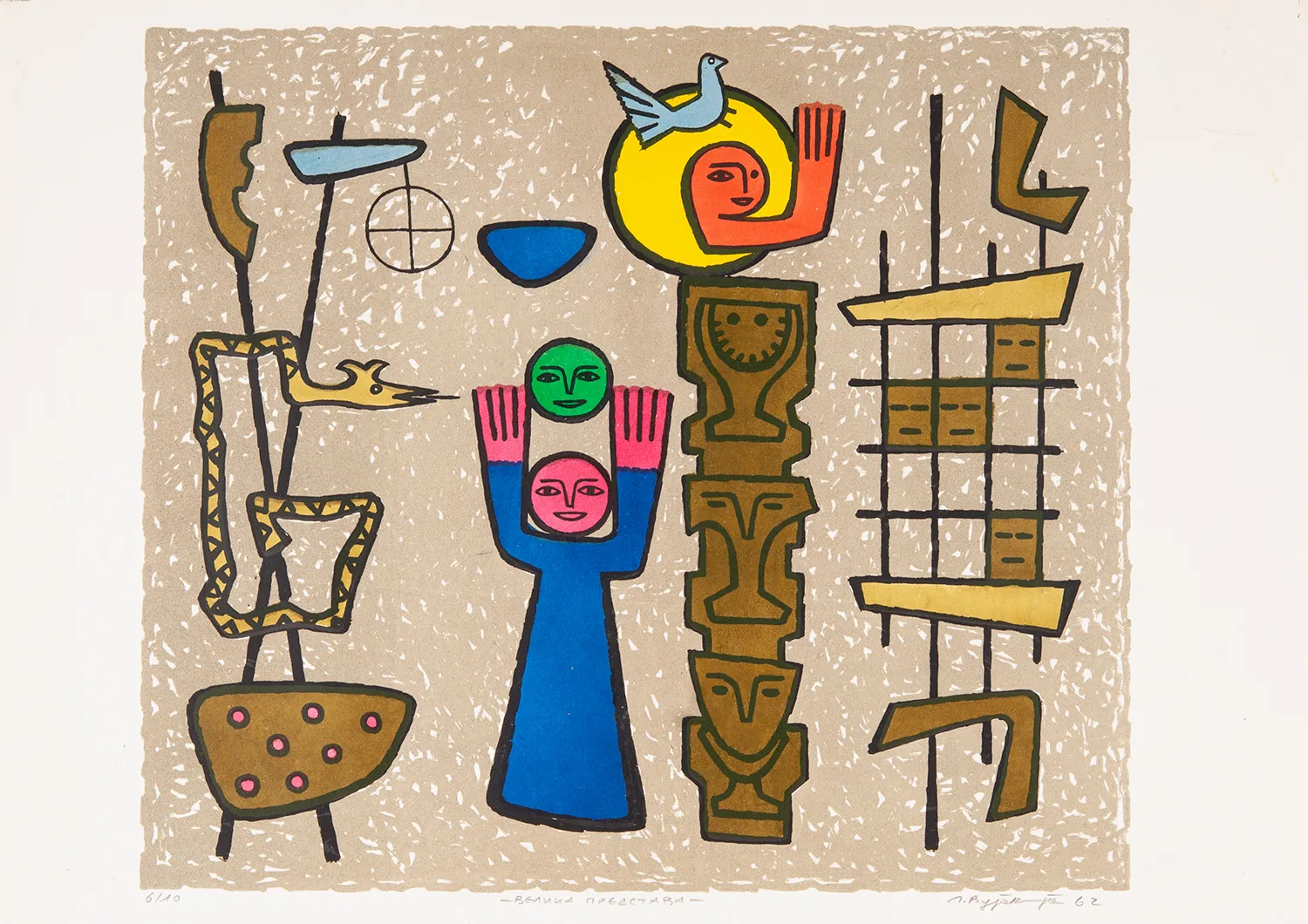
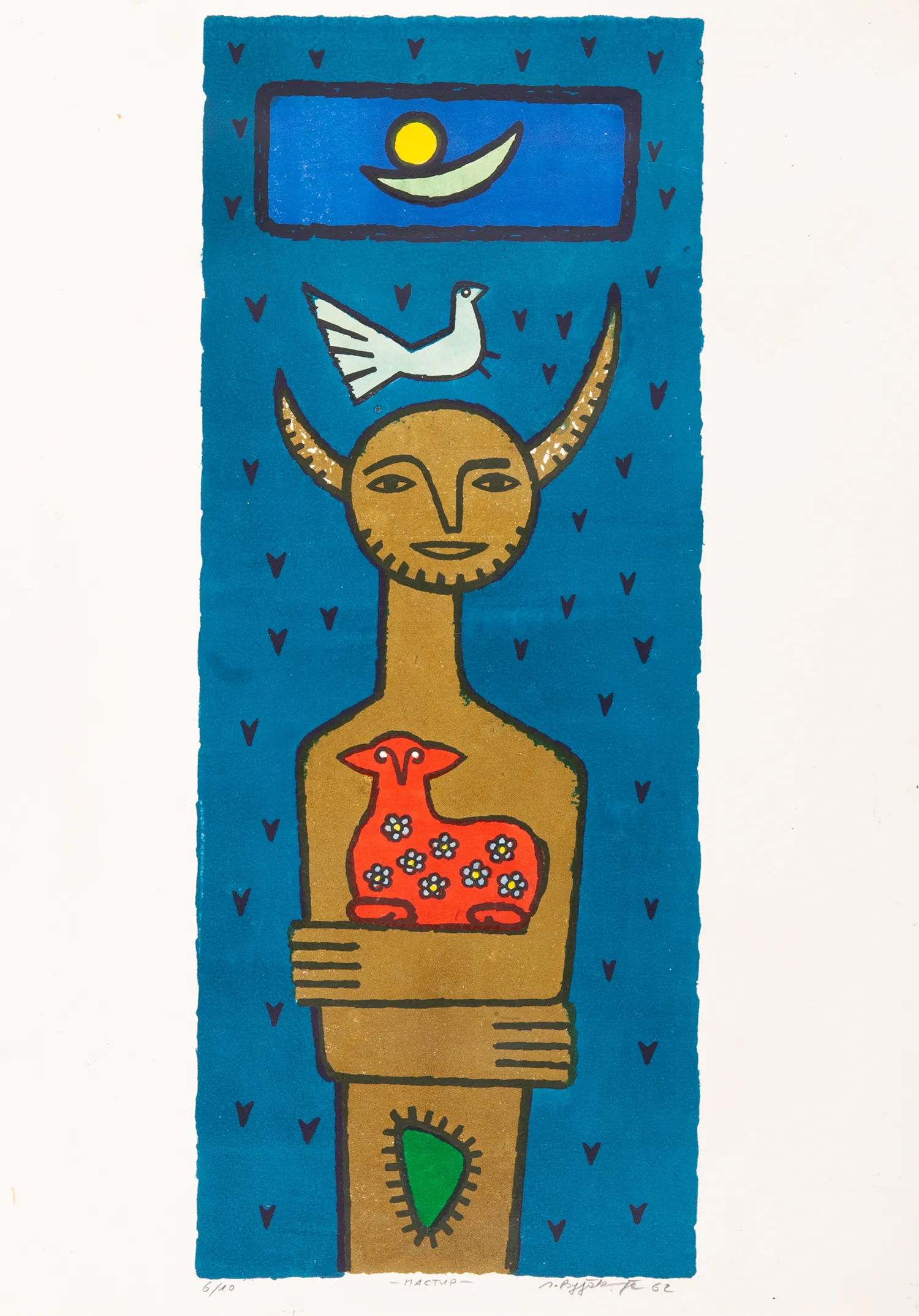
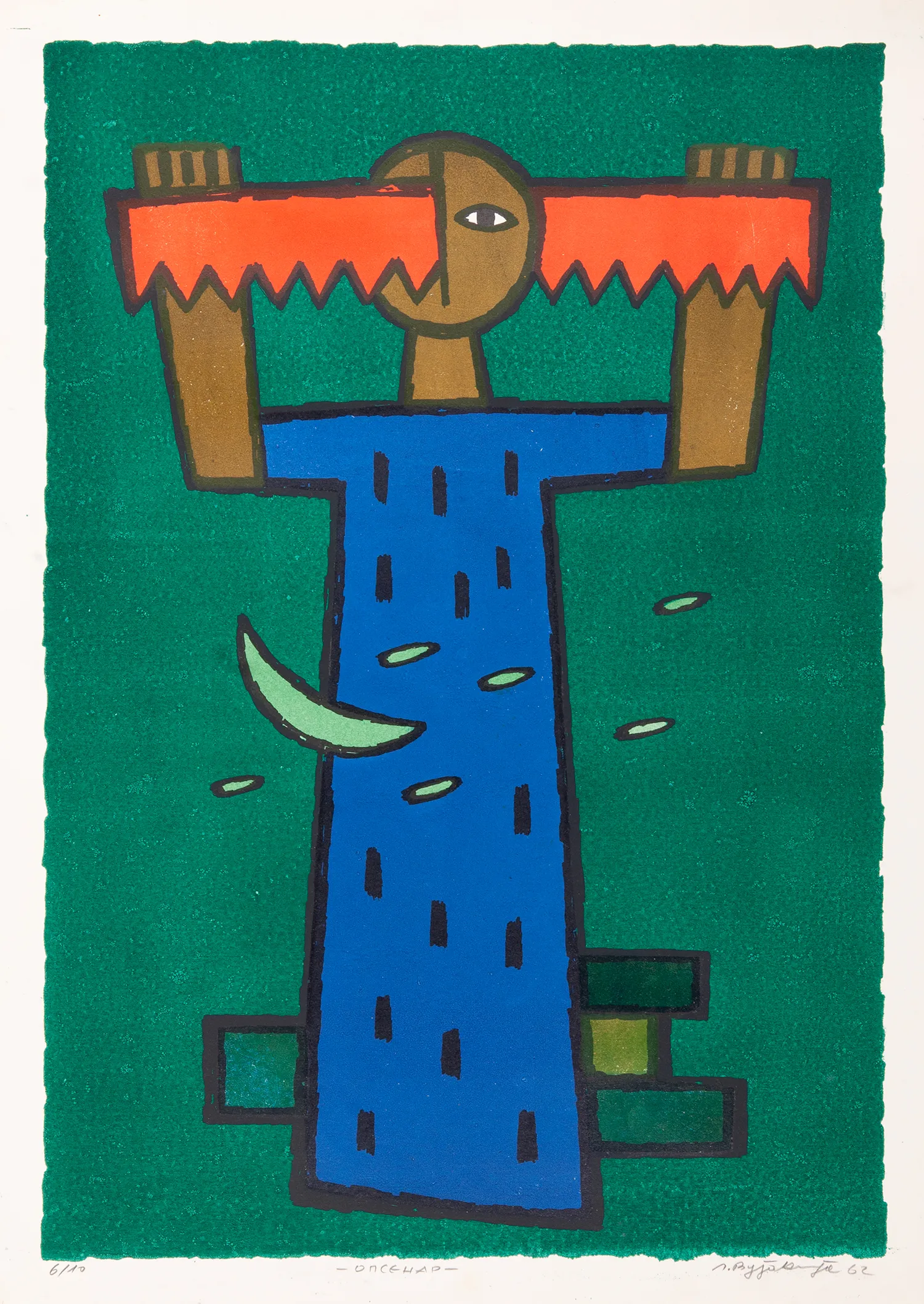
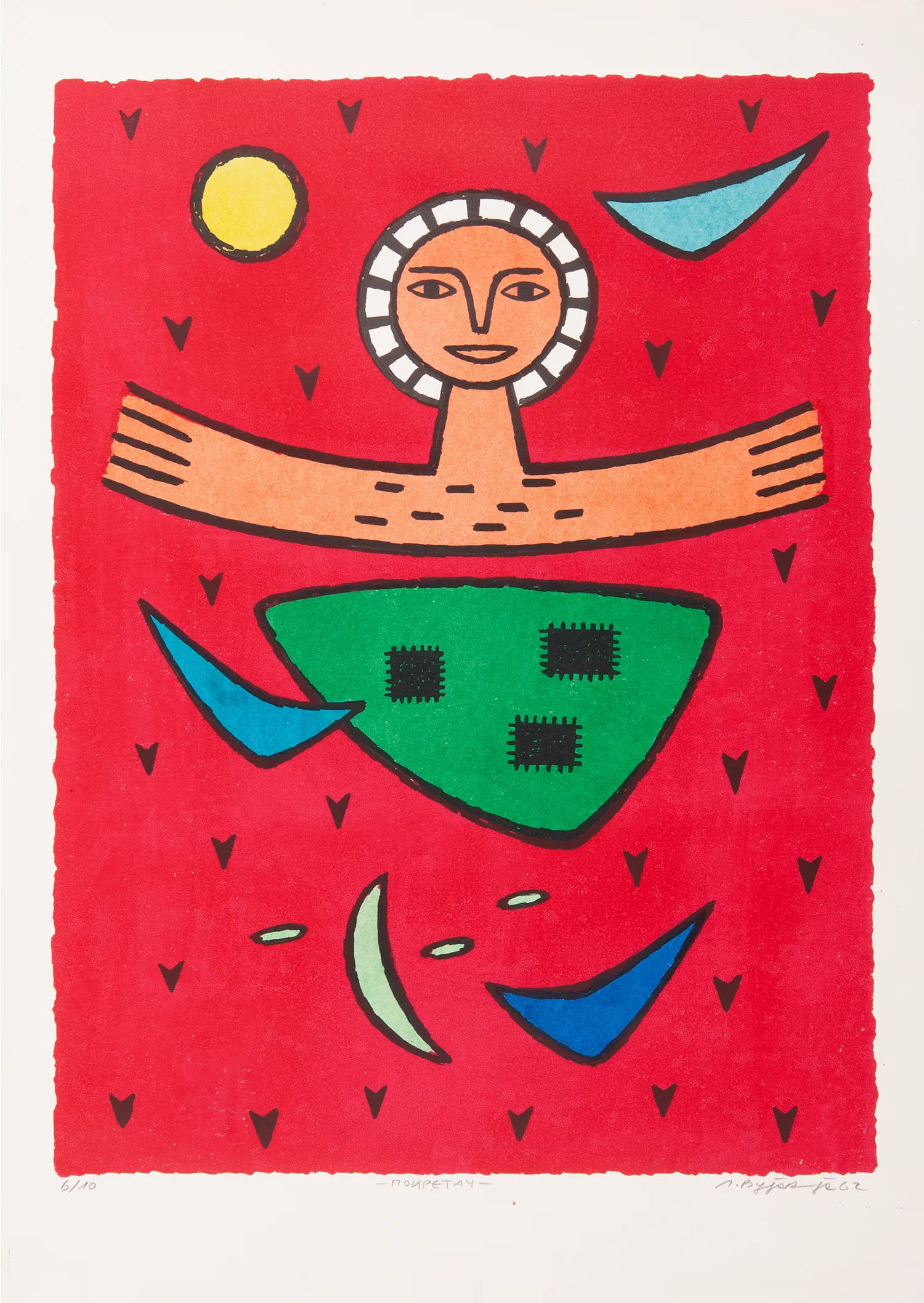
The most concentrated expression of his philosophy is in three major series of prints produced in the late 1960s and early 1970s. These address the human experience in its fullest range, from the extreme to the everyday, with the same formal conviction: that art must be present in people's lives, and that its function is to affirm rather than to mourn.
A Note About Darinka (1969) visualizes a poem by Dušan Petrović-Šane about Darinka Radović, a woman from a village near Topola who was killed by gendarmes on May 9, 1943, along with her two daughters, because she would not betray a wounded partisan. The twenty prints unfold the episodes of that day using the full vocabulary of his alphabet: strict geometric forms, stylized figures, the familiar symbols of sun and bird and hand, set against a bright, optimistic palette that insists on the indestructibility of what Darinka Radović represented rather than the fact of her death.
Red Poem and Peasant Poem, both series of prints, work according to the same logic. The first addresses the mass execution at Kragujevac by the Nazis in October 1941, where Vujaklija's visual response—doves, suns, the motifs of continuity—enacts his own description of the event as "a drama that teaches love and peace." The second turns to ordinary rural life. Across all three, the human figure remains at the center, and the task of art is to affirm.
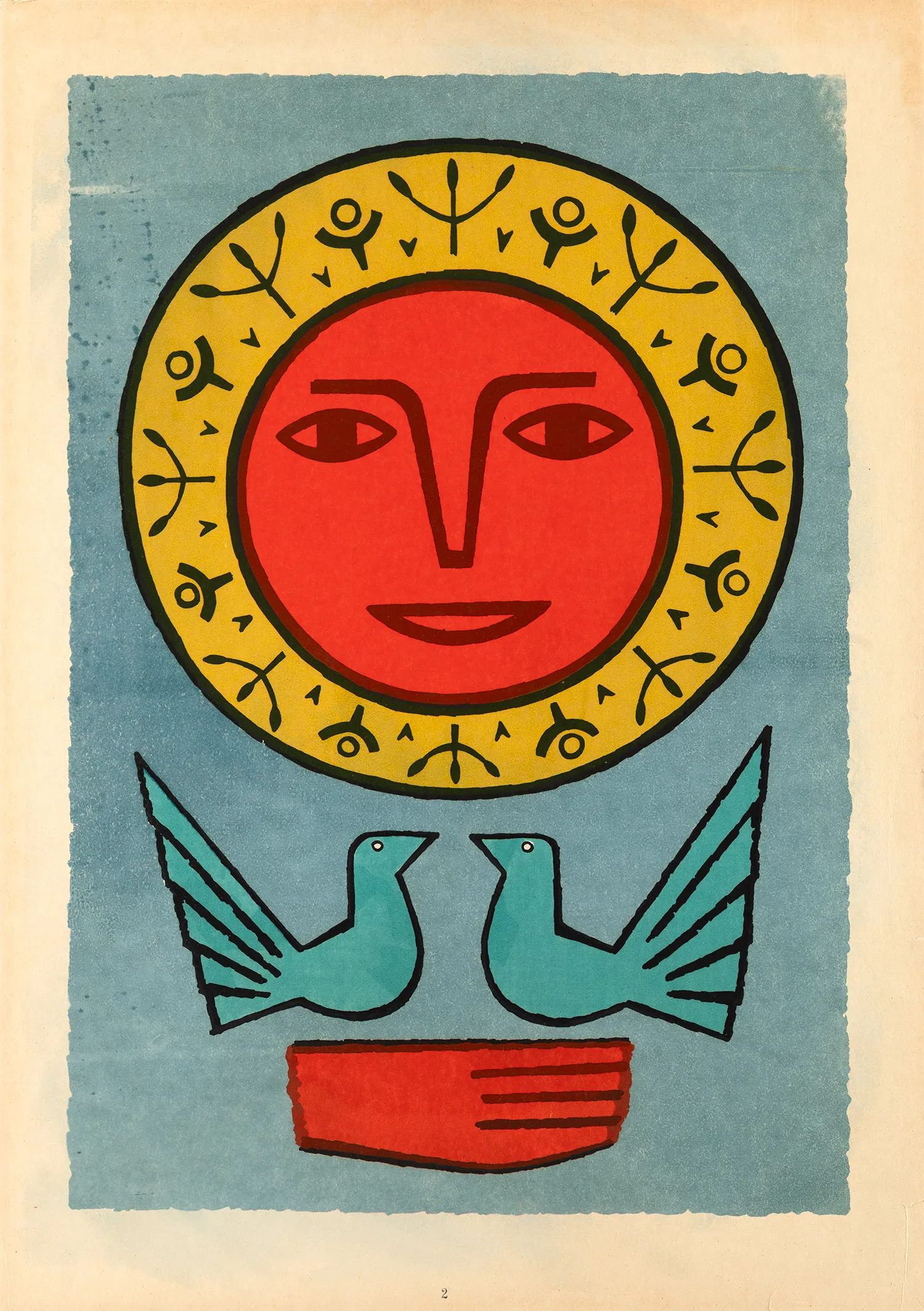
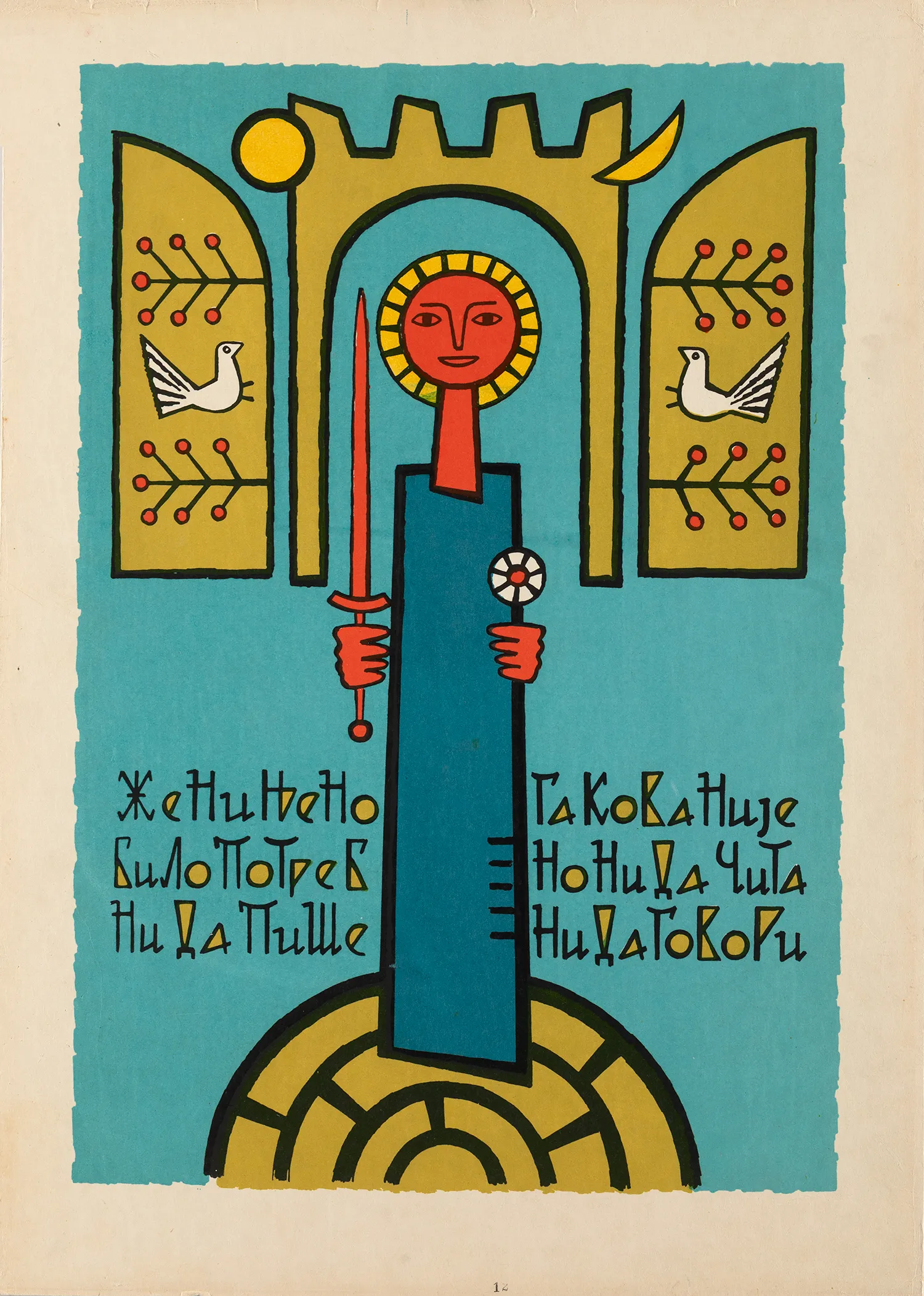
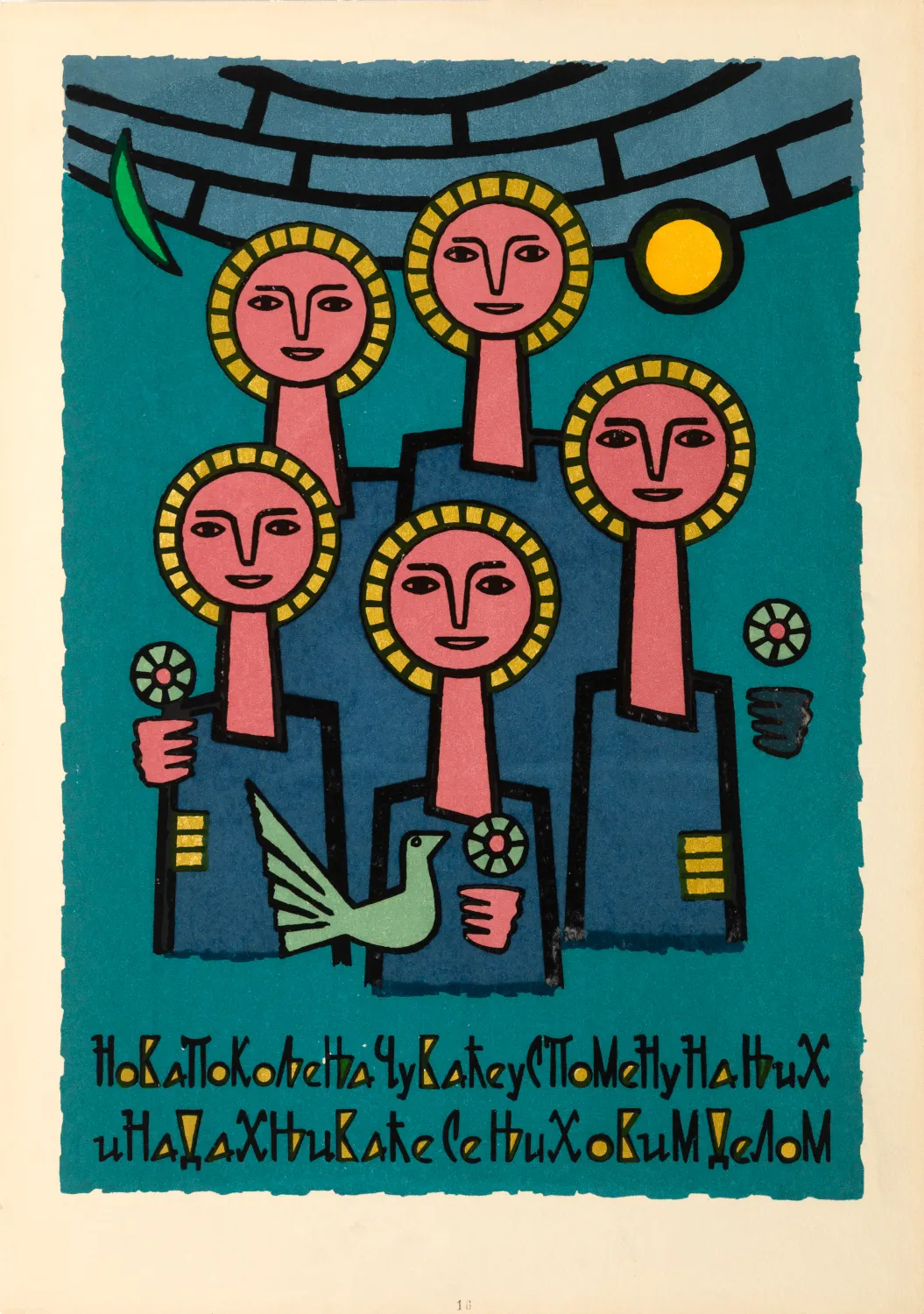
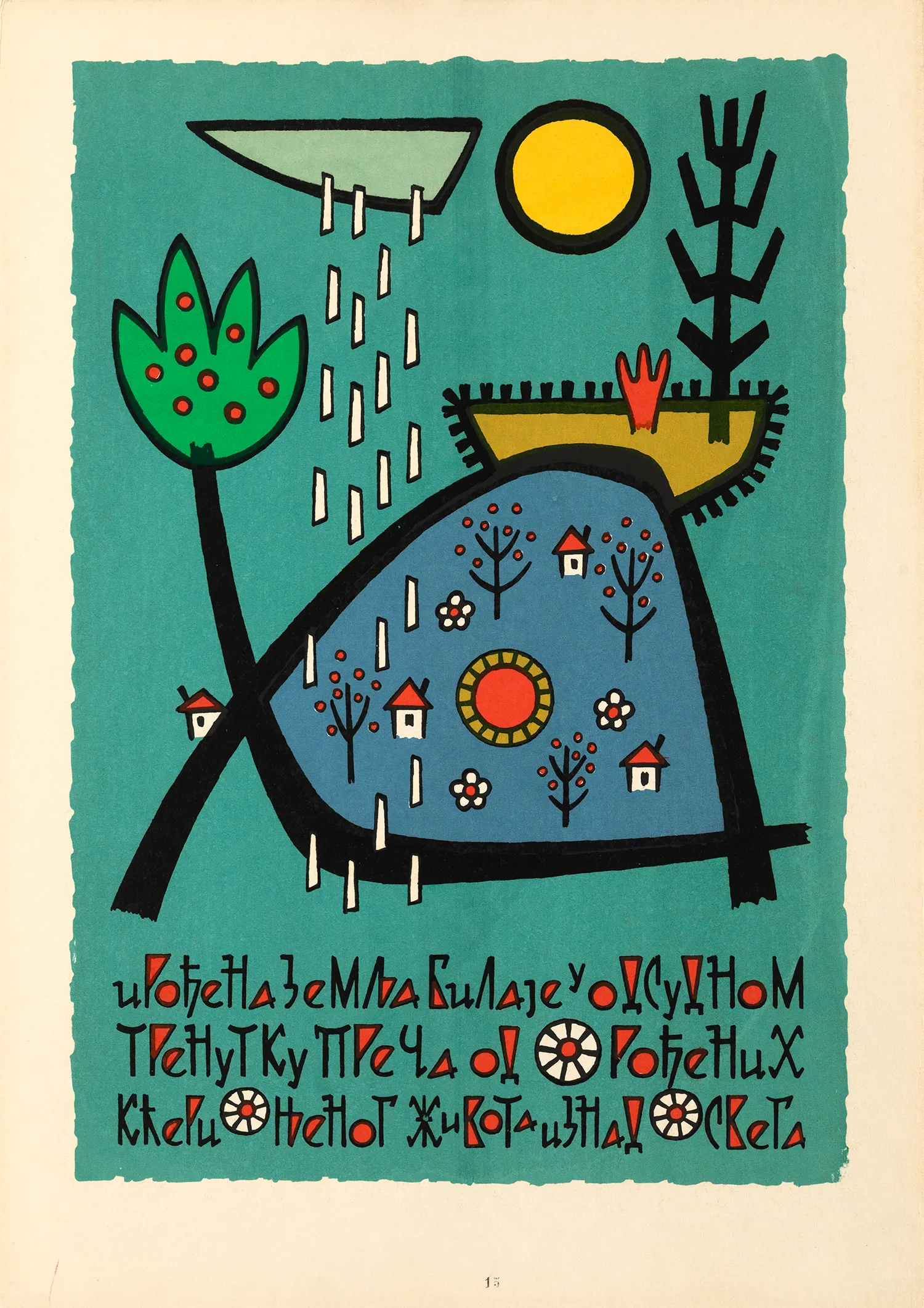
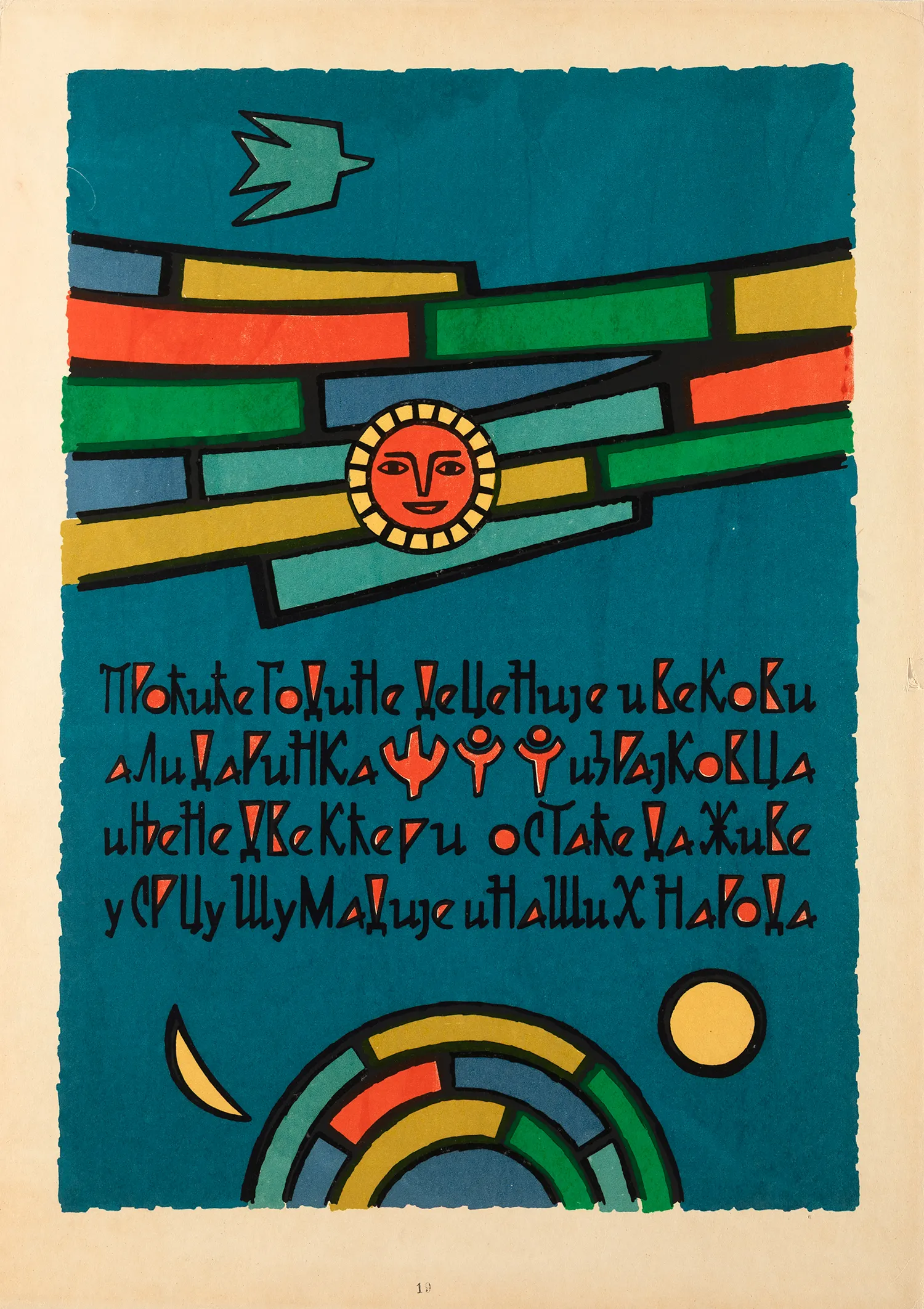
From the mid-1960s, the critical climate shifted decisively against him. The rise of conceptual art had left little room for painting of his kind, and he found himself without the support of the artistic milieu that had once celebrated him. He had built a language of extraordinary consistency and range, and watched it declared obsolete.
In 1972, twenty years after his first exhibition, Vujaklija began removing titles from his paintings, stating that he no longer wished to name them. It was a deliberate act: by stripping the work of language, he was insisting on the autonomy of the image, on its capacity to mean without being directed. The nameless paintings he offered to the world that year, as protest and as longing, gave the retrospective its title.
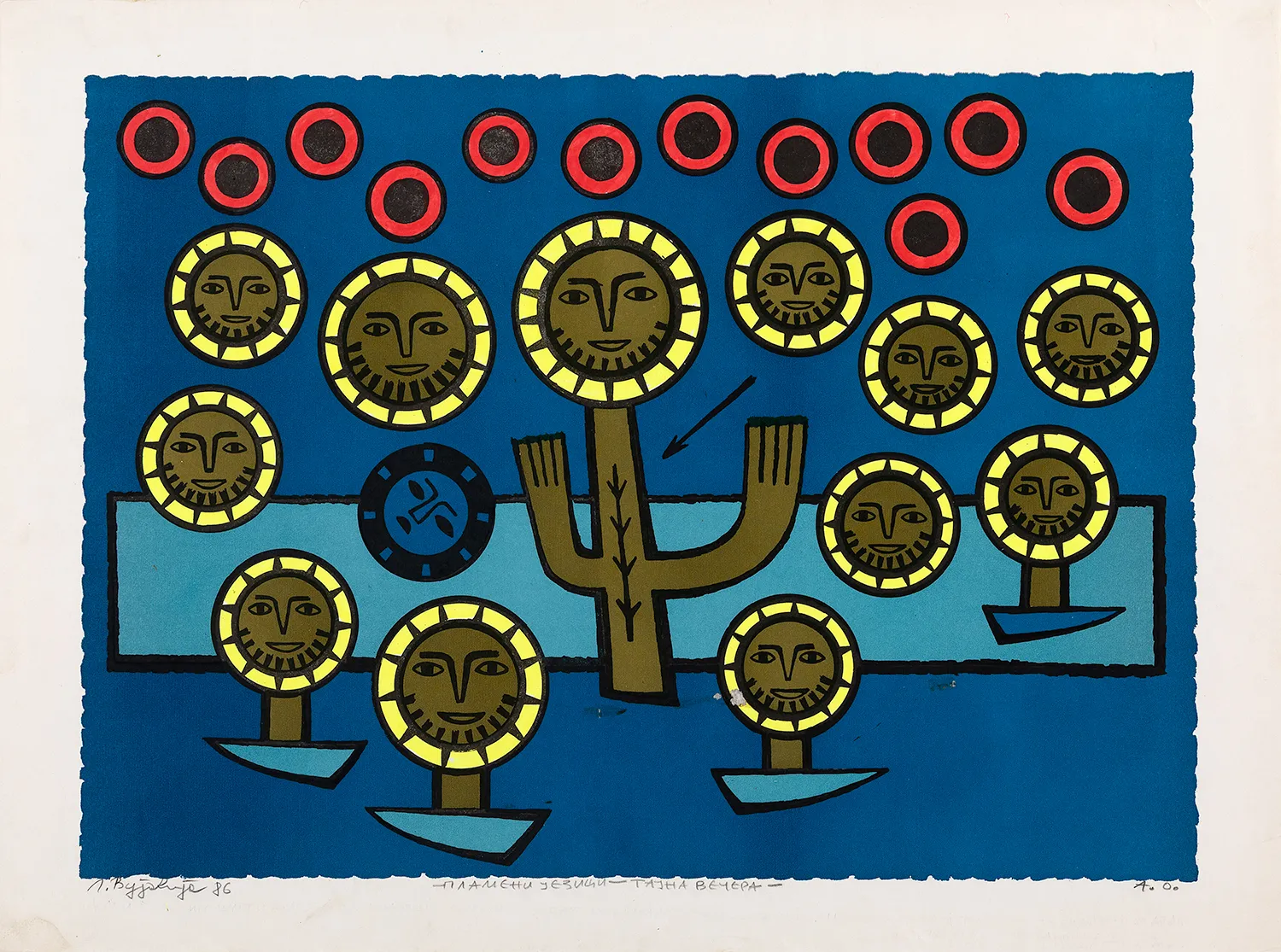
In 1980, he submerged two bronze busts bearing his likeness, made by his friend the sculptor Sava Sandić, in the Danube at their confluence with the Sava, saying he hoped archaeologists would find them one day and deliver a final verdict. That same year, he withdrew a bequest of 163 works that he and his wife Josipa had donated to the City of Belgrade. In 1985, he organized what he called his last solo exhibition, at the ULUS Gallery in Belgrade, staging a kind of death of the author.
Vujaklija's protest was directed as much inward as outward. He was an artist who refused to let his work settle into habit or formula, who kept questioning his own practice even as the critical consensus turned against him. When he submerged his own image in the Danube and invited archaeologists to find it one day, he was imagining a future reckoning. His paintings meanwhile continued to hang in federal buildings and public spaces across the country, seen by thousands of people daily. The retrospective now traveling could be that reckoning: the first time his work has been gathered and examined in full, thirty years after his death.
The exhibition Lazar Vujaklija: A Protest Within debuted at the Museum of Naïve and Marginal Art in Jagodina and will be on view at the Museum of Contemporary Art of Republika Srpska in Banja Luka by September 3, 2026. The exhibition was realised in collaboration with ten museums and cultural institutions and is accompanied by a richly illustrated monograph featuring critical essays by Dr Ivana Bašičević Antić, Dr Branislav Dimitrijević, and Danica Đorđević Janković.