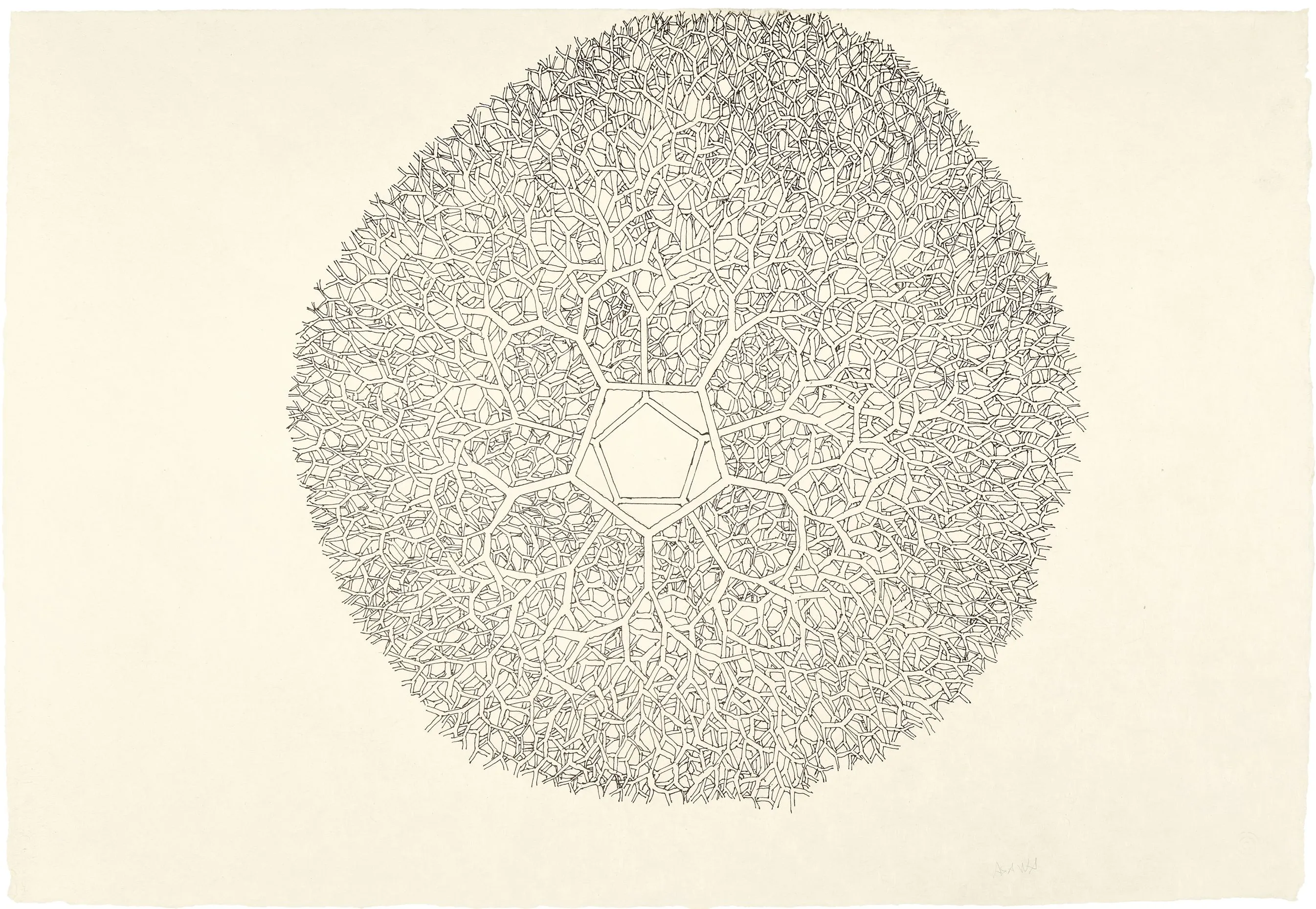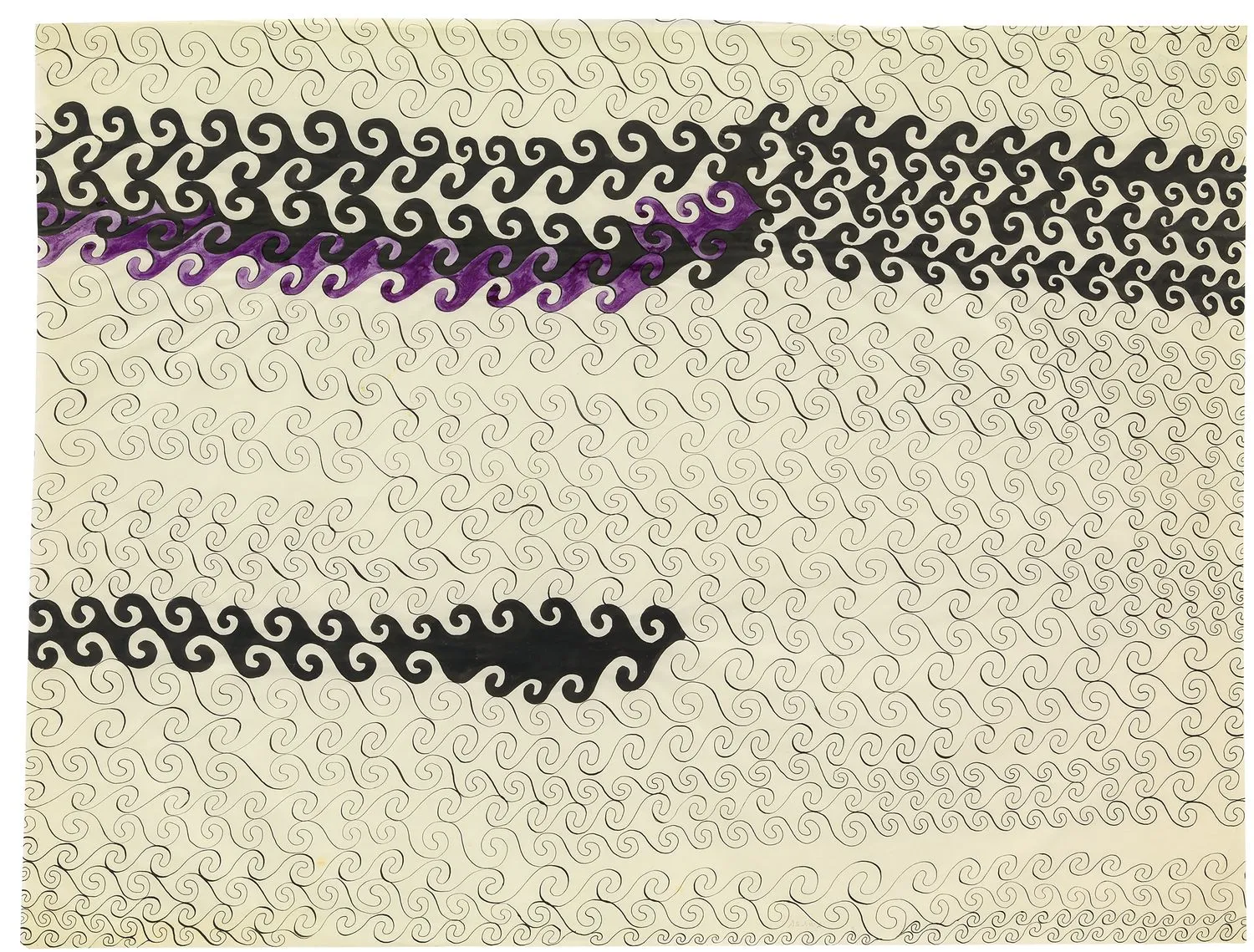

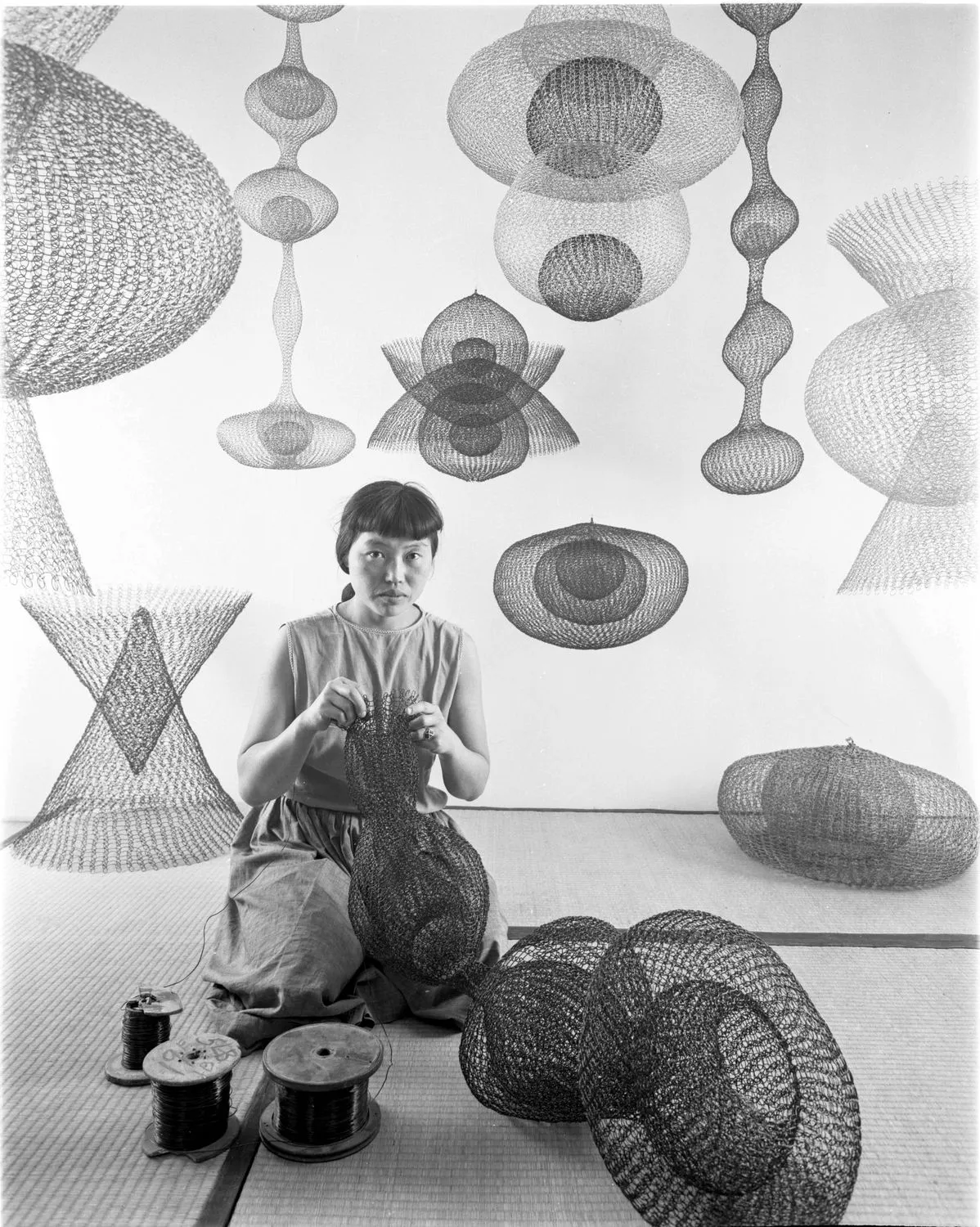
 Artist Ruth Asawa making wire sculptures, California, United States, November 1954. Image: Nat Farbman/The LIFE Picture Collection/Shutterstock. Artwork: © 2026 Ruth Asawa Lanier, Inc., courtesy David Zwirner
 "An artist is not special," Ruth Asawa once said. "An artist is an ordinary person who can take ordinary things and make them special." Few artists embodied that belief as completely as Asawa, whose hand-looped wire sculptures transformed humble industrial materials into some of the most original forms of postwar modernism. At a time when sculpture was defined by mass and monumentality, she offered something entirely different: airy, handmade, intimate work that collapsed the boundary between crafts and fine art. For Asawa, art was never separate from life, but intertwined with raising a family, teaching, and her broader community. As a Japanese American artist who had endured wartime incarceration, she overcame discrimination and exclusion to build one of the most expansive and radical practices of the twentieth century on her own terms.
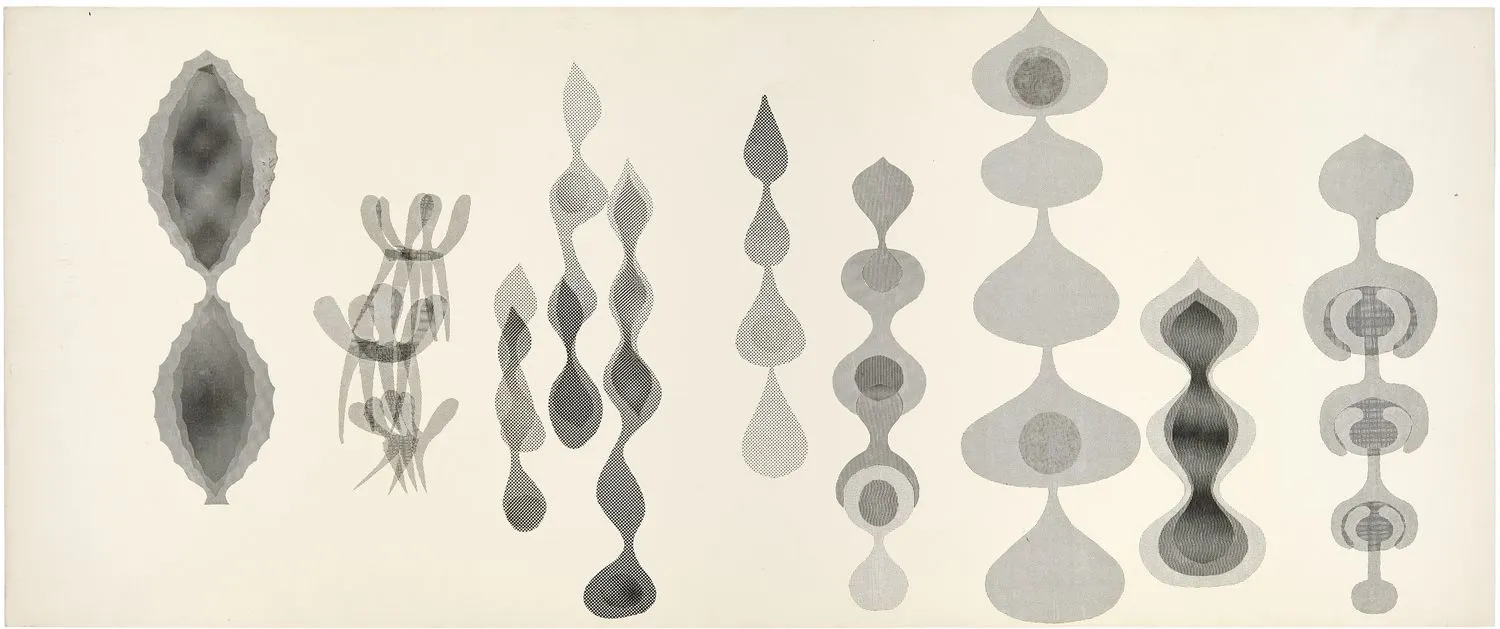
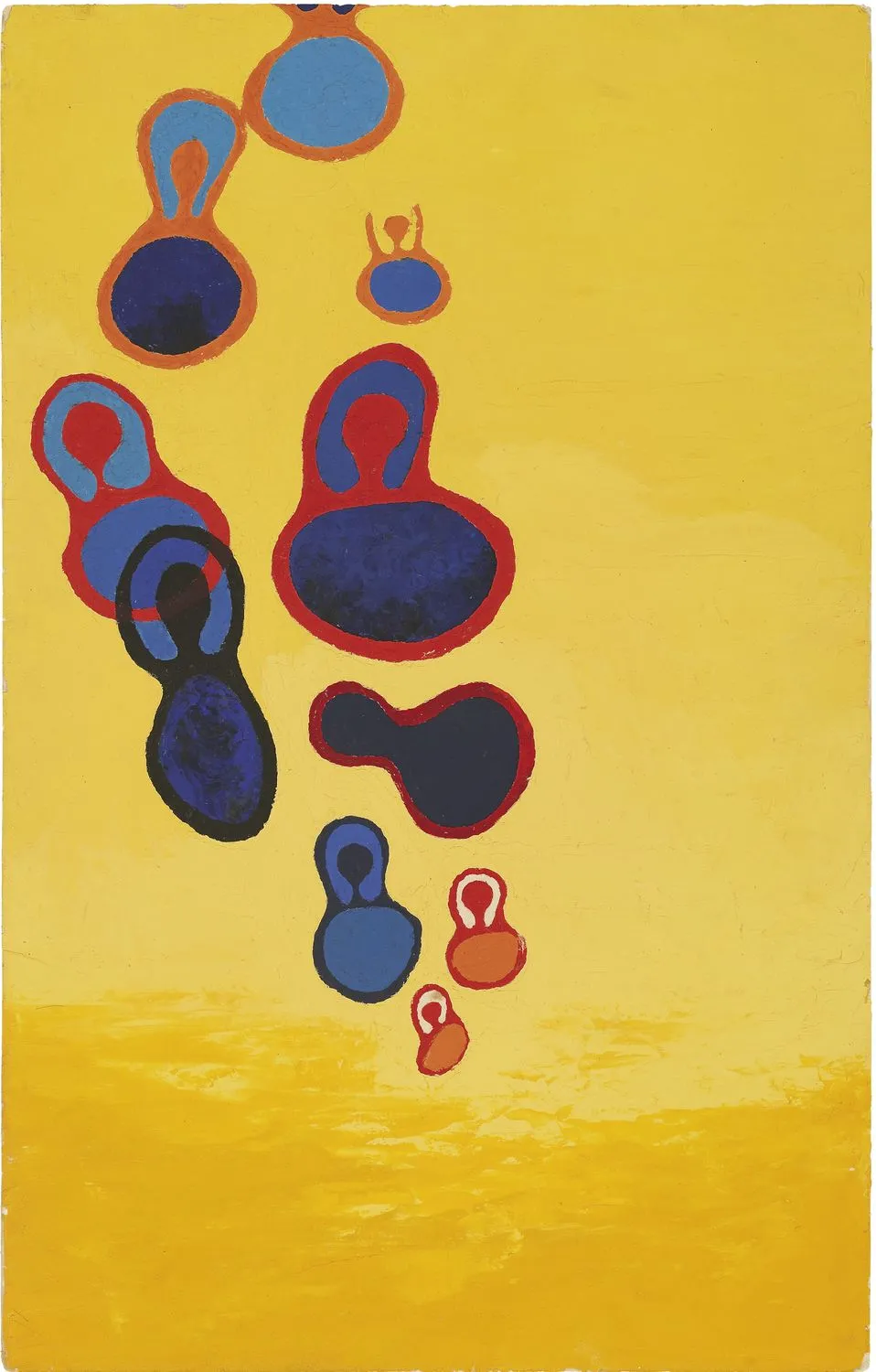
Asawa died in 2013, and it is only in the years since that her work has begun to receive the recognition it deserves. Organised with SFMOMA and MoMA, Ruth Asawa: Retrospective—the first full-scale retrospective of her practice and the most comprehensive overview of it to date—arrives at the Guggenheim Bilbao in the centenary year of her birth. Spanning ten sections and some 250 works across six decades, it foregrounds her wire sculptures while situating them within a broader practice that encompassed printmaking, drawing, clay, bronze and public commissions. At the same time, it constructs a portrait of an artist for whom art and life were continuously feeding into each other.
Born in 1926 in Norwalk, California to Japanese immigrant farmers, Asawa grew up between field work and close observation of the natural world. During World War II, she and her family were incarcerated in U.S. internment camps, an experience that marked her deeply and made the path ahead considerably harder. Unable to pursue a conventional teaching degree because of anti-Japanese prejudice, she enrolled at Black Mountain College in North Carolina in 1946, a radical experimental school where boundaries between disciplines were deliberately dissolved. There she studied with Josef Albers, a former Bauhaus master who became her most important mentor and lifelong friend, and from whom she learned, as she later put it, "how to see."
It was at Black Mountain that she developed a philosophy of making that would stay with her for life: that any material held potential, that art making was a continuous process of experimentation inseparable from living. A formative turning point came during a trip to Mexico, where, at a market in Toluca, she encountered wire baskets made in a continuous looping technique, typically used to carry eggs to market without breaking them. Bringing the technique back to Black Mountain, she began looping wire into continuous forms and closing the open vessel form into something entirely new: what she would later describe as a shape that was inside and outside at the same time.
These sculptures are made of a continuous wire... enclosing volumes transparently... and producing forms within forms... The wire must be continuous and the hollow shapes can only be shapes that grow this way.—Ruth Asawa
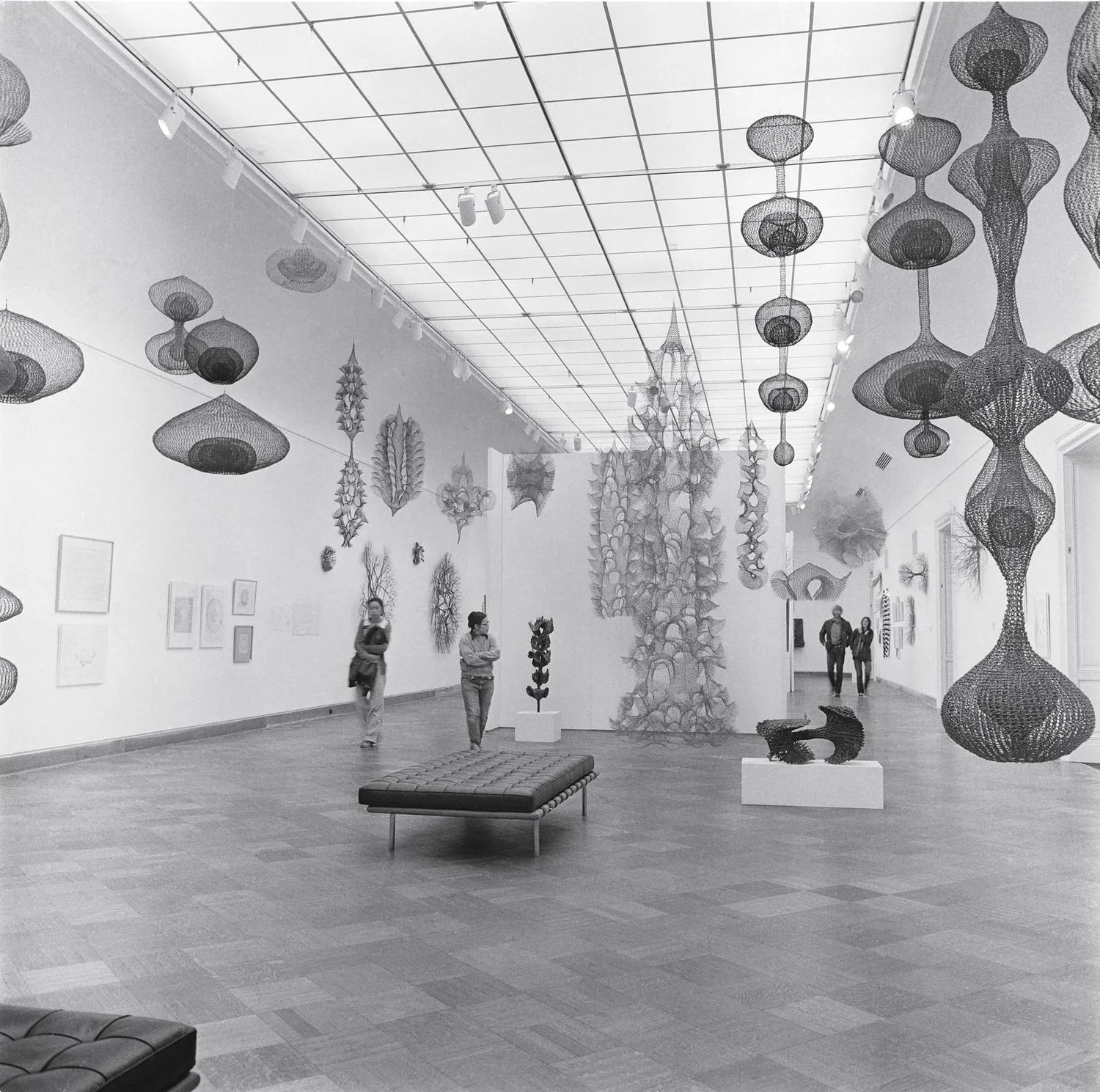
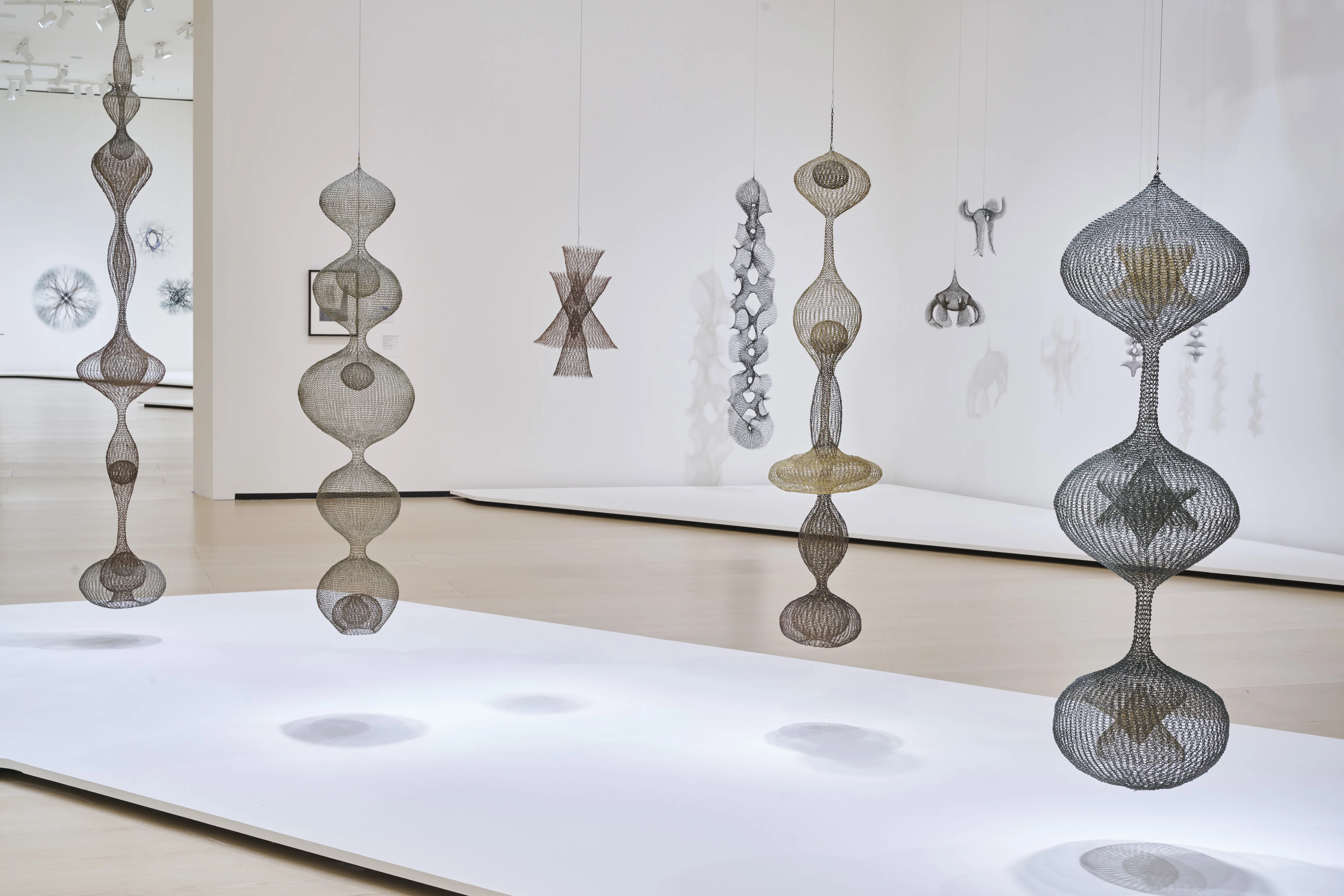
In the galleries at the Guggenheim Bilbao, the looped wire sculptures occupy several rooms, suspended from near-invisible threads. The forms are hard to categorise: elongated columns of spheres that swell and narrow, nested volumes that contain further volumes, surfaces that are simultaneously closed and permeable. Their shadows fall on the white platforms below in near-perfect circles, extending the sculptures into the space around them. Asawa described wanting to make sculpture whose form, silhouette and shadow would each have volume. "You can show inside and outside, and inside and outside are connected," she said. "Everything is connected, continuous."
The sculptures invite you to move around and see them from different angles, at different distances—they shift and change, with shadows functioning as secondary sculptures and space being as integral to the work as the wire itself. What she called a "continuous form within a form"—a single uninterrupted surface that is inside and outside at once—became her signature motif, one that persisted across media and decades, and the clearest expression of a practice built on the idea that everything is connected.
I am able to take a wire line and go into the air and define air without stealing it from anyone. A line can enclose and define space while letting the air remain air.— Ruth Asawa
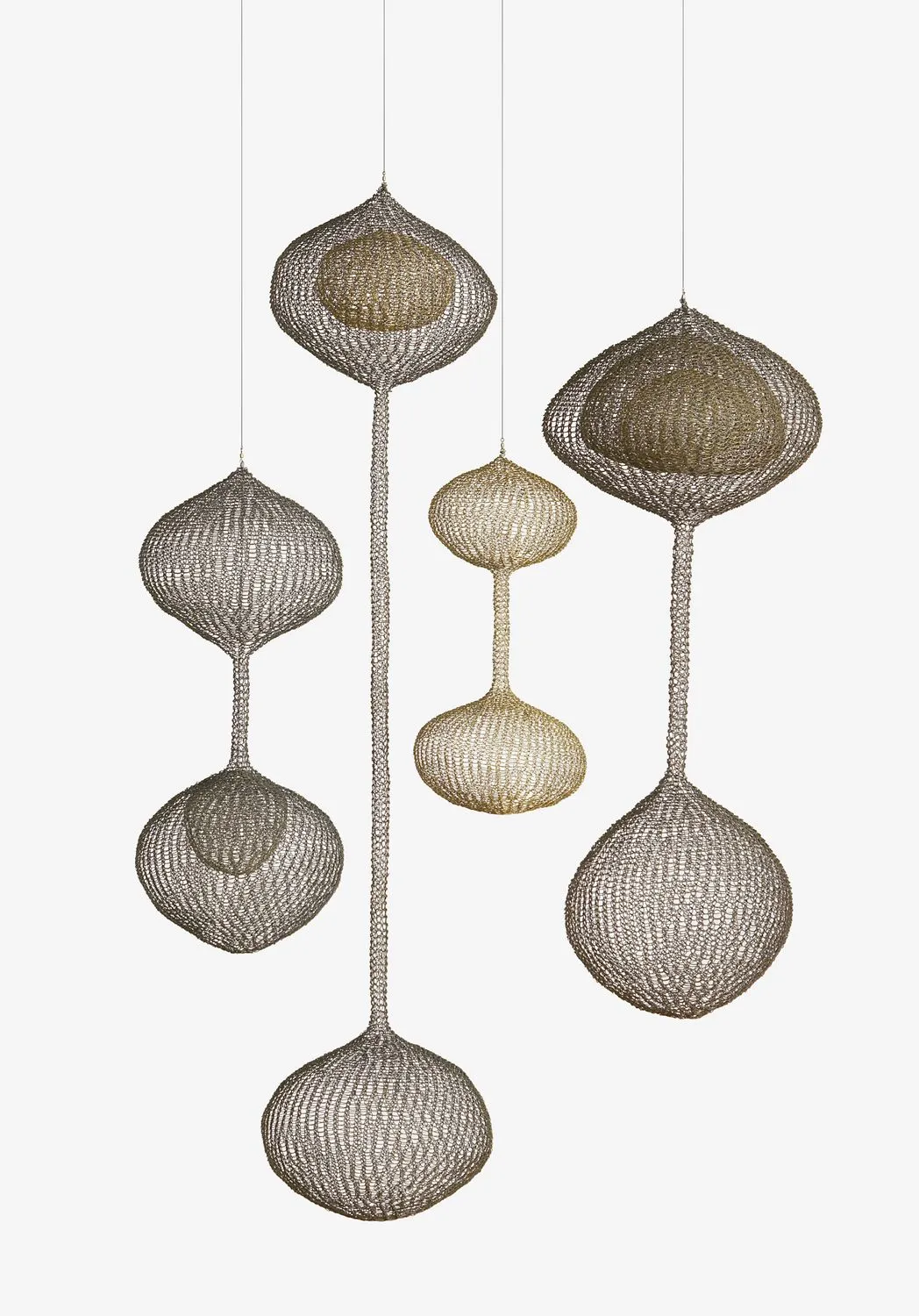
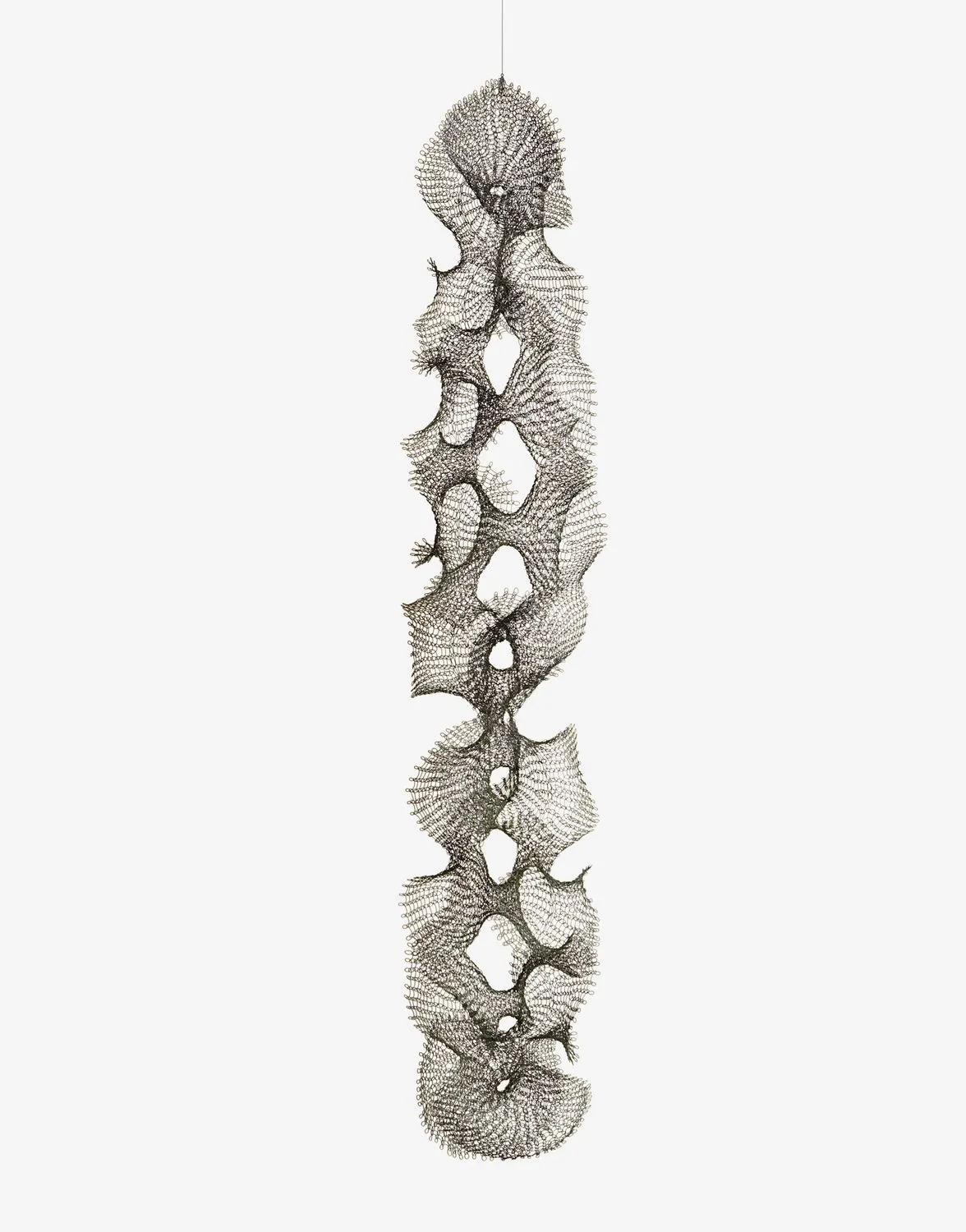
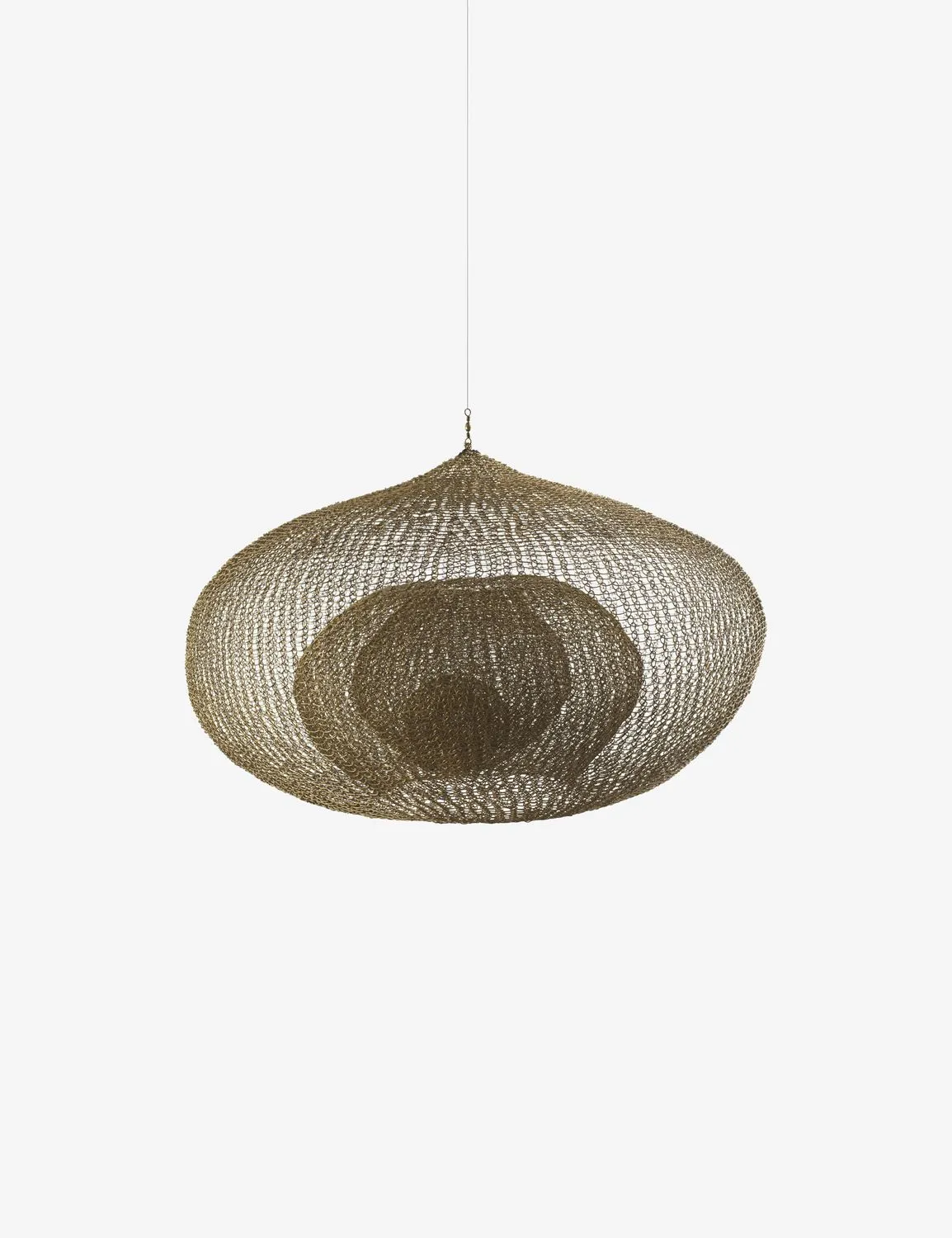
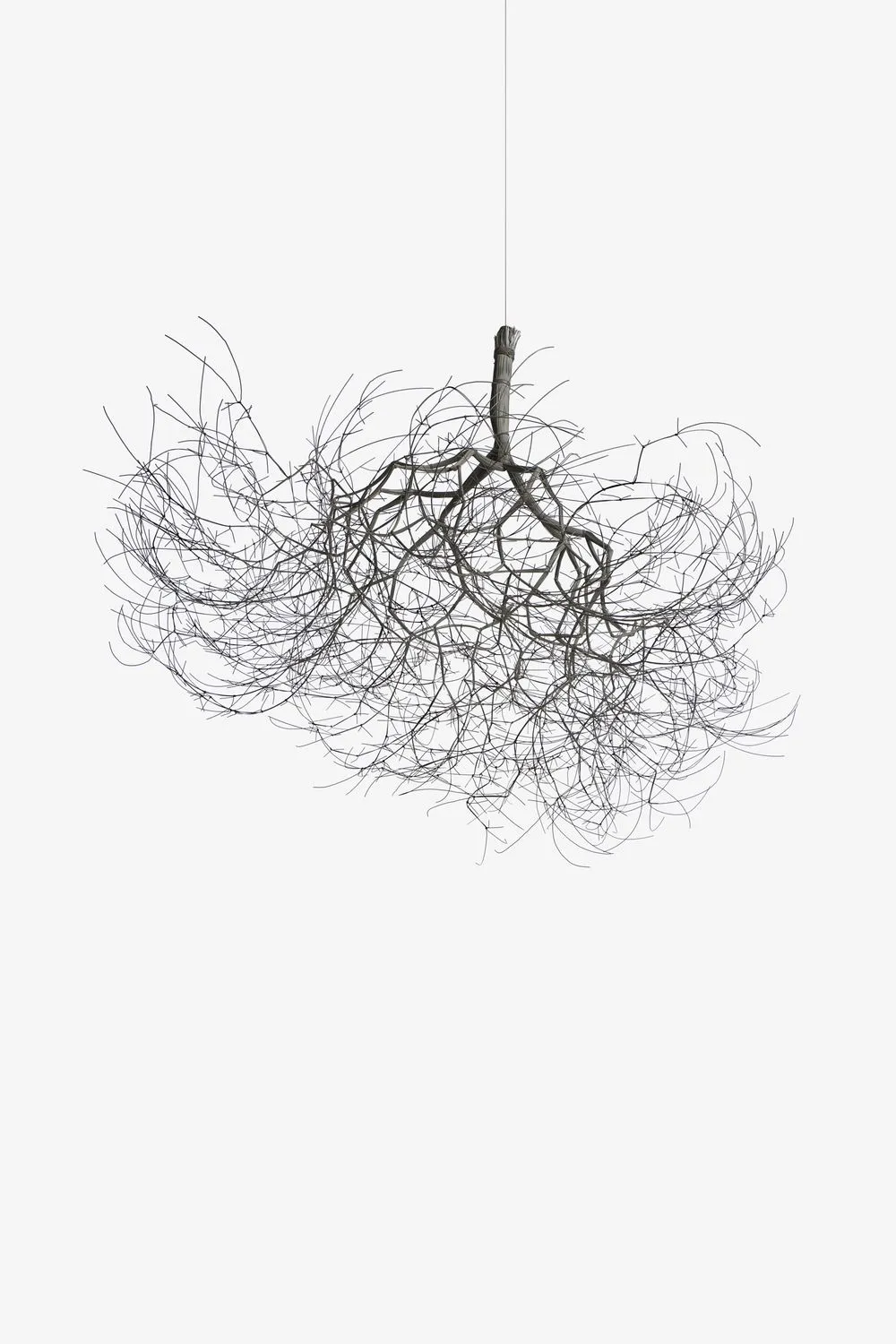
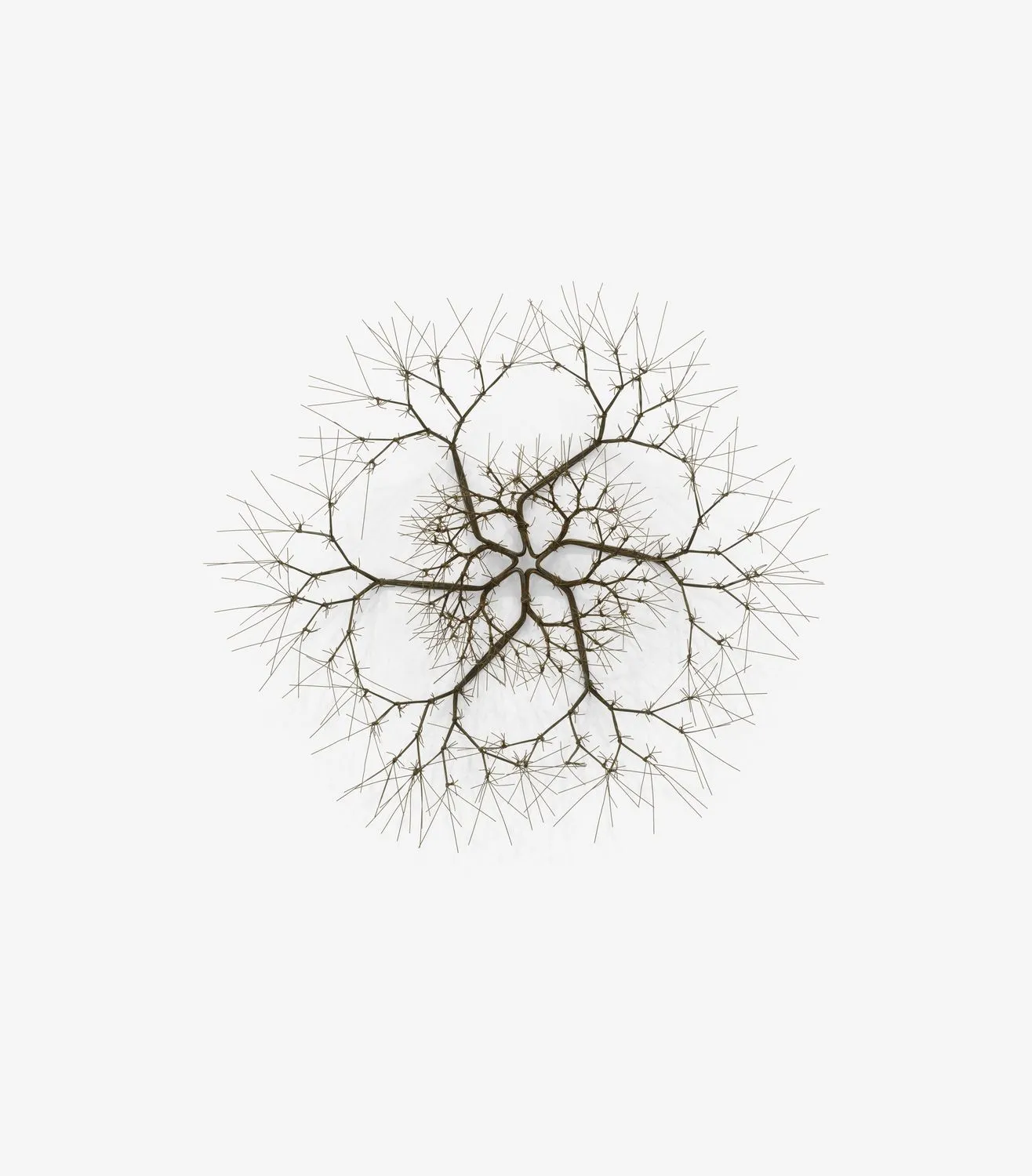
Later in the exhibition, the tied-wire works introduce a different register. Where the looped sculptures are symmetrical and abstract, these are organic and branching, closer in spirit to the natural world Asawa had observed since childhood. The shift came in 1962, when a friend gave her a dried desert plant from Death Valley. She tried to draw it and found it impossible, so she turned to wire instead, working with bundles and spools into complex botanical forms. The two bodies of work look different but share the same logic of natural growth: a continuous material worked outward from a centre, following what Asawa called "what the wire dictates." Seen together, what might look like a shift in direction reveals itself as a deepening of the same inquiry.
Nature is my teacher, and I have used materials that are a product of our twentieth century to study her growth patterns.—Ruth Asawa
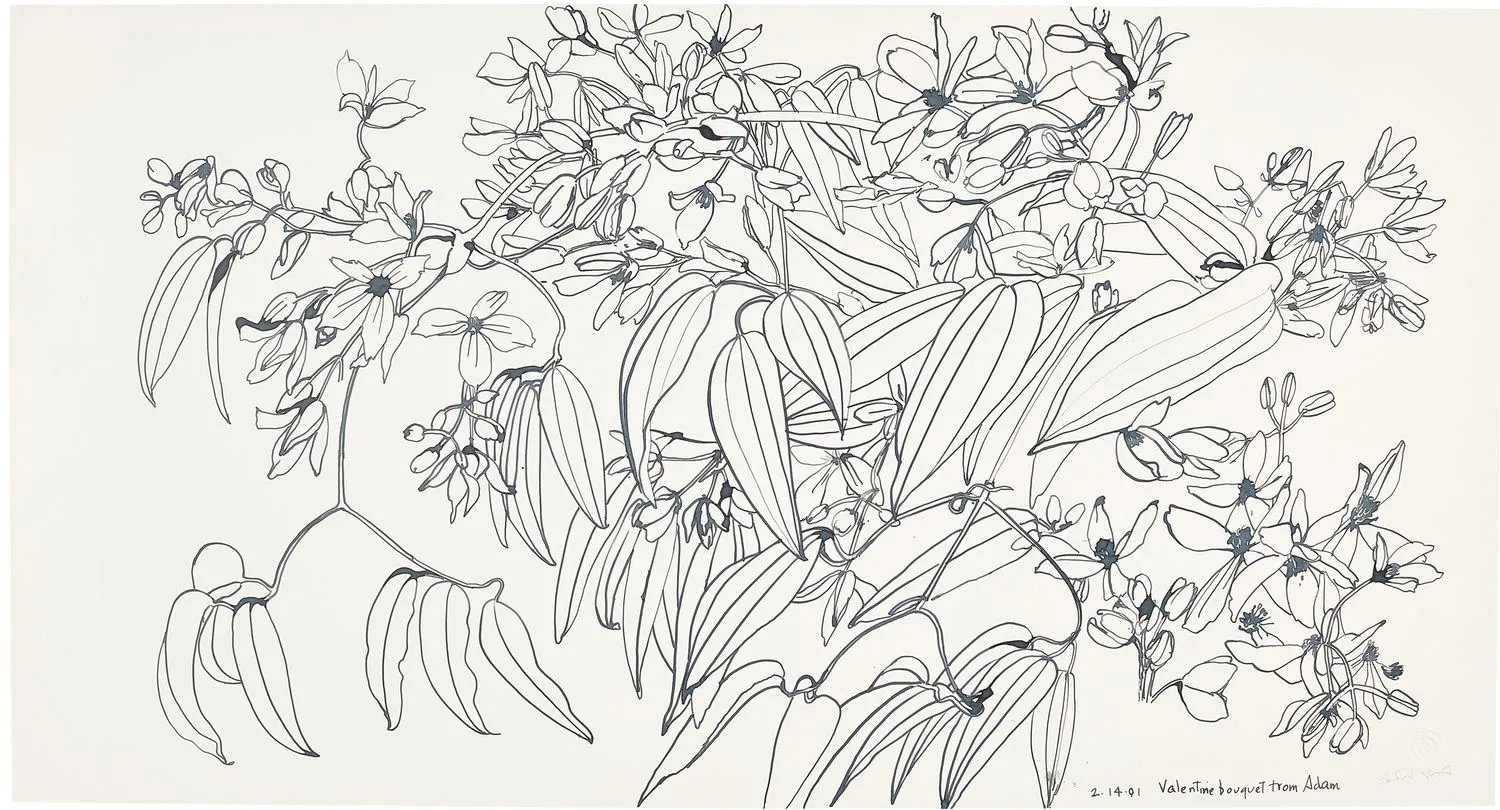
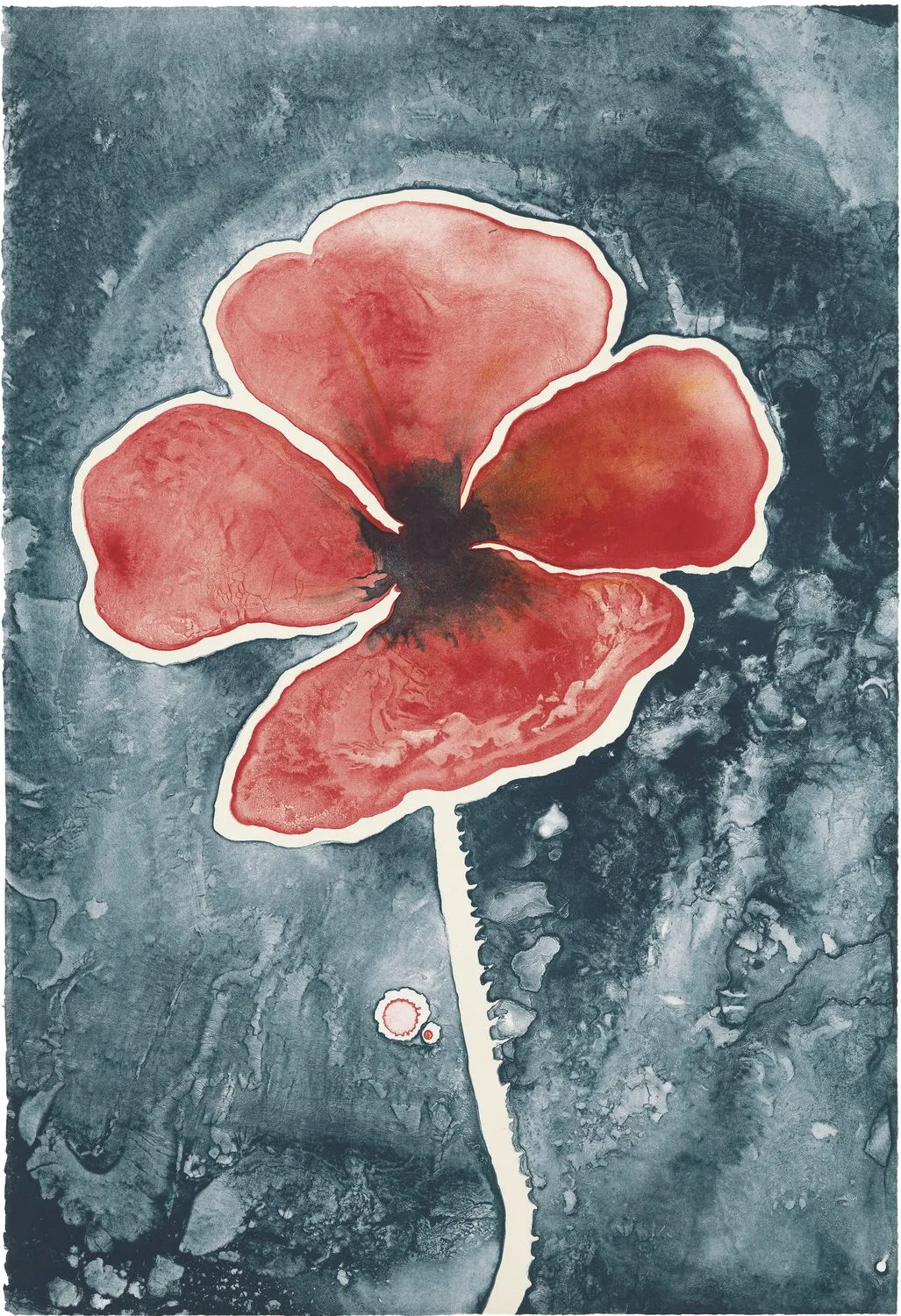
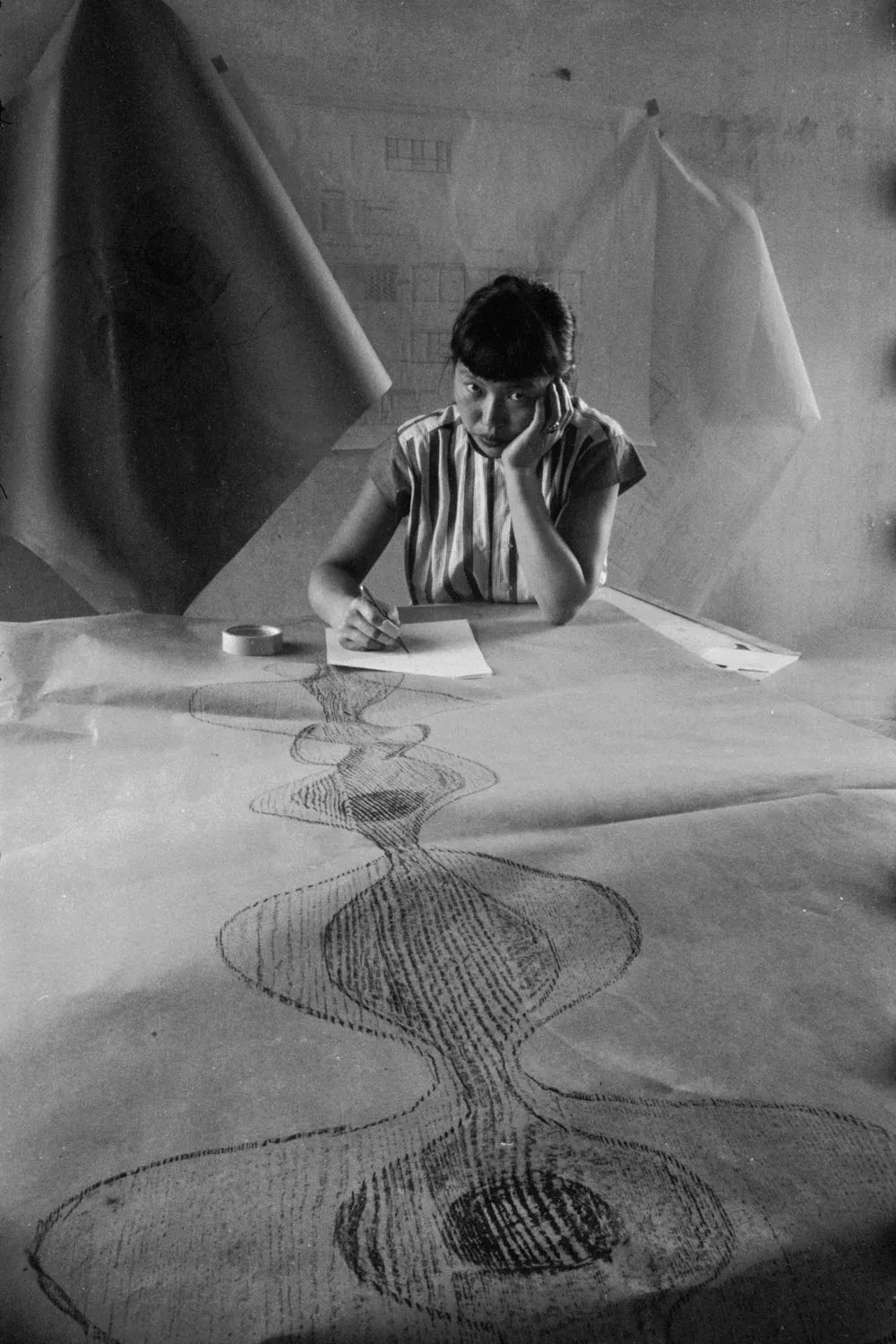
Asawa's attentiveness to the natural world runs through her practice, as well as the retrospective, like a thread. In 1965, a residency at the Tamarind Lithography Workshop in Los Angeles produced 54 experimental prints, among them the Poppy, a virtuoso depiction of California's state flower. In the last decades of her life, following a lupus diagnosis in 1985 that significantly reduced her physical capacity, drawing became her primary medium. Working in ink on paper, without preliminary sketching, she recorded the flowers growing in her Noe Valley garden—irises, hydrangeas, chrysanthemums—given to her by friends and family. Her husband, Albert, tended the garden and made bouquets; drawing one was her way of really spending time with it, of absorbing the love behind the gift. She drew plants at every stage—budding, in full bloom, petals beginning to fall—and typically started in the middle of the composition and worked outward, the same logic as the wire sculptures made decades earlier.
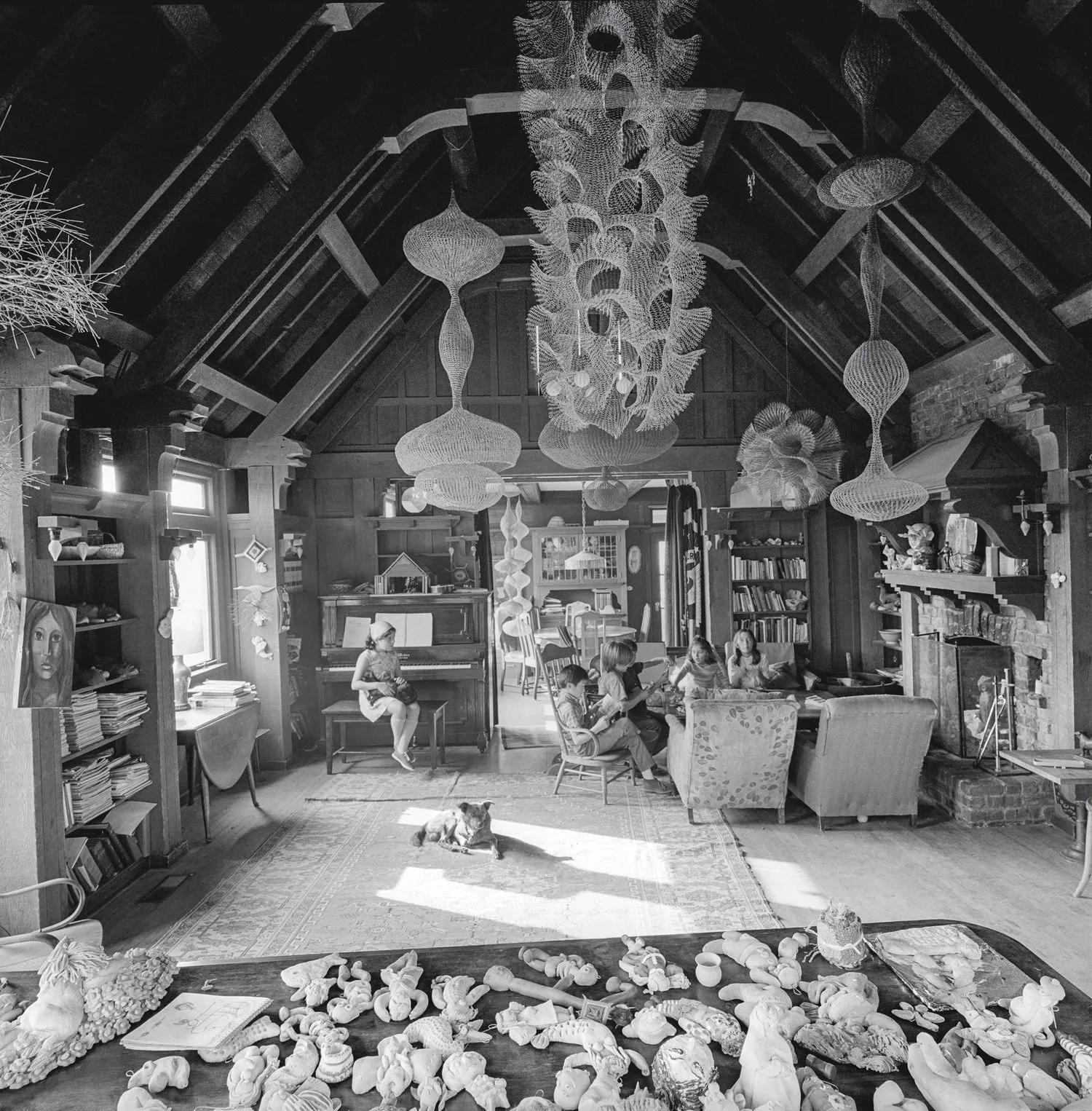
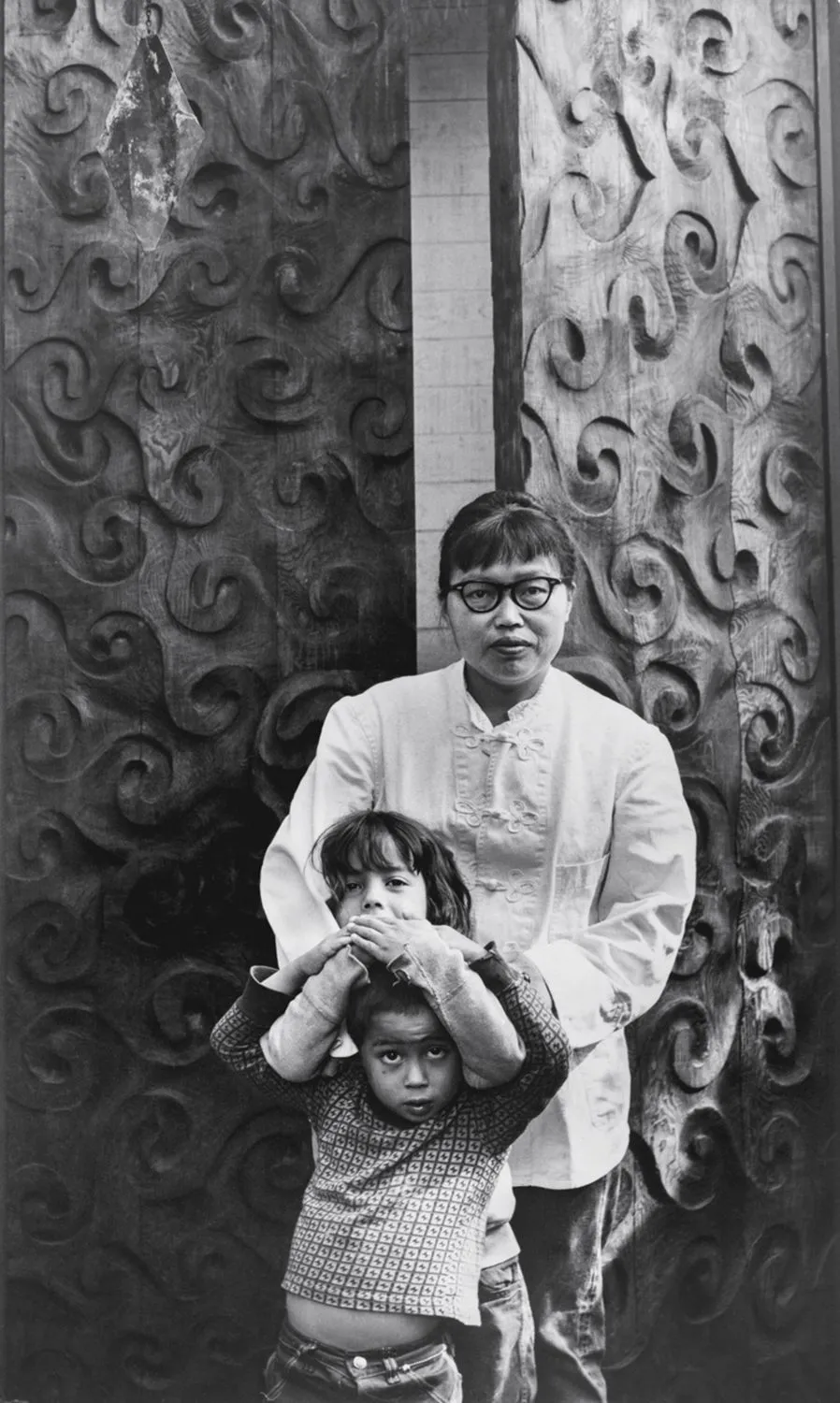
"My home was and is my studio," Asawa would say. The Noe Valley house she and Albert Lanier moved into in 1961 was renovated to accommodate both family and practice: Lanier excavated the basement to create a workshop, while Asawa designed the monumental front doors herself. But she rarely worked downstairs. She preferred the main living space, a cathedral-ceilinged room with south-facing windows, working there amid the household rather than in the studio below. Her wire sculptures hung from the overhead beams and there was always something in progress—wire being coiled, paper being folded, a sketchbook open on the table. If a child needed her attention, she would hand them a dowel and a spool of wire and carry on working. "I've always had my studio in the house," she said, "because I wanted my children to understand what I do and I wanted to be there if they needed me."
Between 1966 and 2000, she cast hundreds of face masks of friends, family and colleagues—a growing index of everyone who passed through the house. A selection of these face masks are on view in a separate room, alongside the actual carved redwood doors Asawa designed for the house's entrance. The rest of the room brings together works from across her career alongside works by her lifelong friends—among them Josef Albers—ephemera and archival documents, anchored by a large photograph of the Noe Valley living room installed directly on the wall.
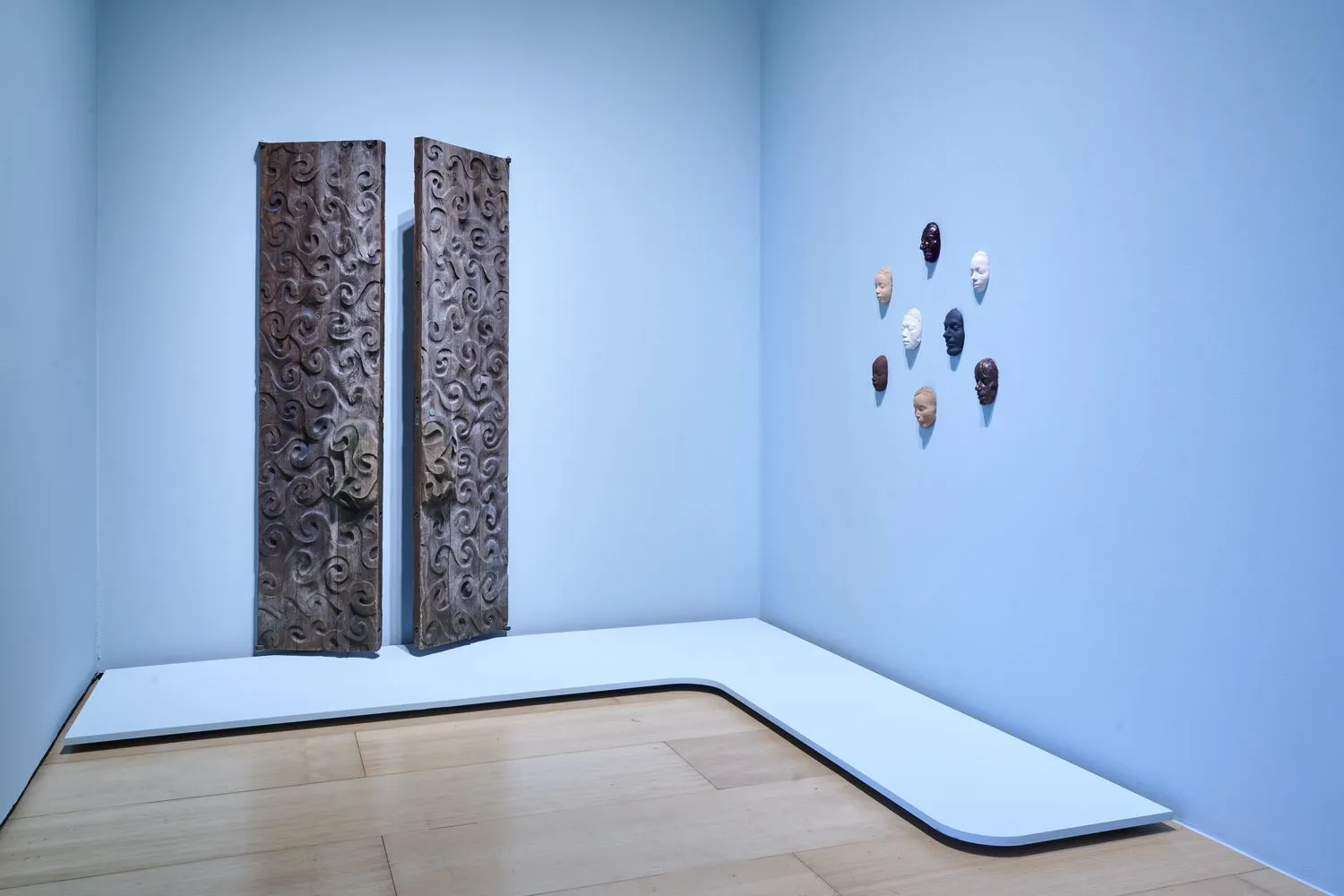
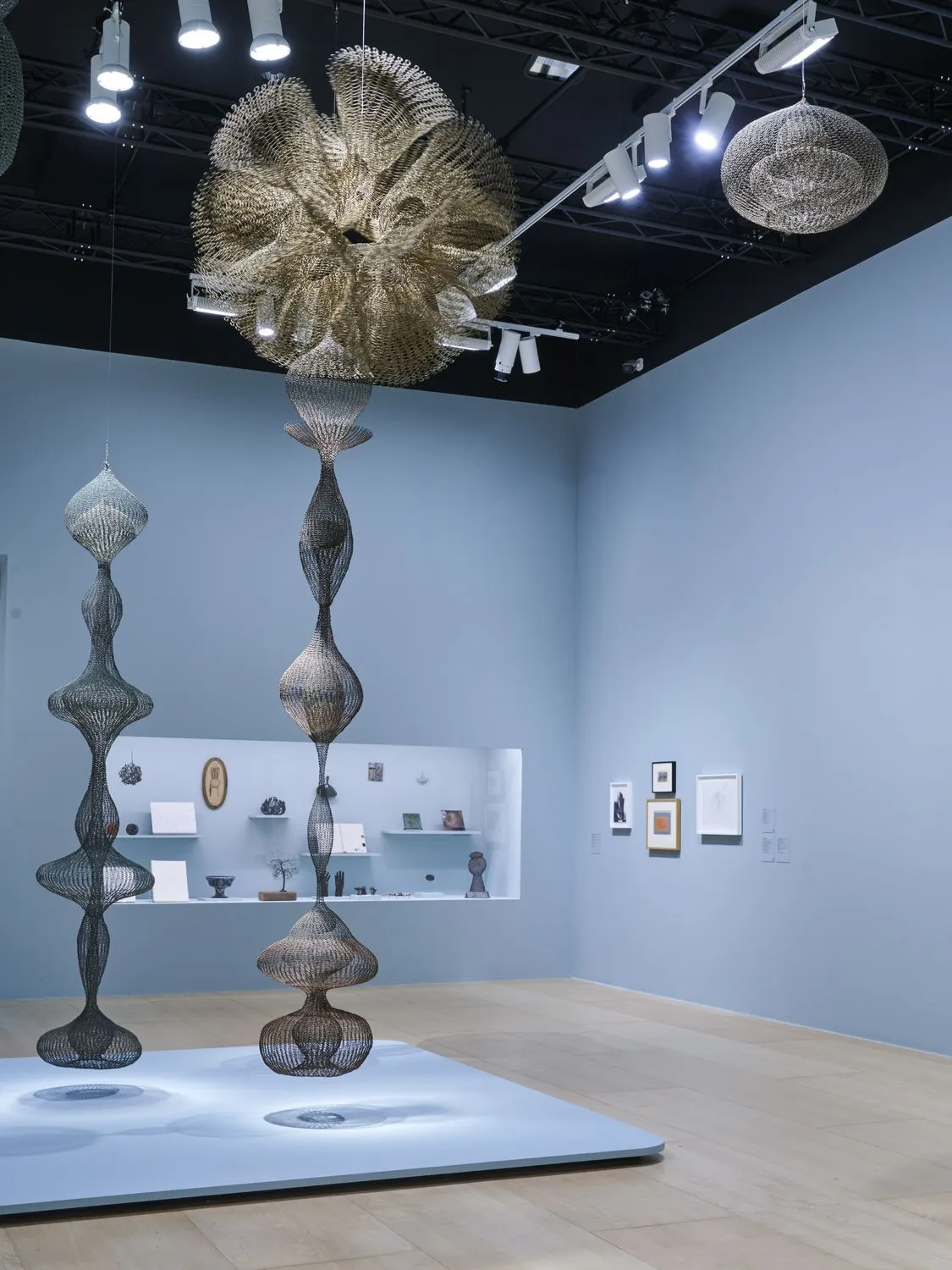
Asawa's commitment to her community extended well beyond her home. In 1968, dissatisfied with the arts curriculum at her children's school, she helped develop a grassroots programme that brought practising artists into classrooms, using materials as simple and accessible as baker's clay—something she had originally invented to keep her own children busy on rainy days. Within five years, the programme had spread across seventy San Francisco public schools. She also served on the San Francisco Arts Commission, the California Arts Council and the National Endowment for the Arts, advocating for art's place in public life at every level. When asked late in life what she was most proud of, she said her work in schools.
My need to be an artist does not exceed my desire to be a parent, and also part of a community.—Ruth Asawa
Her public commissions grew from the same ethos. Beginning with the bronze fountain Andrea at Ghirardelli Square in 1968, she created a series of works permanently embedded in San Francisco's landscape, many of them made collaboratively with community members—children and adults alike contributing to their making. In 1994, she completed the Japanese American Internment Memorial in San José, created with her son Paul Lanier, a monumental bronze narrative that addressed her own history of incarceration directly and publicly, half a century later. These works, as she put it, were made "to make a sculpture that could be enjoyed by everyone."
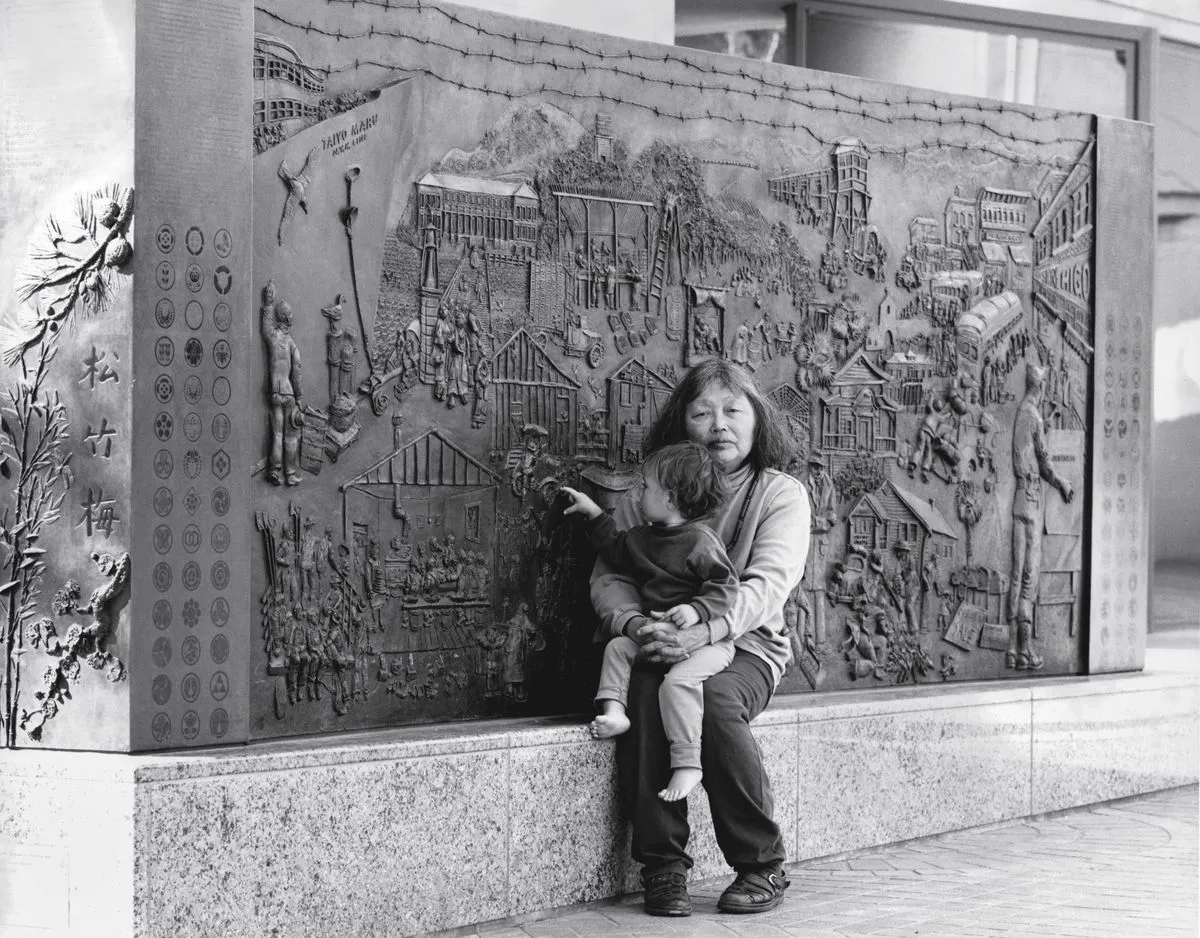
What the Guggenheim Bilbao retrospective makes clear is that Asawa redefined not just what art could look like but what it could be. It proposes continuity as its central argument—in Asawa's formal vocabulary, in her understanding of life as an interconnected whole, and in her conviction that making was inseparable from thinking. Her sculptures were called decorative and feminine handiwork, her technique dismissed as craft, her Asian heritage exoticised, and her domestic life treated as a distraction rather than a foundation of her practice—dismissals that were never neutral, but gendered and racially charged. Yet her art emerged from the conviction that making belonged to ordinary life rather than apart from it, and that creation can come from the humblest of means. Out of that conviction came one of the most expansive and daring practices of the twentieth century, operating entirely outside the structures that validated artists at the time. Arriving in the centenary year of her birth, what this retrospective reveals, above all, is an artist whose life and work were so thoroughly continuous that to understand one is to understand the other. "Life draws," she once wrote.
Ruth Asawa: Retrospective is an exhibition partnership between the San Francisco Museum of Modern Art (SFMOMA) and the Museum of Modern Art, New York (MoMA) in collaboration with the Guggenheim Museum Bilbao. It will be on view at the Guggenheim Museum Bilbao until September 13, 2026, after which it will travel to Fondation Beyeler in Riehen/Basel, Switzerland.