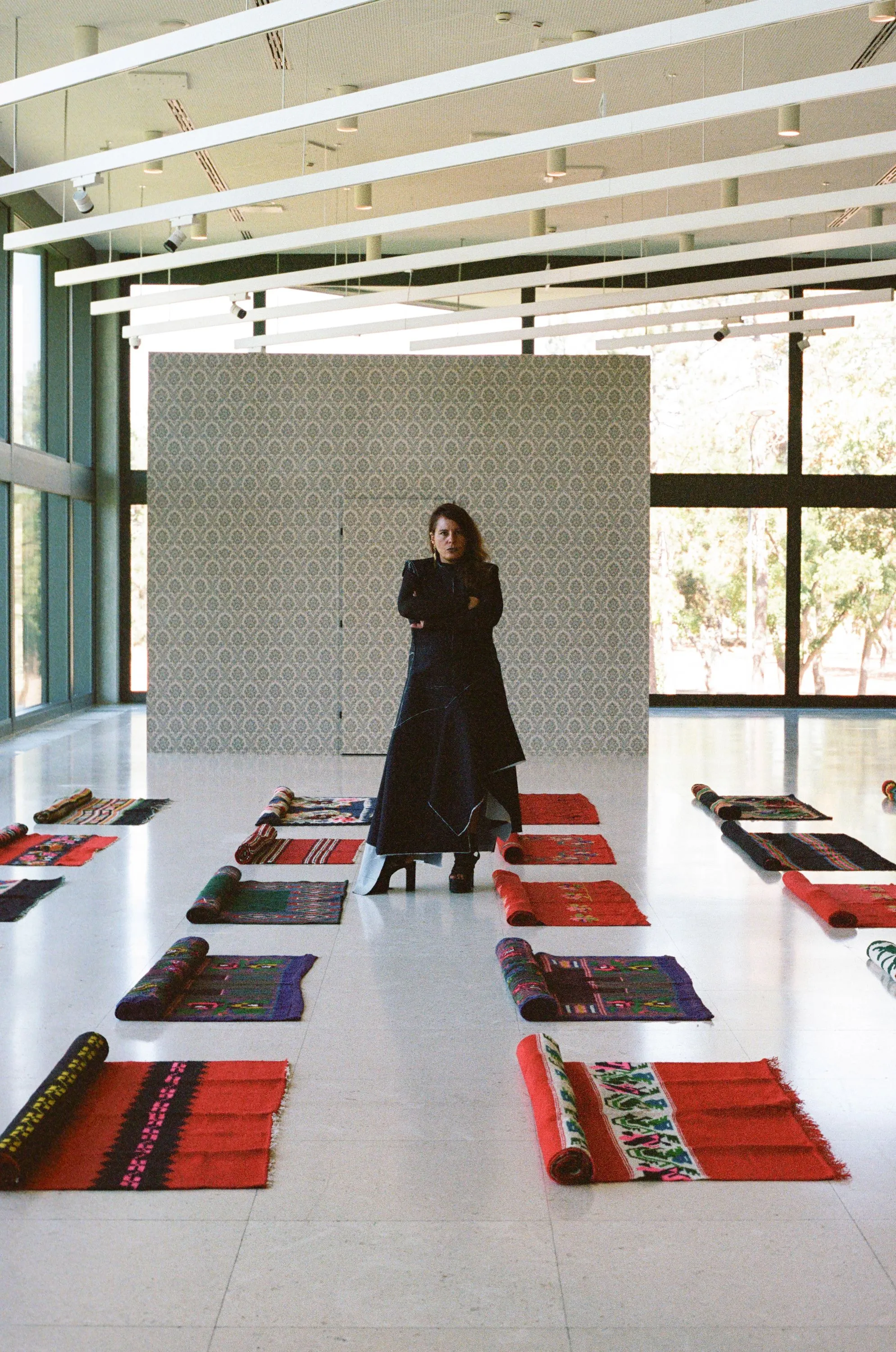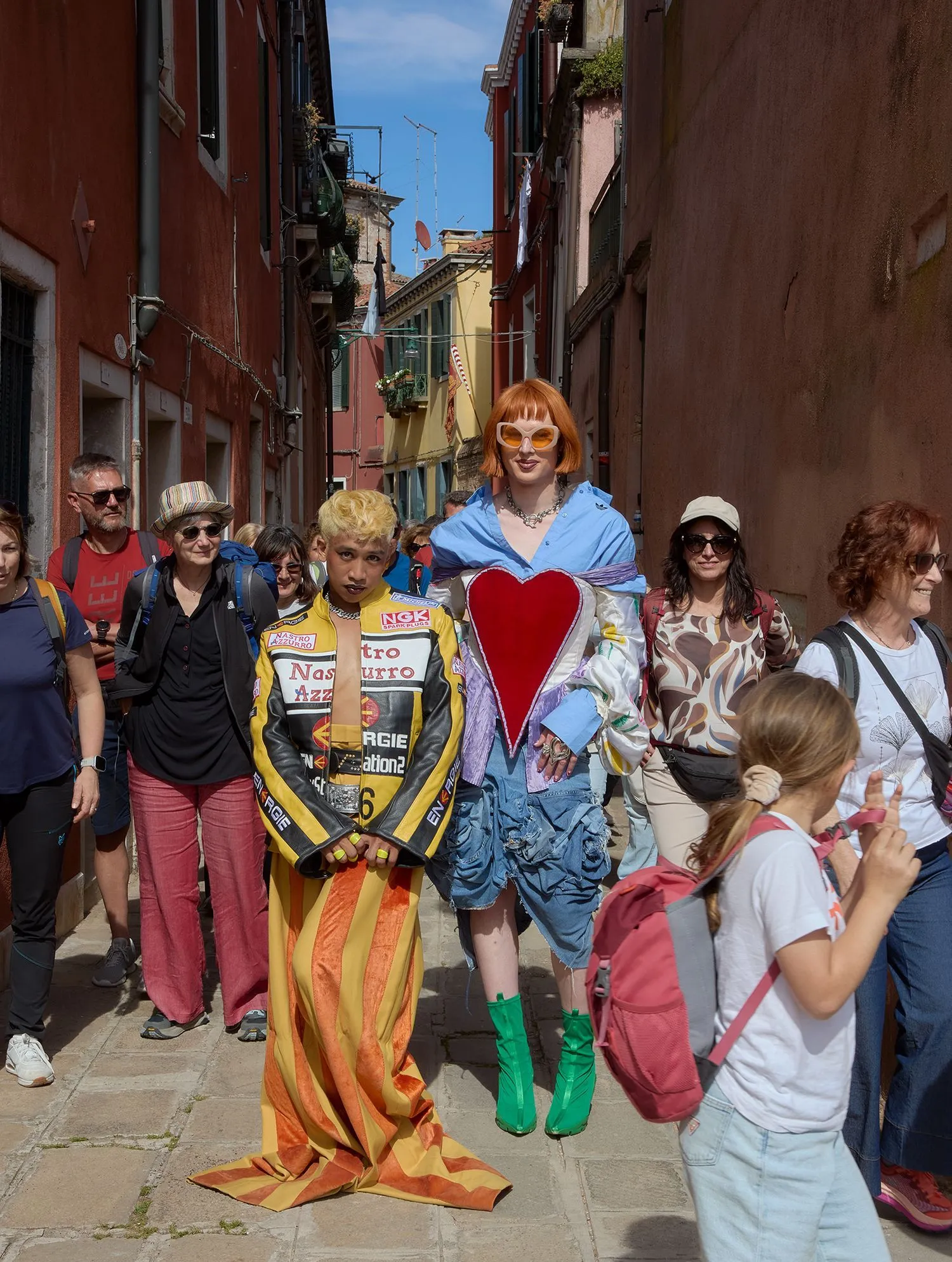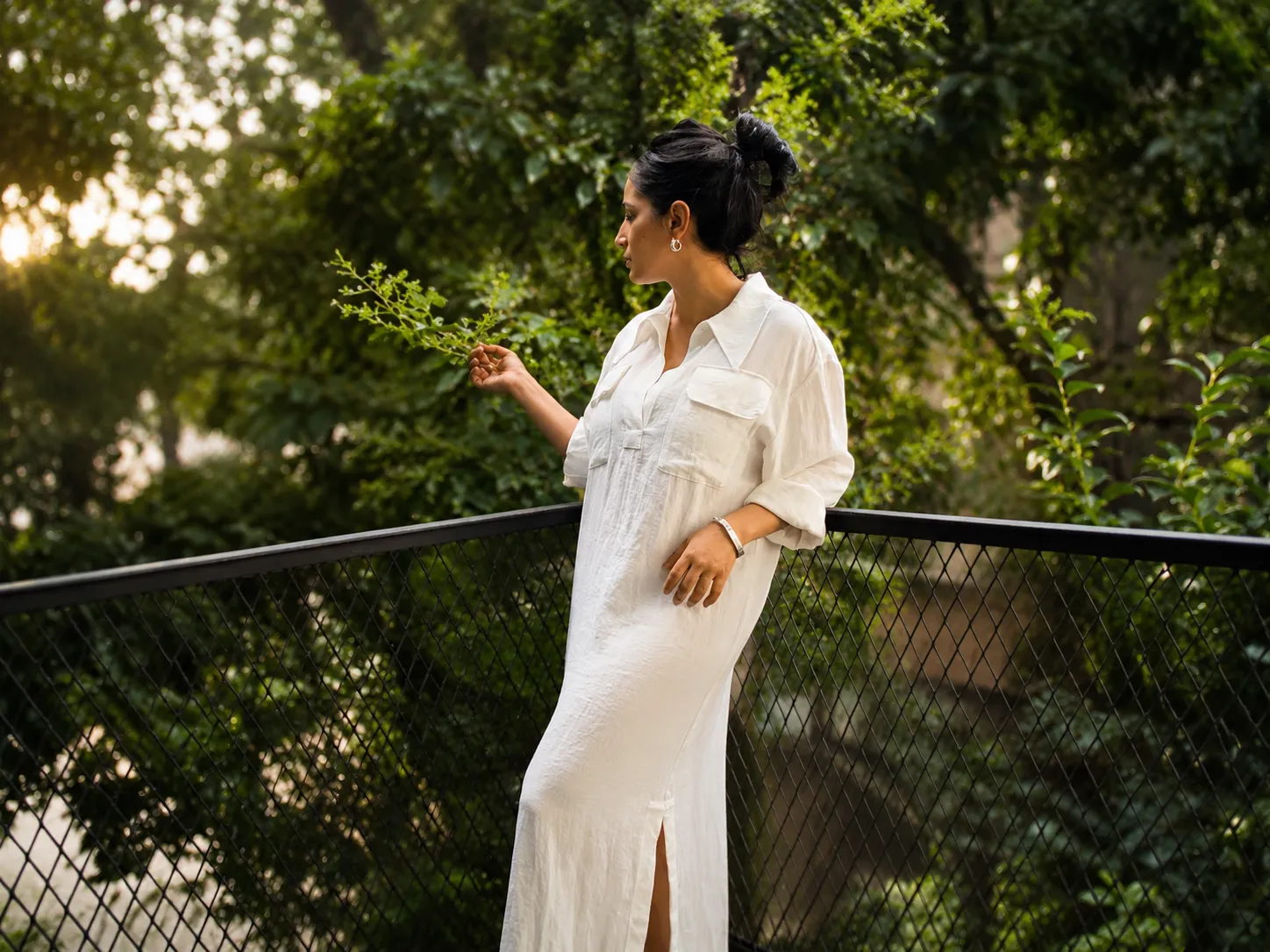

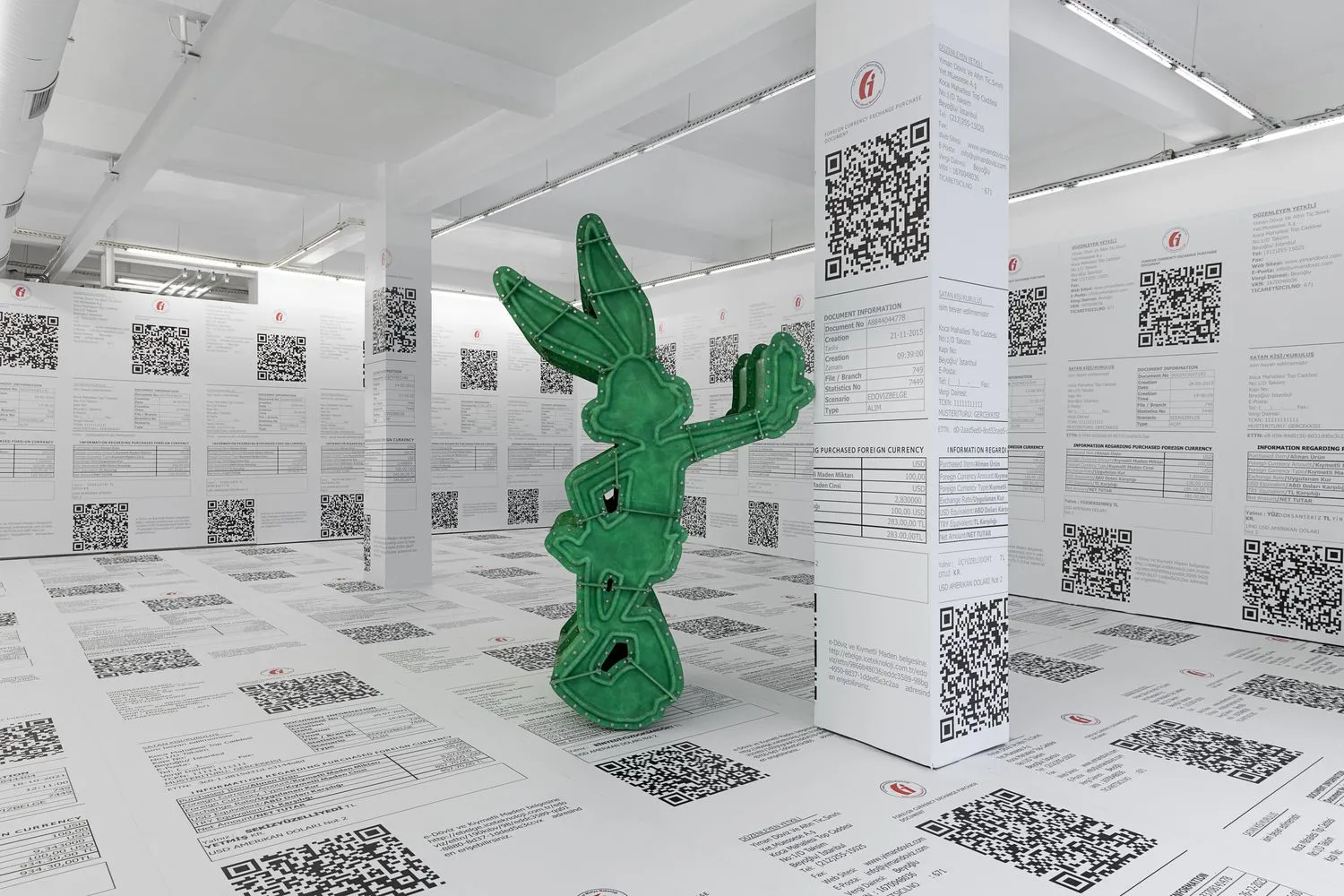
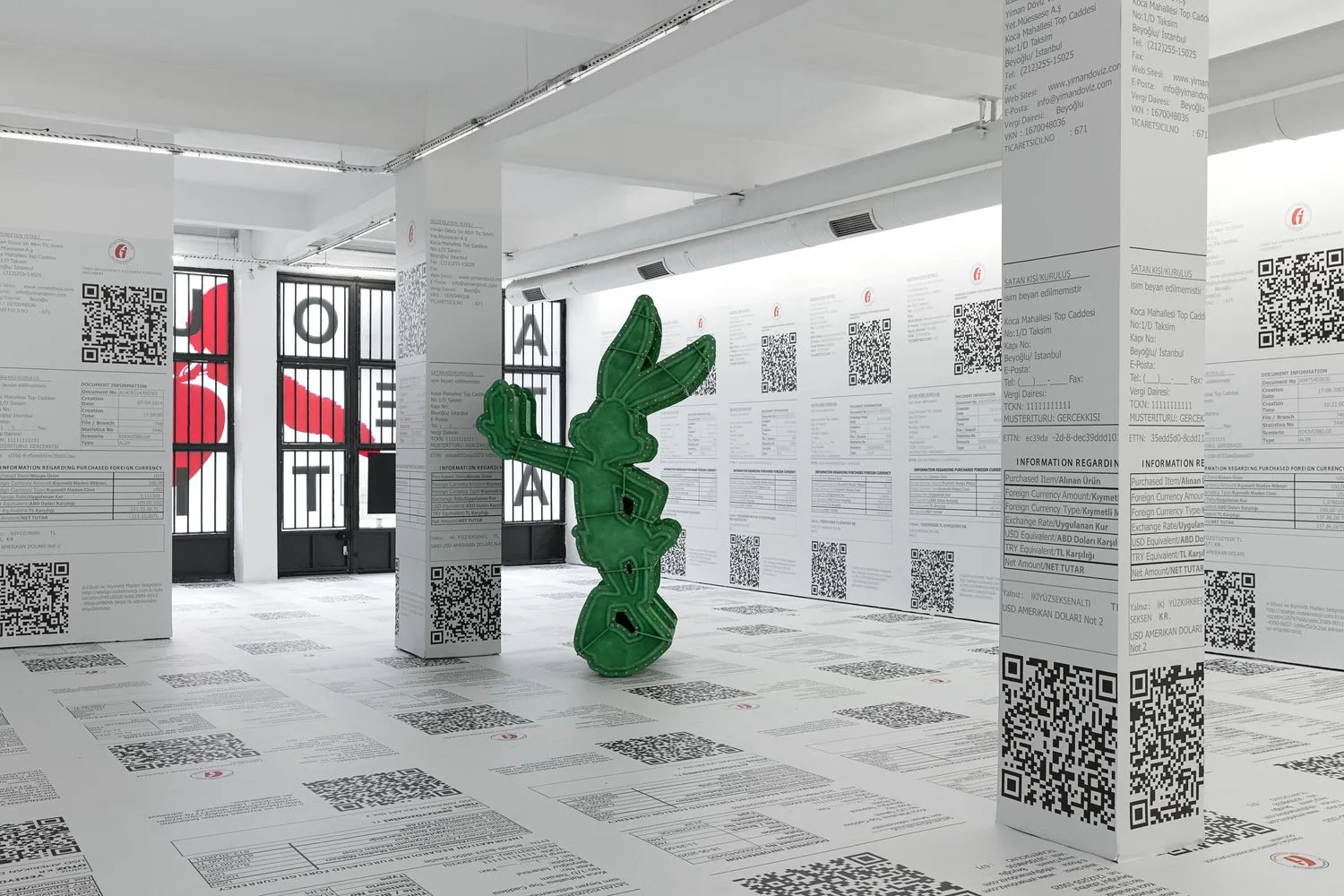
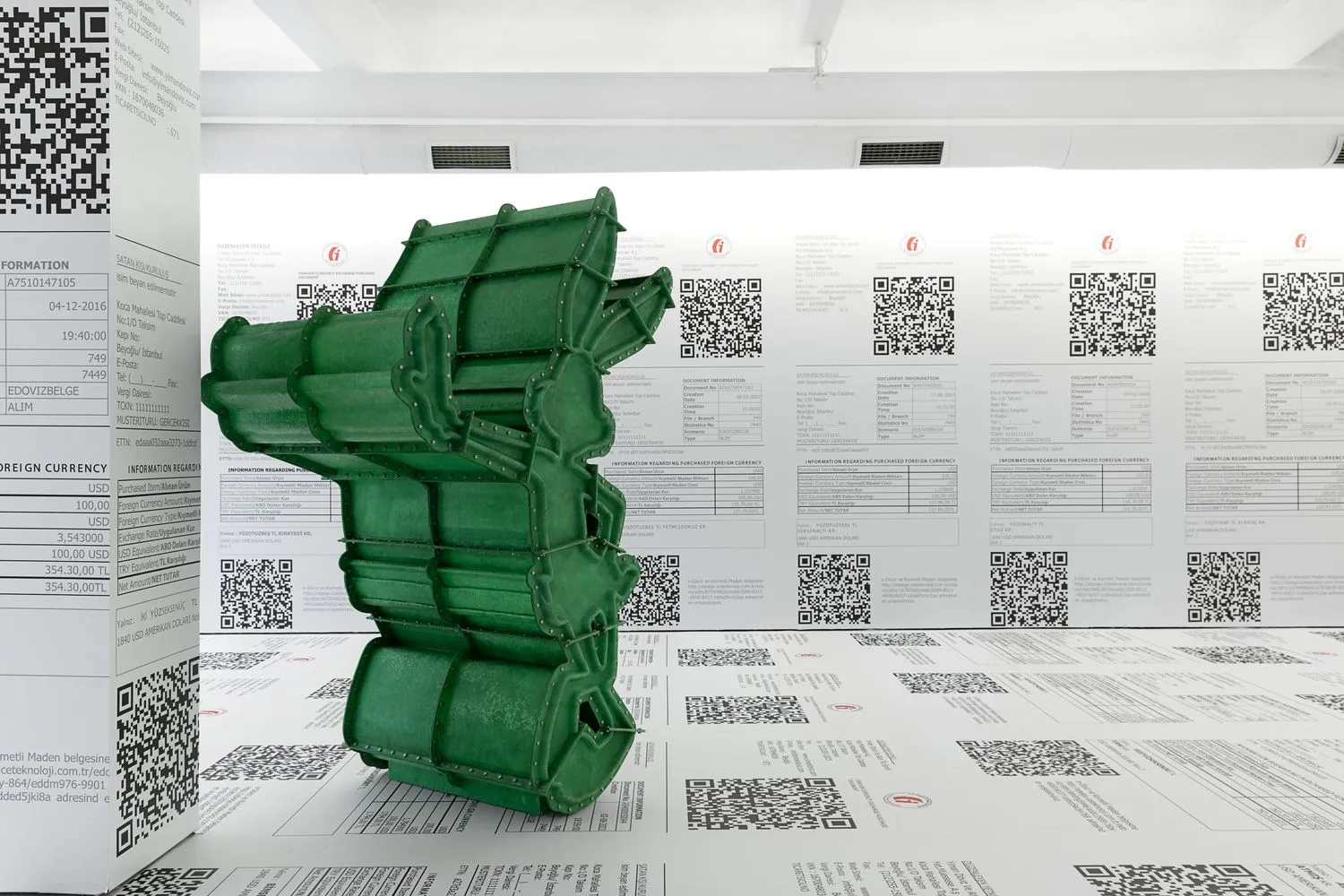
 Installation view of About the Artist by İrem Günaydın at THE PILL. Courtesy of the artist and gallery.
 İrem Günaydın describes herself as an artist and a suffix, someone who works after authorship, attaching herself to structures that already exist and shifting their conditions from within. Working across installation, sculpture, and text, the Istanbul-based artist engages with what sits at the edges of institutional memory and official narratives. Her work consistently gravitates toward what systems discard or overlook, reframing it as the central subject.
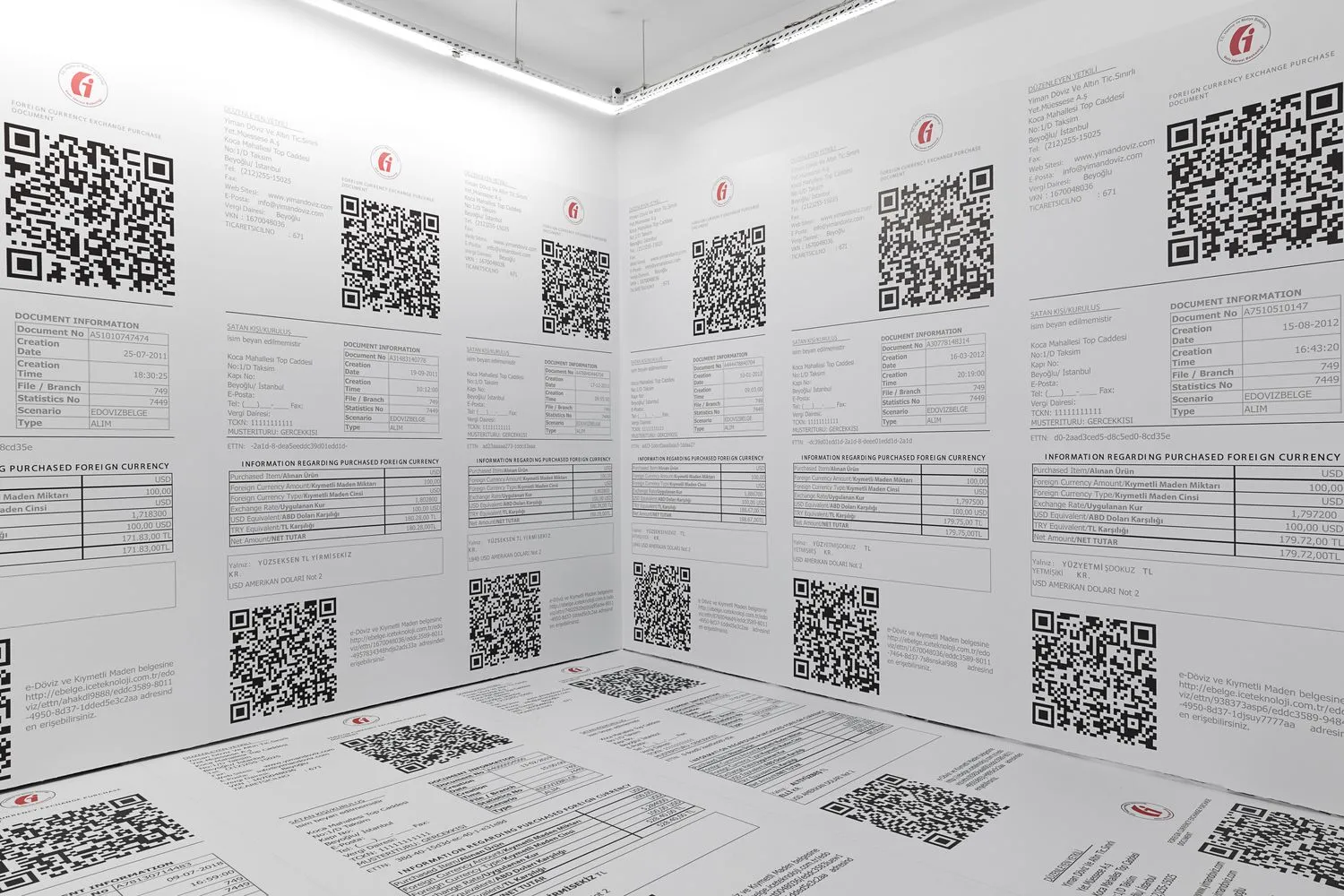
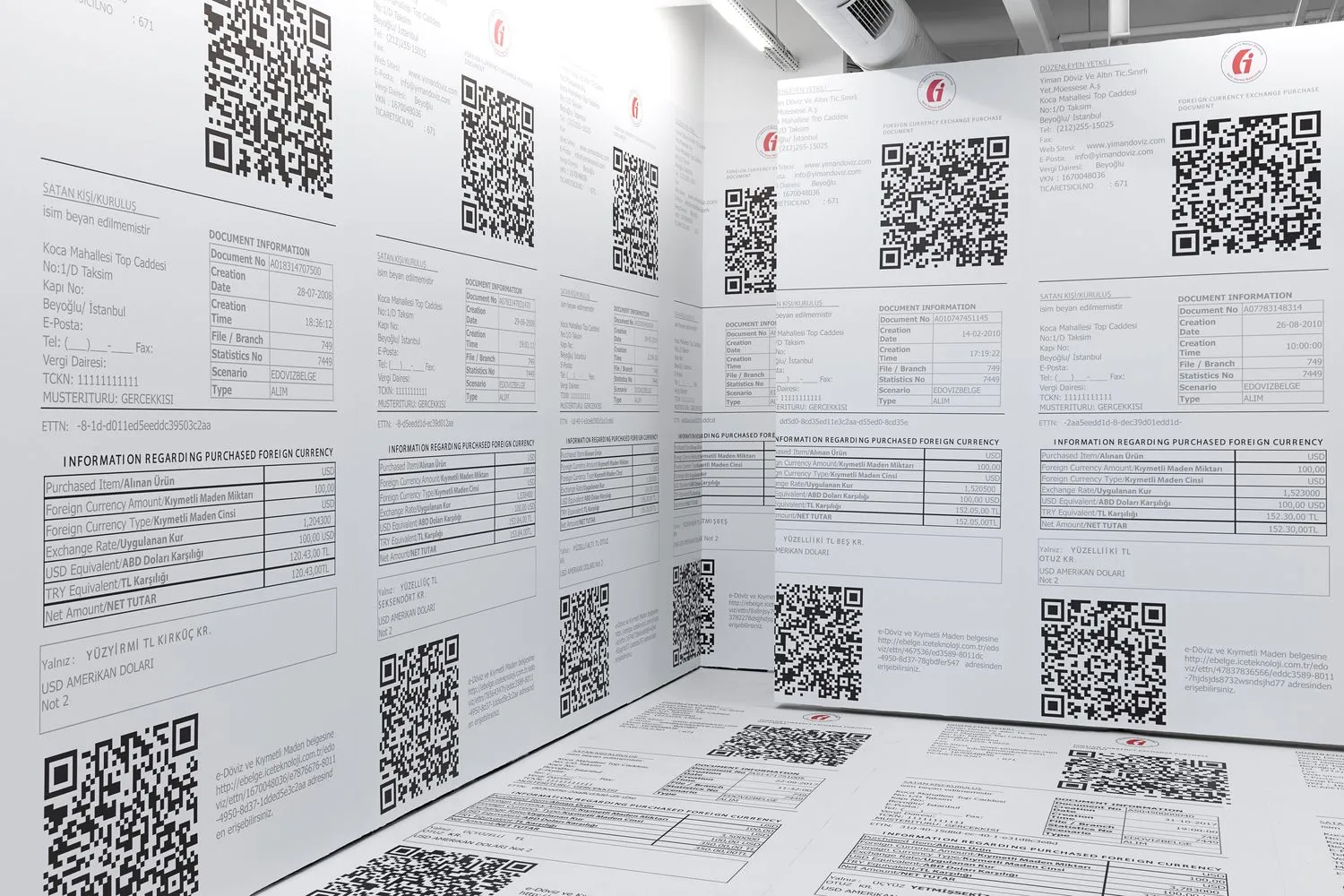
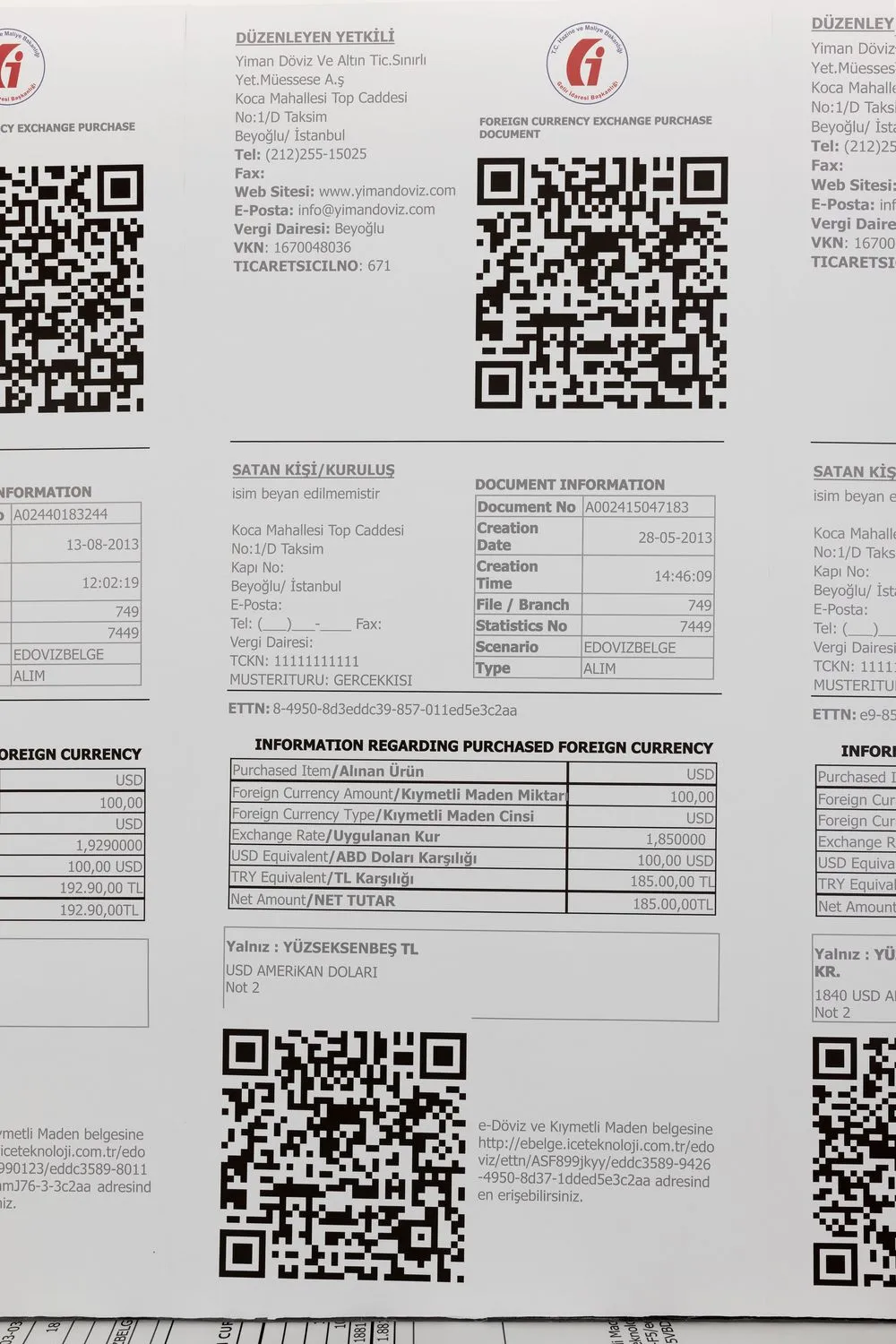
Her third solo exhibition at THE PILL in Istanbul, About The Artist, turns 24 years of Turkish economic history into an environment. Seventy-five currency exchange receipts, enlarged to architectural scale and covering every surface of the gallery, document the collapse of the lira against the dollar from 2002 to the present. Each receipt carries a QR code linking to weather and wind data from the same date as the transaction. In Turkey, Günaydın observes, people check exchange rates with the same compulsive frequency as the weather forecast.
The receipts at the centre of the installation are documents most people sign and throw away. Produced in their millions across two decades of economic turbulence, they record a history that has been collectively lived but normalised and absorbed. Günaydın builds a counter-archive from them, blown up to a scale that makes the history they carry impossible to ignore.
We spoke with Günaydın about what it means to make art in Istanbul today, the economic conditions that shaped the exhibition, the logic of the suffix, and what it means to build a counter-archive out of documents that were never meant to be kept.
Jelena Martinović: You've been making work in Istanbul through one of the most turbulent economic periods in the country's recent history. What is it like to be an artist in Istanbul today, and how does that experience feed into your work?
İrem Günaydın: It's been hell, honestly. To be an artist in Istanbul today means constantly negotiating between survival and art-making. You are trying to sustain a practice within an economy that is collapsing in real time, while simultaneously working multiple jobs just to continue making art. Inflation, currency devaluation, rent, material costs-everything moves faster than artists can keep up with.
And I say this while being relatively privileged compared to many of my peers. There are artists around me who simply disappear from visibility because they cannot afford to make it. The exhaustion becomes infrastructural.
At the same time, there is almost no meaningful public support for emerging artists. The few institutions that do provide support often reproduce another imbalance: they tend to circulate artists who are already validated by international networks rather than taking risks on artists locally struggling to survive.
Artists begin adjusting themselves to the economy by miniaturizing everything-artworks, scale, ambition, even social life. You start calculating every movement, every material, every gathering. The shrinking becomes psychological as much as physical. People live smaller.
But despite all of this, artists here continue making art. And I think this is an important difference. In many European contexts, art can easily become tied to funding structures. If support disappears, people relocate toward another system that can sustain them. Here, many artists continue without any certainty of support at all.
In Turkey, for many artists, art is not a business model. It comes from within. People continue making work despite the conditions. The work emerges directly from instability and exhaustion. That creates a very different relationship to art—one that is far less protected, but also much harder to detach from life itself.
So inevitably, these realities enter the work. Istanbul teaches you very quickly that culture is never separate from economics or political pressure. You feel it every day.
Jelena Martinović: You describe yourself as an artist and a suffix, someone who works after authorship. What does that mean, and what does that position open up?
İrem Günaydın: I often describe myself as an artist and a suffix because I am interested in what comes after authorship, after the monument, after the supposedly complete form. A suffix attaches itself to something that already exists. It extends and destabilizes meaning without claiming absolute origin. I think my relationship to art history and institutions functions in a similar way.
I work with fragments, molds, supports, reproductions, silhouettes, institutional leftovers, existing narratives, and displaced symbols. In that sense, I am less interested in producing autonomous objects than in entering structures that already carry ideological, historical, or aesthetic weight and slightly shifting their conditions.
This position also comes from geography and history. Working from Istanbul means constantly operating after empires, after ruins, after failed modernities, after imported institutional models. You are always surrounded by layers that have already been written by someone else. So the question becomes: how do you work within inherited structures without simply reproducing them?
Thinking through the suffix opens up a space where art can function parasitically, critically, or even ghost-like. I think this position also resists the fantasy of the artist as a sovereign producer of meaning. In that sense, the suffix is not secondary or weaker. It is a way of infiltrating meaning from the edge.
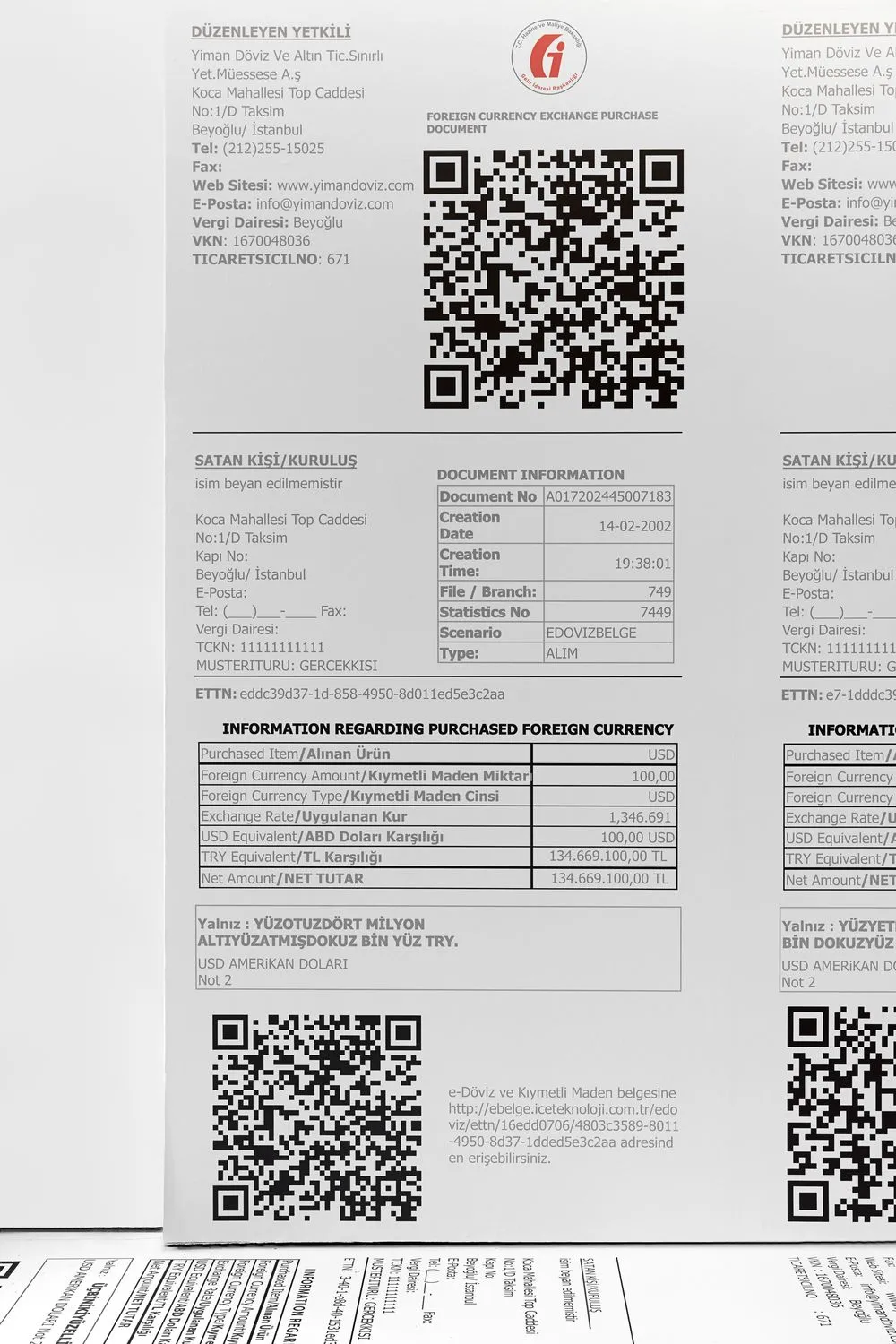
Jelena Martinović: About The Artist fills the entire gallery with 75 enlarged currency exchange receipts spanning 24 years of Turkish economic history. What drew you to build an archive out of these disposable documents?
İrem Günaydın: I have always been drawn to documents that are considered too ordinary, temporary, or disposable to enter official archives. Currency exchange receipts are produced to be immediately discarded, but at the same time, they silently record entire economic and political conditions. They carry inflation, instability, state policy, global dependency, tourism, crisis, speculation, survival, all compressed into a tiny thermal paper surface.
The work is also deeply personal. My family owns a foreign exchange business, and I worked there for many years myself. I spent a very long time surrounded by these receipts, collecting them almost unconsciously as they accumulated and disappeared throughout the day. So the work did not begin from an external observation of the economy, but from inside its daily mechanics. The receipts were part of my everyday life long before they became an artwork.
For me, these receipts were never neutral financial documents. They are almost like accidental portraits of a country. Especially in Turkey, where the economy has become inseparable from everyday psychology, people read exchange rates obsessively, sometimes multiple times a day. The currency rate becomes emotional infrastructure. It determines how people think, move, plan, travel, eat, rent, or even imagine the future.
Jelena Martinović: The receipts are enlarged to architectural scale, covering every surface of the gallery. How do scale and repetition function in the work?
İrem Günaydın: Scale and repetition are central to the work because economic violence itself operates through repetition. Inflation is not experienced once; it is experienced daily, obsessively, continuously. You wake up checking rates, prices, conversions, and losses. The same numbers return again and again until they begin shaping perception itself. I wanted the installation to produce something close to that psychological atmosphere.
The receipts are originally tiny. They pass through the hand and disappear immediately. By enlarging them to architectural scale, I wanted to reverse their status completely. Something disposable becomes overwhelming. The viewer no longer looks at the receipt; they are surrounded by it, almost trapped inside it. The gallery itself starts functioning like an enlarged exchange office, an economic interior.
Repetition also collapses individuality. A single receipt can still be read as a document, but seventy-five receipts covering every surface begin to operate differently. They become the environment. This was important to me because prolonged economic instability eventually exceeds comprehension. Numbers stop functioning rationally and become atmospheric.
I am also interested in repetition as a sculptural and political condition. In Turkey, crises repeat themselves so frequently that repetition itself becomes governance. People adapt psychologically to instability through constant exposure. In that sense, the installation is reproducing the exhausting spatial logic of living inside continuous fluctuation.
At the same time, scale destabilizes value. These receipts record systems of exchange and monetary value, but once enlarged they almost lose legibility and become abstract surfaces, closer to architectural skins or monuments than financial documents. I was interested in that tension between information and abstraction, intimacy and monumentality, the microscopic and the infrastructural.
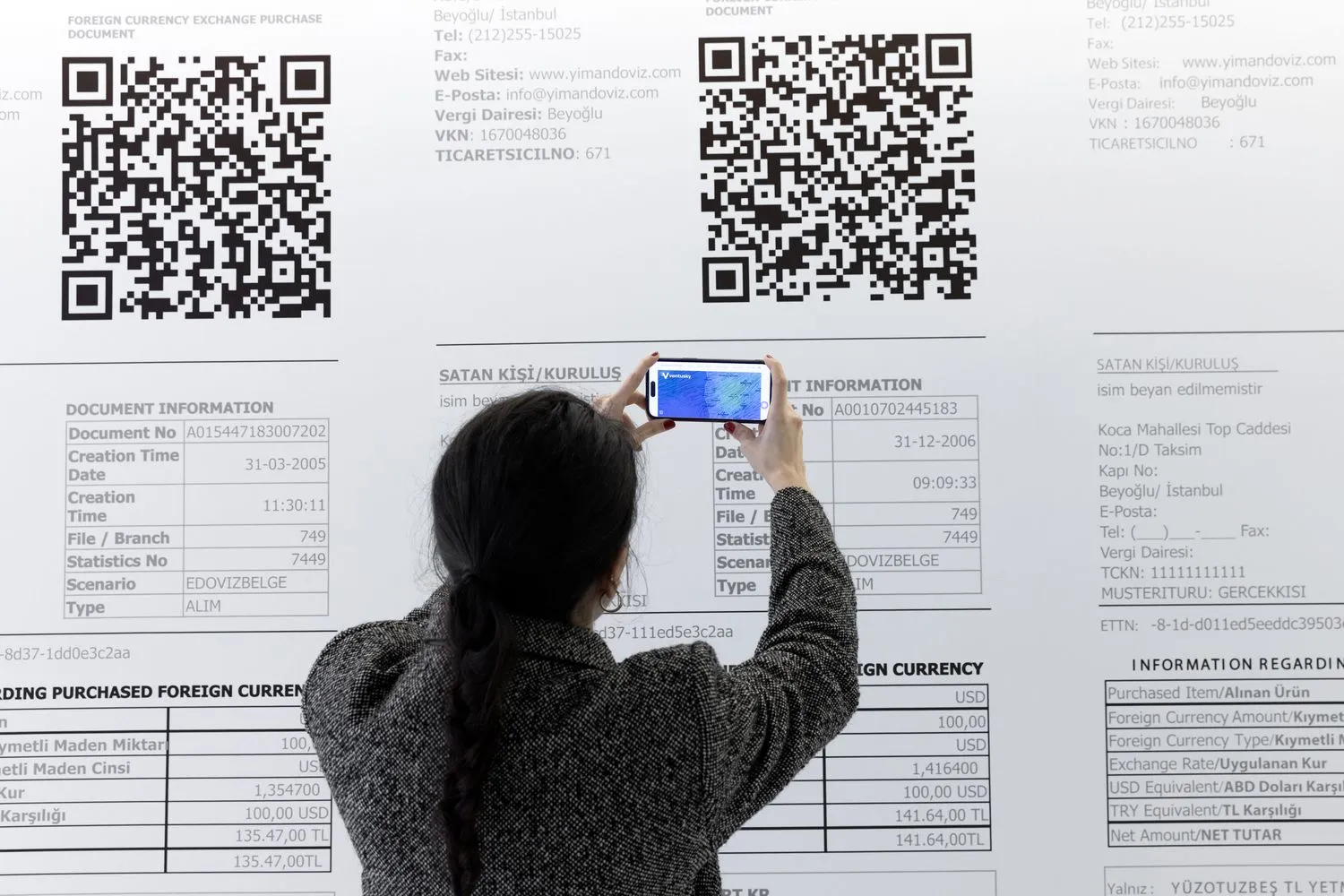
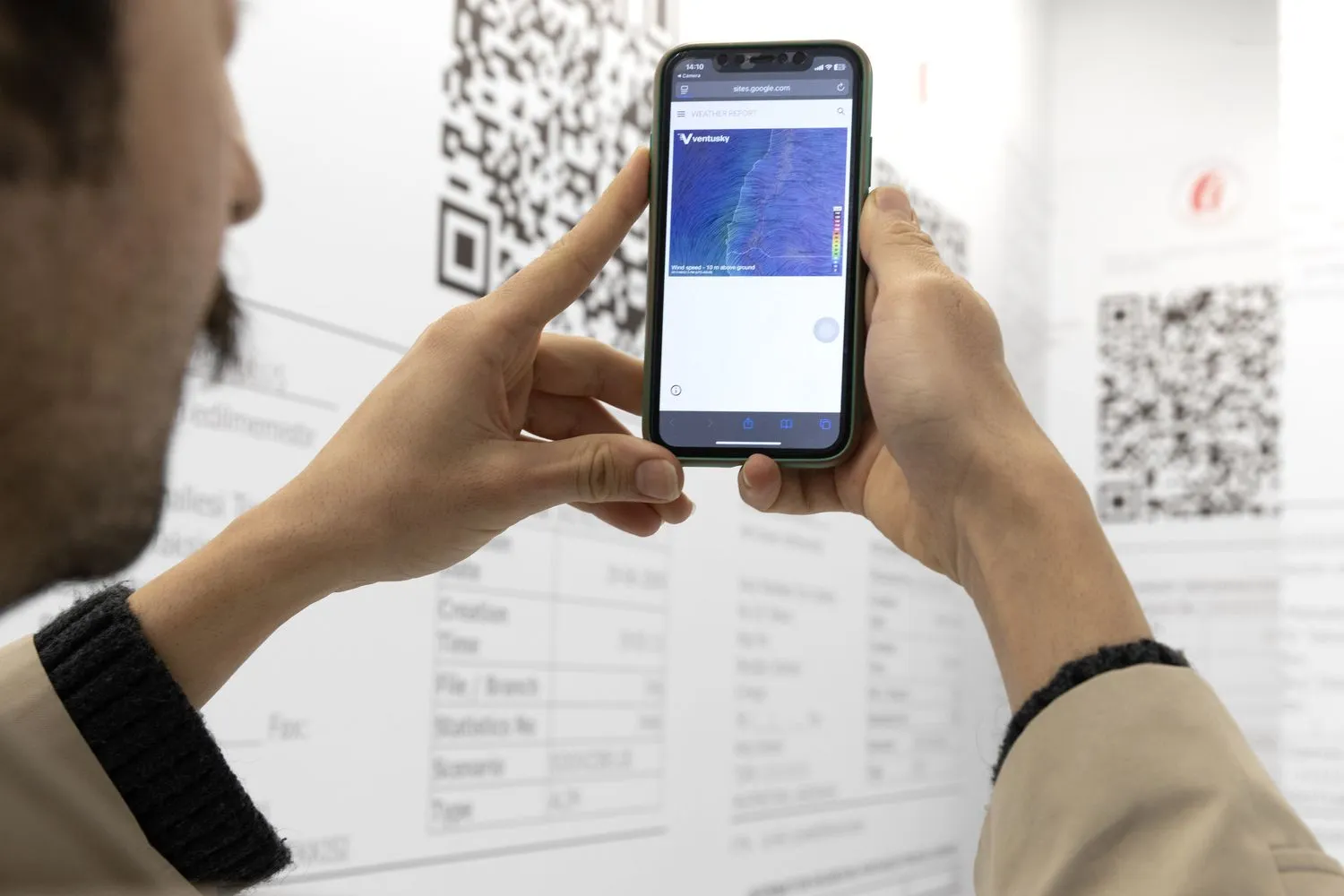
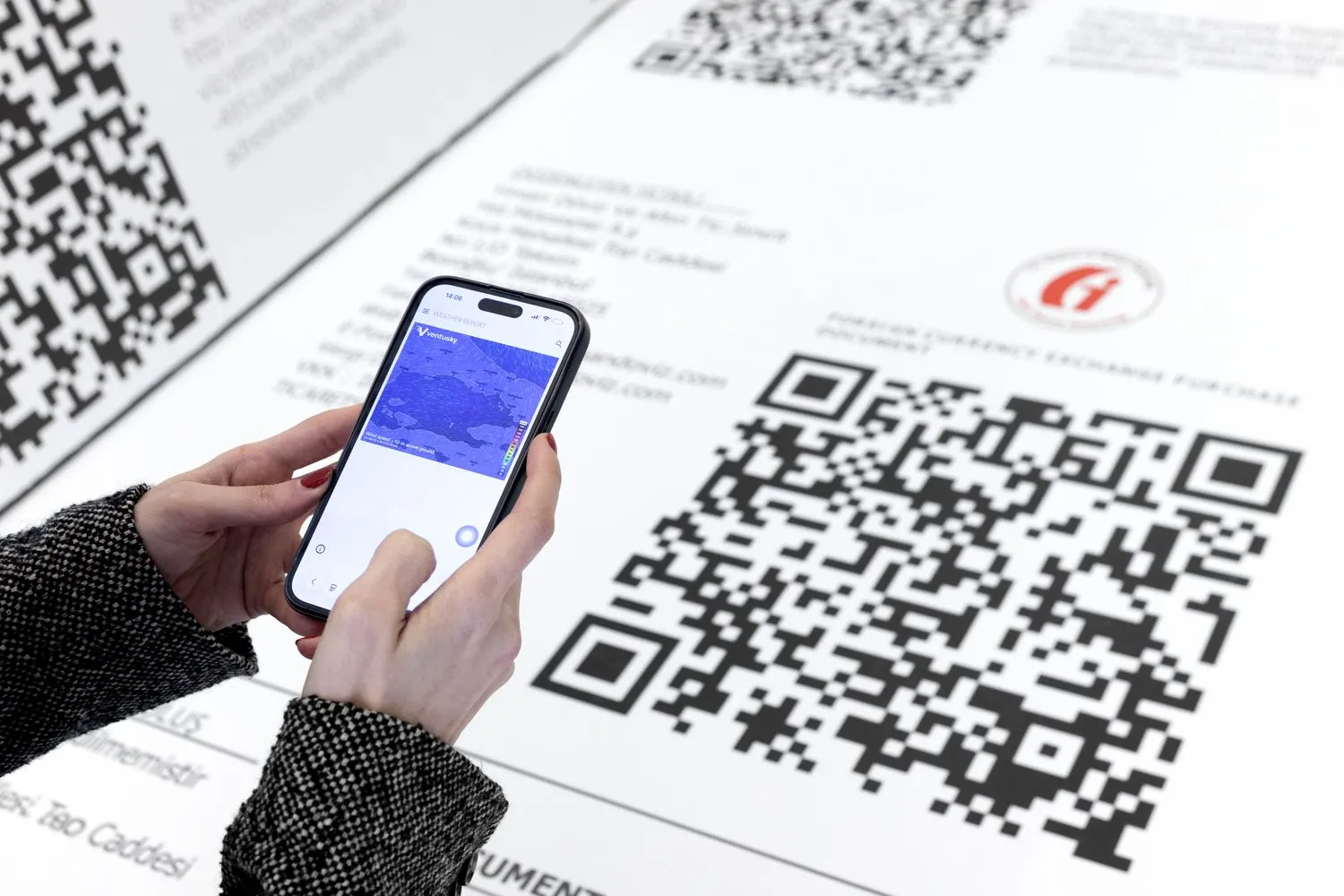
Jelena Martinović: Each receipt carries a QR code linking to weather and wind data from the same date as the transaction. Where did that connection come from?
İrem Günaydın: The connection came from thinking about the economy almost as a weather system. In Turkey, economic instability is experienced atmospherically. You wake up into it. It changes psychological states. People talk about exchange rates almost the same way they talk about the weather, as something surrounding them.
At some point, I became interested in the strange proximity between meteorological language and economic language. We already speak about inflation in terms of waves, turbulence, fluctuation and pressure. Financial systems and weather systems both operate through forms of prediction, uncertainty, circulation, and collective anxiety.
So the QR codes create another invisible layer inside the work. Each receipt is linked to the actual weather and wind conditions from the exact date of the transaction. It turns the receipt into something more than an economic record; it becomes an atmospheric timestamp.
I was especially interested in wind data because wind is something you cannot fully see but constantly feel through its effects. Economic violence often functions similarly. It moves through circulation, pressure, invisible systems, and collective behavior. Wind also carries geopolitical and historical associations—trade routes, borders, energy as well as migration. So connecting currency exchange to meteorological data allowed the work to oscillate between the intimate and the planetary.
The QR codes also disrupt the static nature of the enlarged receipts. The installation looks archival and fixed, but the codes open small portals into moving, unstable datasets. Suddenly, the viewer leaves the surface of the receipt and enters another temporal layer—a day’s atmosphere, a wind condition, a climate event happening alongside that transaction.
In a way, I wanted the economy to stop appearing purely numerical and start feeling climatic.
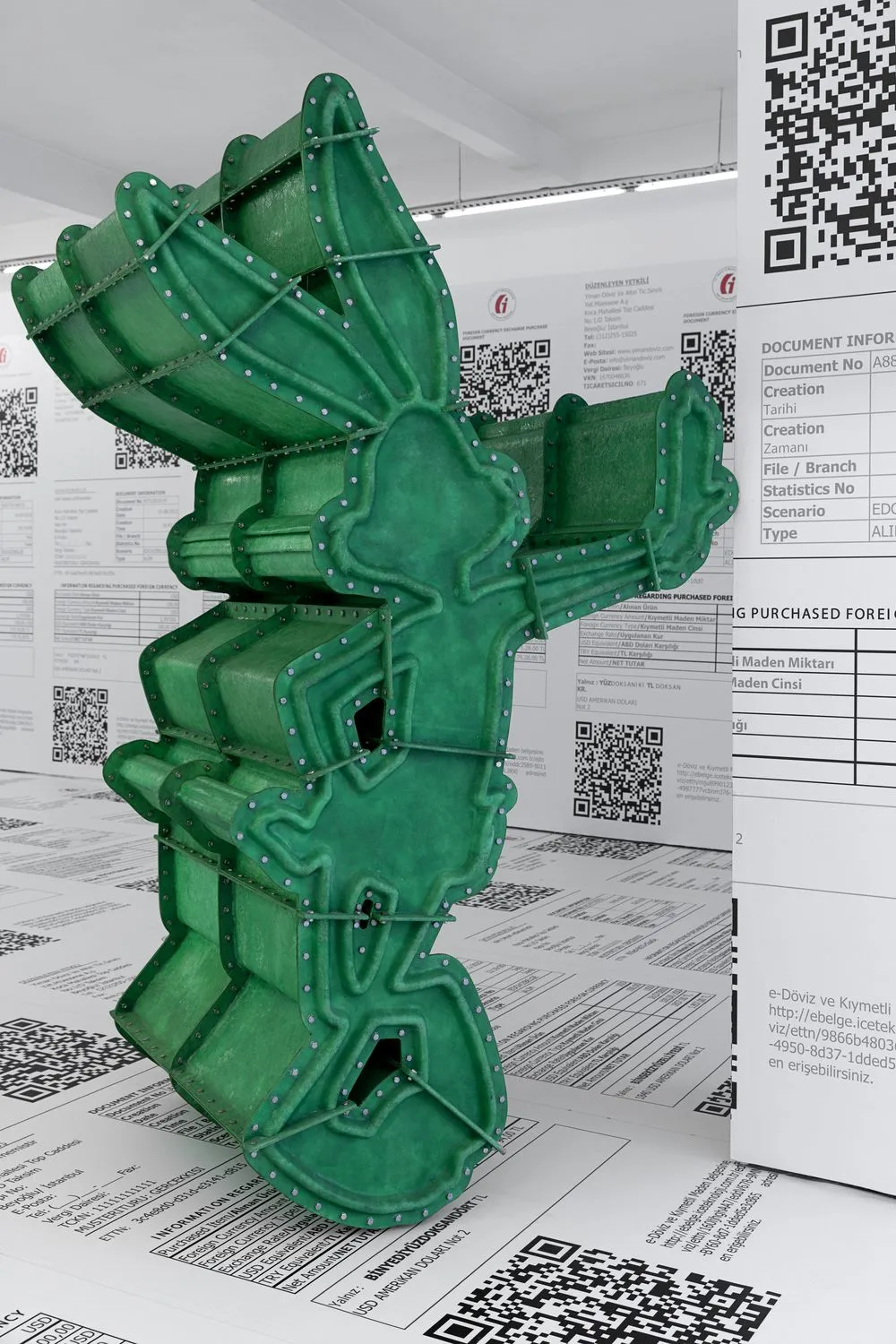
Jelena Martinović: Bugs Bunny has been a recurring figure across your practice and, in this exhibition, takes the form of a monumental fiberglass sculpture painted in toxic green. How does it relate to the evidence of economic collapse surrounding it?
İrem Günaydın: Bugs Bunny entered my practice partly because they are already a globally circulated survivor figure. They are elastic and impossible to fully destroy. They move through catastrophe with humor and disguise. Strangely, I think many people in Turkey have psychologically developed similar survival mechanisms under continuous instability.
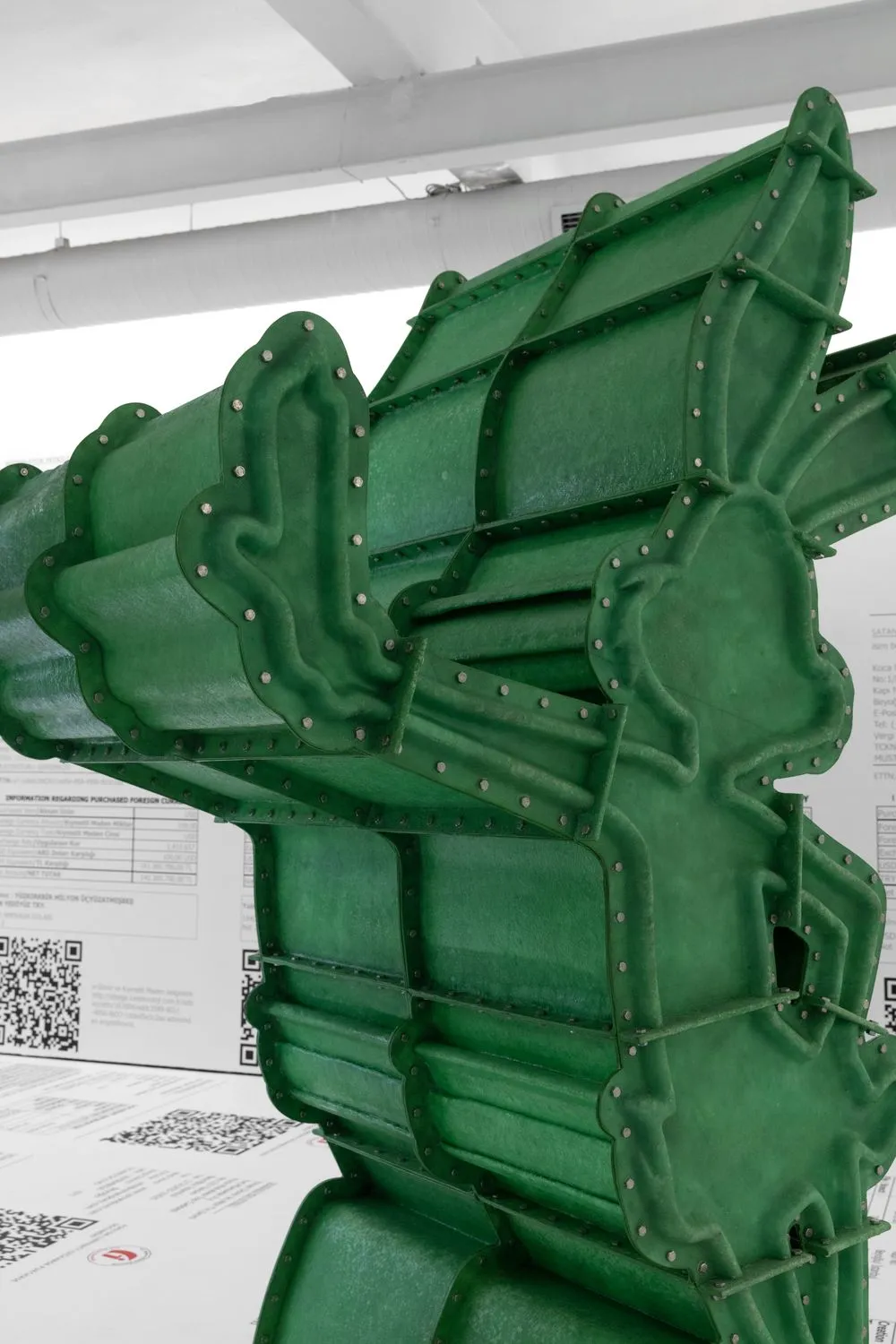
But I am not interested in Bugs Bunny nostalgically. I strip the figure from its original animation logic and turn it into something fragmented, exhausted, and almost infrastructural. In this exhibition, the sculpture appears as a monumental fiberglass mold painted in toxic green, standing inside an environment saturated by twenty-four years of economic fluctuation. It becomes less a cartoon character than a contaminated monument.
The toxic green is important because it directly relates to the visual psychology of currency, exchange offices, digital finance interfaces, fluorescent economic graphics, and circulation itself. Fiberglass also matters. I often say fiberglass is not simply a material but a symptom. It is lightweight yet monumental, hollow yet industrial, endlessly reproducible, associated with imitation, display, infrastructure, and cheap permanence. It felt appropriate for a figure emerging from an atmosphere of economic exhaustion.
I also think the sculpture operates like a portrait, but not in a classical sense. I sometimes describe these cartoon figures as "portraits of the artist." Not because they represent identity literally, but because they embody certain conditions of survival under pressure.
Inside the installation, Bugs Bunny almost appears trapped within the receipts, as if the economic environment itself has produced the figure. The sculpture and the receipts feed each other. One records the violence of circulation numerically; the other absorbs it psychologically and bodily.
At the same time, there is something tragicomic about placing a cartoon survivor inside a collapsing economic atmosphere. Humor becomes inseparable from exhaustion. The figure is seductive and absurd, but also slightly toxic, hollowed out, over-scaled, and unstable. That contradiction feels very close to the emotional texture of contemporary life in Istanbul.
Jelena Martinović: During the show, visitors began spontaneously intervening in the space, leaving messages on the walls with lipstick. How did that come to be?
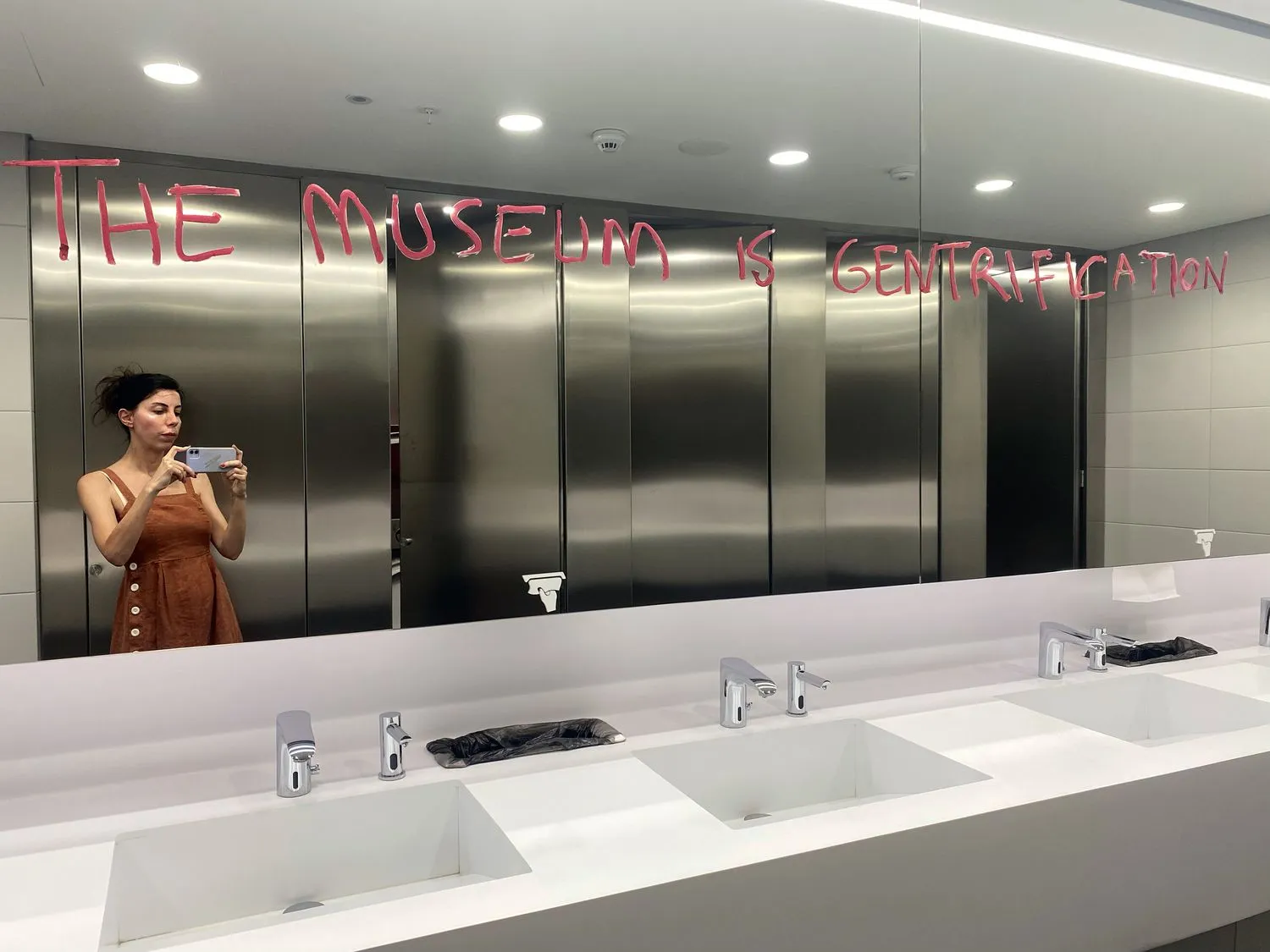
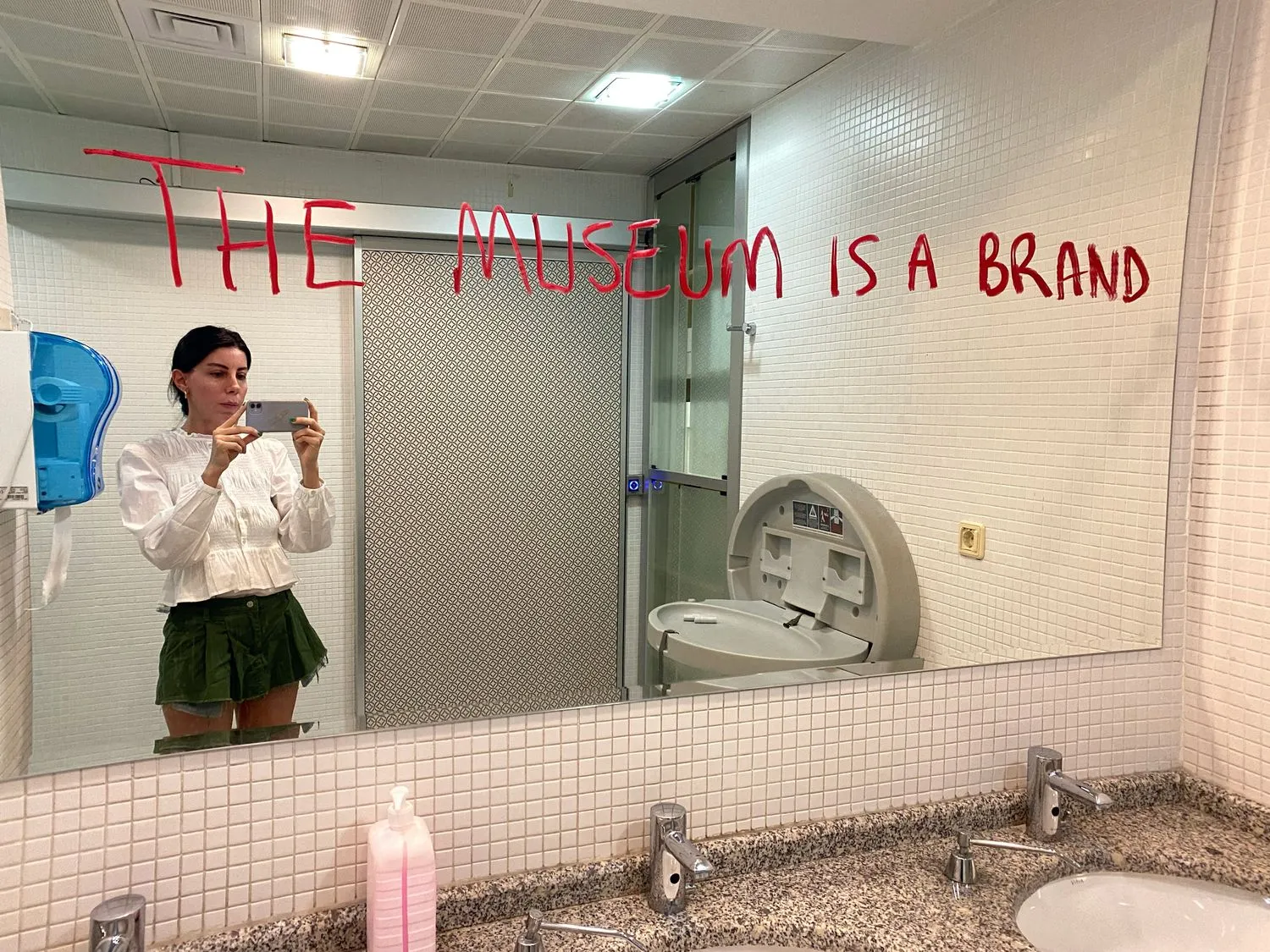
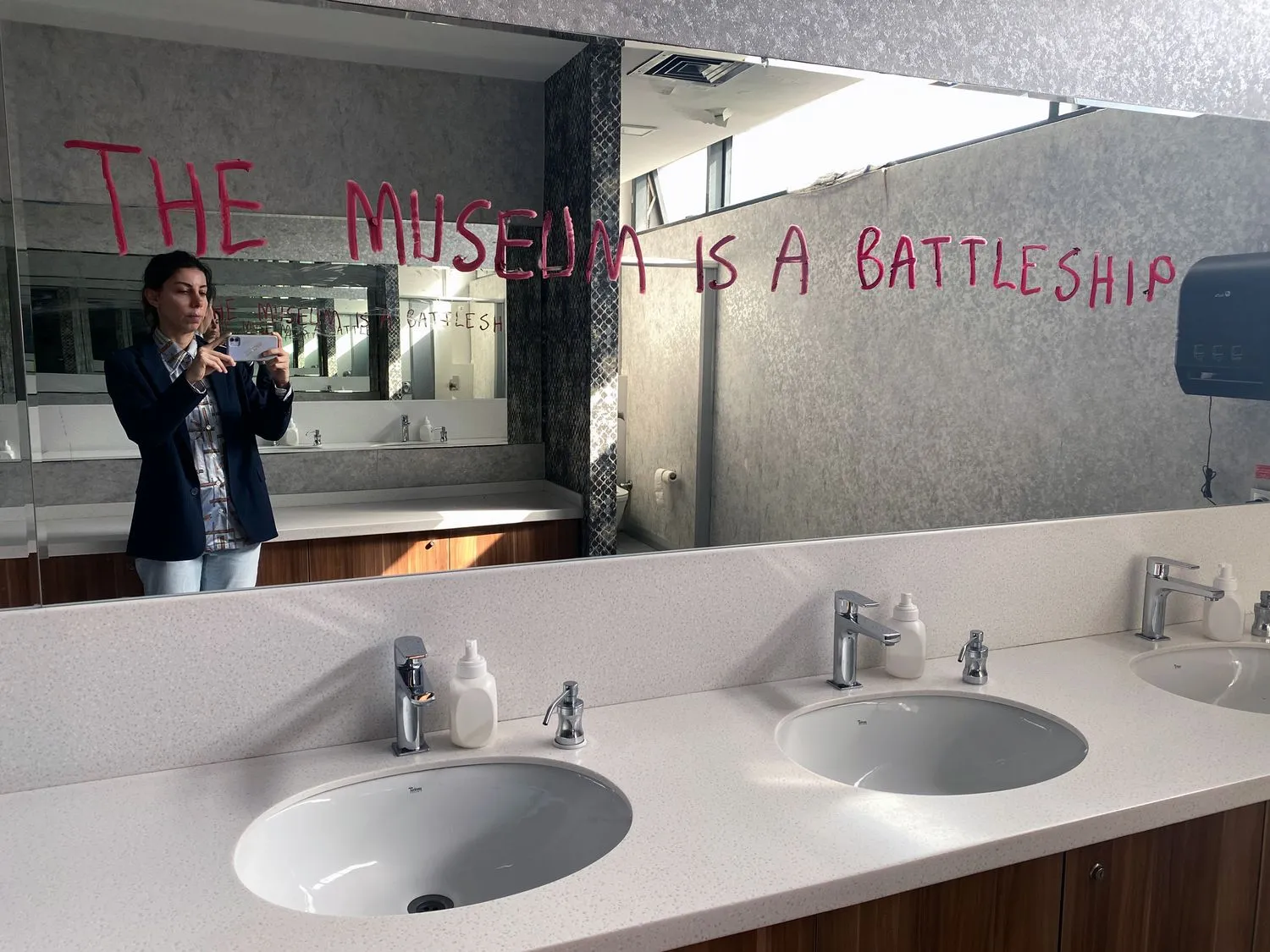
İrem Günaydın: That is very important for me because it happened almost organically. For a year, I have been making the The Museum Is… intervention series, where I write short statements in lipstick directly onto restroom mirrors inside institutions.
During About The Artist, visitors unexpectedly began doing something similar inside the exhibition. People started leaving messages, drawings, reactions, and statements on the receipt-covered walls using their own lipstick. Suddenly, the audience was intervening in the exhibition in the same way I had intervened in museums.
I was very interested in that reversal. The walls were no longer only carrying economic records from the past twenty-four years; they also started absorbing present reactions and collective participation.
There was something psychologically revealing about people immediately reaching for lipstick. Lipstick carries associations with intimacy. In my The Museum Is… series, lipstick functions almost like a temporary institutional weapon—fragile but highly visible. Seeing visitors adopt the same gesture inside the exhibition suggested that the intervention had already escaped authorship and entered collective behavior.
I also think this transformed the exhibition into a more unstable social space. In a way, the exhibition became temporarily occupied by its viewers. That was important to me because institutional critique often risks remaining symbolic or contained. Here, the gesture began circulating socially, almost virally, inside the exhibition itself.
Jelena Martinović: The title About The Artist is tautological. How does it reflect on the role of the artist today?
İrem Günaydın: I was interested in the title precisely because of its emptiness and circularity. About The Artist is generic. It resembles the kinds of institutional texts we constantly encounter in exhibitions, catalogues, and press releases—texts that claim to explain the artist while often reproducing a professional mythology around artistic identity.
But in this exhibition, the title becomes unstable. Who is the artist being described? Is it the individual artist, the economic subject, the worker, the survivor, the brand, the exhausted cultural producer? The title keeps pointing back toward itself without fully resolving anything.
I think artists today are increasingly trapped inside systems that demand constant self-narration. You are expected not only to make work but to brand yourself continuously. The artist becomes inseparable from networking and economic negotiation.
So the title functions almost like a bureaucratic loop. About The Artist promises access to the artist, but instead, the viewer enters an overwhelming environment of receipts, exchange rates, atmospheric data, economic anxiety, institutional interventions, and contaminated cartoon monuments. The artist appears less as an autonomous genius and more as a figure entangled within infrastructures.
At the same time, I was interested in the absurdity of the phrase. It sounds self-important but also strangely hollow, almost like an autofilled institutional placeholder. That tension mattered to me. The title both performs and critiques the contemporary demand for artistic legibility.